
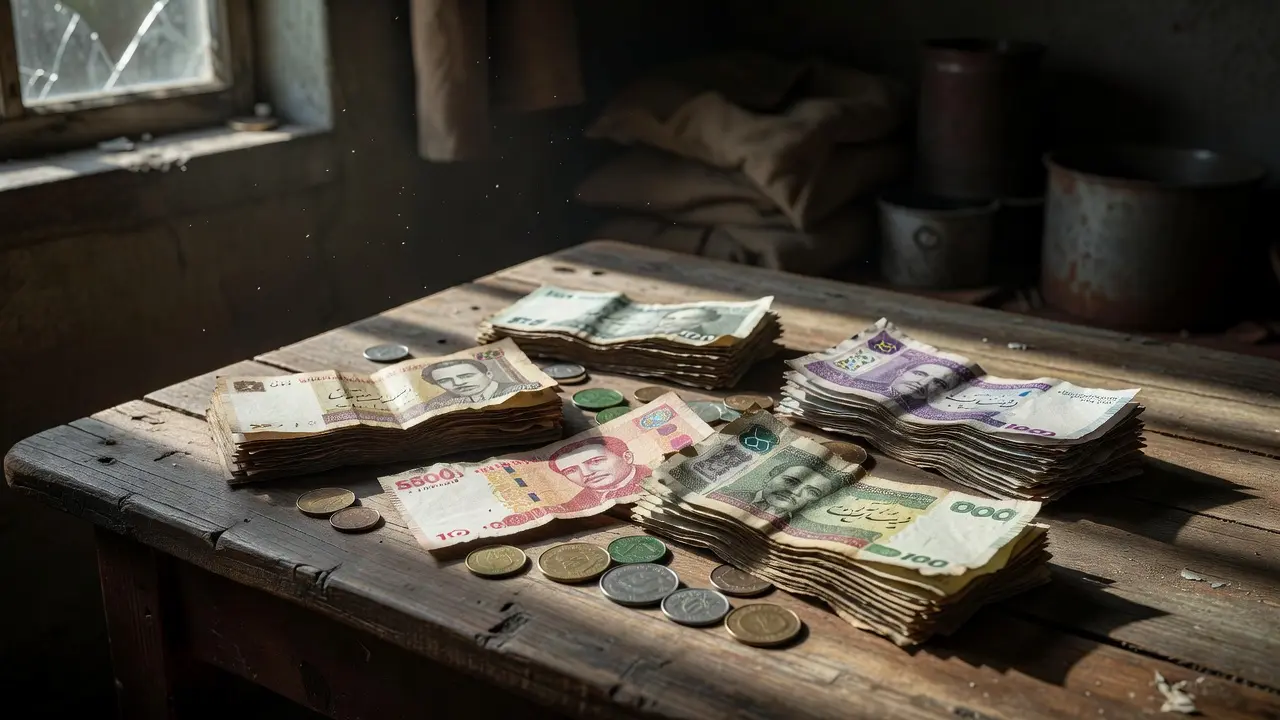
Lowest currency in the world: the list
The table ranks the ten currencies with the lowest value per unit against the US dollar, based on rates at the time this list was compiled in 2026. Live values for 1 unit in US dollars and in Vietnamese dong are shown as of 25 November 2026. Because rates move every day, two neighbouring currencies can swap places.
| Rank | Currency | Code | 1 unit in USD (25 November 2026) | 1 unit in VND (25 November 2026) |
|---|---|---|---|---|
| 1 | Iranian rial | IRR | 0.00 | 0 |
| 2 | Lebanese pound | LBP | 0.00 | 0 |
| 3 | Vietnamese dong | VND | 0.00 | 1 |
| 4 | Lao kip | LAK | 0.00 | 1 |
| 5 | Indonesian rupiah | IDR | 0.0001 | 1 |
| 6 | Uzbekistani som | UZS | 0.0001 | 2 |
| 7 | Guinean franc | GNF | 0.0001 | 3 |
| 8 | Paraguayan guarani | PYG | 0.0002 | 4 |
| 9 | Malagasy ariary | MGA | 0.0002 | 6 |
| 10 | Cambodian riel | KHR | 0.0002 | 6 |
For the Iranian rial, the figure shown is the rate in our data feed. Iran has more than one exchange rate, and the official rate used by most data providers is far stronger than the open-market rate that Iranians pay in exchange shops. Live rates are on the iranian rial exchange rate page.
The weakest currency in the world is a different question from the lowest-valued one. "Weakest" often means the currency that lost the most value in a year, a list that in recent years has included the Lebanese pound, the Argentine peso and the Venezuelan bolívar. The bolívar has a low unit price only because Venezuela has removed zeros three times since 2008.
Why these currencies rank where they do
Each currency on the list reached its low unit value through a long period of inflation or a sharp devaluation, and none of the ten has removed zeros recently. The causes differ by country: sanctions and inflation in Iran, a banking collapse in Lebanon, and slower, steadier price rises over decades in Vietnam, Laos and Indonesia.
- Iranian rial: inflation above 30% in most recent years, international sanctions and limited access to foreign currency. In October 2025 parliament approved removing four zeros, with old and new rials to circulate together before the old notes are withdrawn by 2030, according to bne IntelliNews.
- Lebanese pound: pegged at 1,507.5 per dollar from 1997 until the 2019 banking crisis. The central bank moved its official rate to 15,000 in February 2023 and to 89,500 in 2024, close to the market rate.
- Vietnamese dong: last redenominated in 1985. Inflation in the late 1980s pushed it into the thousands per dollar, and the State Bank of Vietnam has since let it weaken slowly against the dollar.
- Lao kip: high inflation in 2022 and 2023 and large foreign debt made the kip lose close to half its value against the dollar in about two years.
- Indonesian rupiah: fell from about 2,400 to over 10,000 per dollar during the 1997 to 1998 Asian financial crisis and has never removed zeros since.
The rest of the top ten have their own stories:
- Uzbekistani som: the government floated it in September 2017, and it lost almost half its value against the dollar overnight as the old official rate was dropped.
- Guinean franc: years of high inflation since the 1990s, with no redenomination.
- Paraguayan guarani: in use since 1943 and never redenominated, although inflation in Paraguay has been moderate for years.
- Malagasy ariary: replaced the Malagasy franc in 2005 at 1 ariary to 5 francs, which did little to raise its unit value.
- Cambodian riel: Cambodia uses US dollars for most larger payments, and the central bank keeps the riel at roughly 4,000 per dollar for small change.
Our page on the vietnamese dong exchange rate tracks the dong against every major currency. For the wider picture in the region, see our guide to asian currencies.
Unit value vs economic strength
A currency's value per unit says little about the strength of its economy. The Japanese yen trades at over 100 yen per dollar, yet Japan has one of the largest economies in the world. The Kuwaiti dinar is the highest-valued unit, and Kuwait's economy is far smaller than Japan's. What matters is how stable the currency is and how much it buys at home.
A low unit value comes from history: how much inflation a country had, and whether it later removed zeros. Vietnam's economy has grown fast for three decades while the dong stayed in the tens of thousands per dollar. Indonesia is the largest economy in Southeast Asia and still prices meals in tens of thousands of rupiah.
A low unit value does have practical costs. Prices run to many digits, so receipts, accounts and software need room for long numbers. People carry thick bundles of cash for ordinary purchases, and mistakes of one zero are easy to make when converting. In Iran, shops often quote prices in toman, an informal unit worth 10 rials, to shorten the numbers. These costs are the main reason governments decide to remove zeros.
Signs that a currency is actually weak look different:
- Fast loss of value in a short time, for example more than 20% in a year.
- A gap between the official rate and the street rate.
- Limits on buying foreign currency or moving money abroad.
- People saving in dollars or gold instead of their own currency.
A worked example with an assumed rate: at 26,000 dong per dollar, a 50,000 dong bowl of pho costs about $1.92. The large number on the note says nothing about whether pho is cheap or expensive for people who earn dong. The opposite end of the scale is on our page about the highest currency in the world.
How the ranking changes over time
The ranking changes in two ways: slowly, as exchange rates move by a few percent a year, and suddenly, when a country removes zeros from its currency. A redenomination takes a currency off the list overnight, even though nothing about its real value has changed.
Sierra Leone is a recent example. On 1 July 2022 it replaced the old leone (SLL) with the new leone (SLE) at 1,000 to 1, so a currency that once ranked near the bottom now trades at about two dozen per dollar. Other countries have done the same:
- Turkey removed six zeros from the lira in 2005.
- Belarus removed four zeros from the ruble in 2016.
- Venezuela removed three zeros in 2008, five in 2018 and six in 2021.
- Zimbabwe replaced its earlier currencies with the ZiG (Zimbabwe Gold) in April 2024.
If Iran completes its four-zero redenomination, the new rial will be worth 10,000 old rials, and the Lebanese pound will likely become the lowest-valued unit. Sudden devaluations can also push a currency up the list, as happened to the Lebanese pound after 2019 and the Lao kip in 2022.
Codes and names for every currency are in our world currencies list. For the opposite question, which currencies are used most, see Most Traded Currencies in the World. To check how much any of these is worth today, use the currency converter.






