
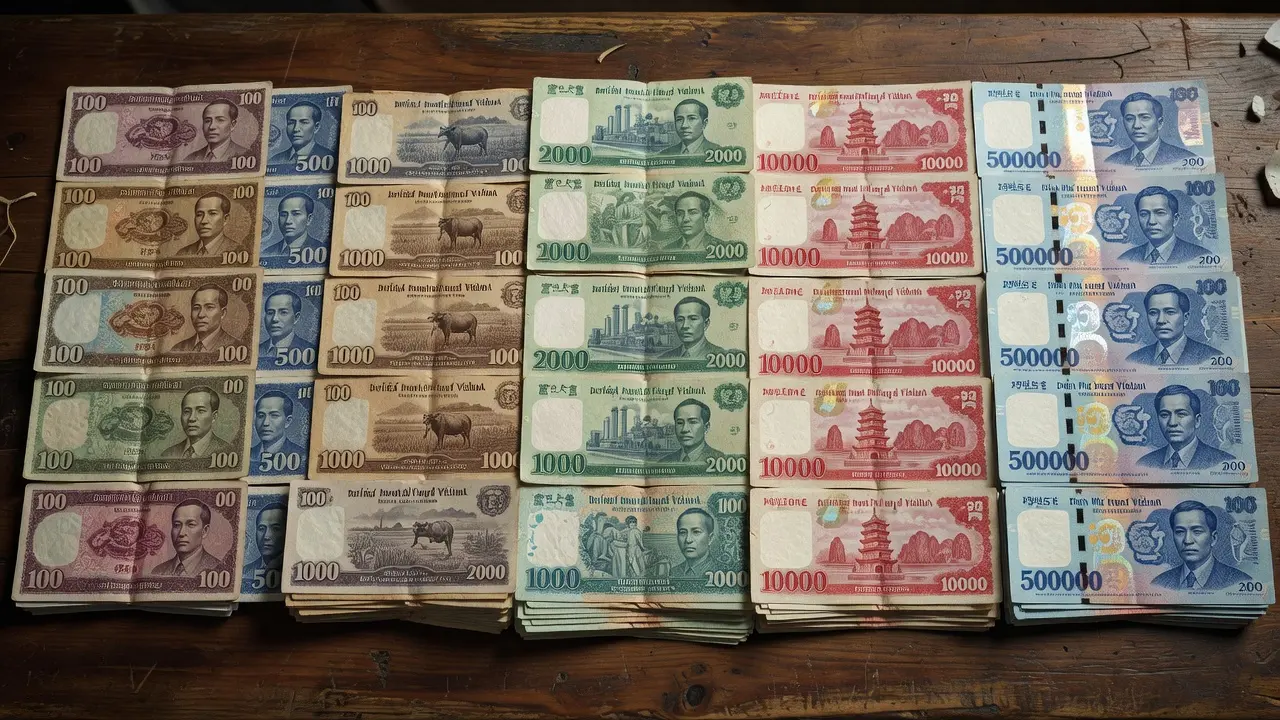
Vietnamese dong history at a glance
The dong was first issued by the Democratic Republic of Vietnam in the north in 1946. After 1975 the north and the south used different currencies until 1978. Since then Vietnam has had a single dong, issued by the State Bank of Vietnam and redenominated once, in 1985.
| Date | Event |
|---|---|
| 1946 | The first dong notes are issued in northern Vietnam |
| 1959 | Northern redenomination: 1 new dong for 1,000 old dong |
| September 1975 | A new currency replaces the southern dong at 1 to 500 |
| 3 May 1978 | Currency unified across the country |
| 14 September 1985 | Redenomination: 1 new dong for 10 old dong |
| December 2003 | First polymer notes issued |
On 25 November 2026, 1 US dollar buys 25,835 dong. Live rates against every currency are on the vietnamese dong exchange rate page.
The 1978 currency unification
On 3 May 1978, Vietnam replaced the two currencies still circulating after reunification with one national dong. In the north, one new dong was exchanged for one old northern dong; in the south, one new dong was exchanged for 0.8 of the southern "liberation" dong. New notes were printed with the name of the State Bank of Vietnam, and the old notes of both zones stopped being legal tender.
The earlier change in the south, in September 1975, had set household limits on how much old money could be exchanged, so for many southern families 1978 was the second currency change in three years.
The 1985 dong redenomination
The 1985 dong redenomination took effect on 14 September 1985. Every 10 old dong became 1 new dong, and prices and wages were rewritten at the same rate. The change was part of a wider "price, wage and money" reform intended to end state price controls and the system of rationing.
The reform did not stop inflation. Wages were raised while goods remained scarce, and the government printed money to cover deficits. Inflation reached several hundred percent in 1986, and prices kept rising fast until the economic reforms known as Doi Moi took hold later in the decade.
A worked example with assumed figures: a bowl of noodles priced at 100 old dong in early September 1985 was 10 new dong the day after the change. Within a few years, the same bowl cost hundreds of new dong, as inflation wiped out the gain from removing a zero.
Banknotes after 1985 and the polymer series
After 1985 the State Bank issued larger notes as prices rose. The 1985 series ran from 5 hào to 500 dong; notes of 200 to 5,000 dong followed in 1987, and 10,000 and 50,000 dong in 1990. In December 2003 it began issuing polymer notes, starting with 50,000 and 500,000 dong, and by 2006 every note from 10,000 to 500,000 dong was polymer.
- Cotton-paper notes still in use: 100, 200, 500, 1,000, 2,000, 5,000 dong.
- Polymer notes: 10,000, 20,000, 50,000, 100,000, 200,000, 500,000 dong.
- Coins were issued from 2003 but stopped being minted in 2011, and are rarely seen.
All current notes show President Ho Chi Minh on the front. Small notes under 1,000 dong are now rare in cities, because most prices are rounded to the nearest 1,000 dong.
Why the dong has not been redenominated again
Removing zeros from the dong has been discussed for years, but no new redenomination has been adopted. Supporters say smaller numbers would make accounts and prices easier. Opponents point to the cost of new notes and systems and the risk that shops round prices up during a switch.
In daily speech, Vietnamese already drop three zeros: a 50,000 dong price is "50 nghìn" or "50k". Accounting software, banks and card networks all handle the large numbers without problems, which reduces the pressure to change.
Long-run exchange rates are covered in our guide to Historical Exchange Rates: How to Read Currency Charts and on the usd to inr history page for the US dollar. For a similar history of another currency, see our Australian dollar history, and for daily moves, the exchange rate chart. Any amount can be converted with the currency converter.






