
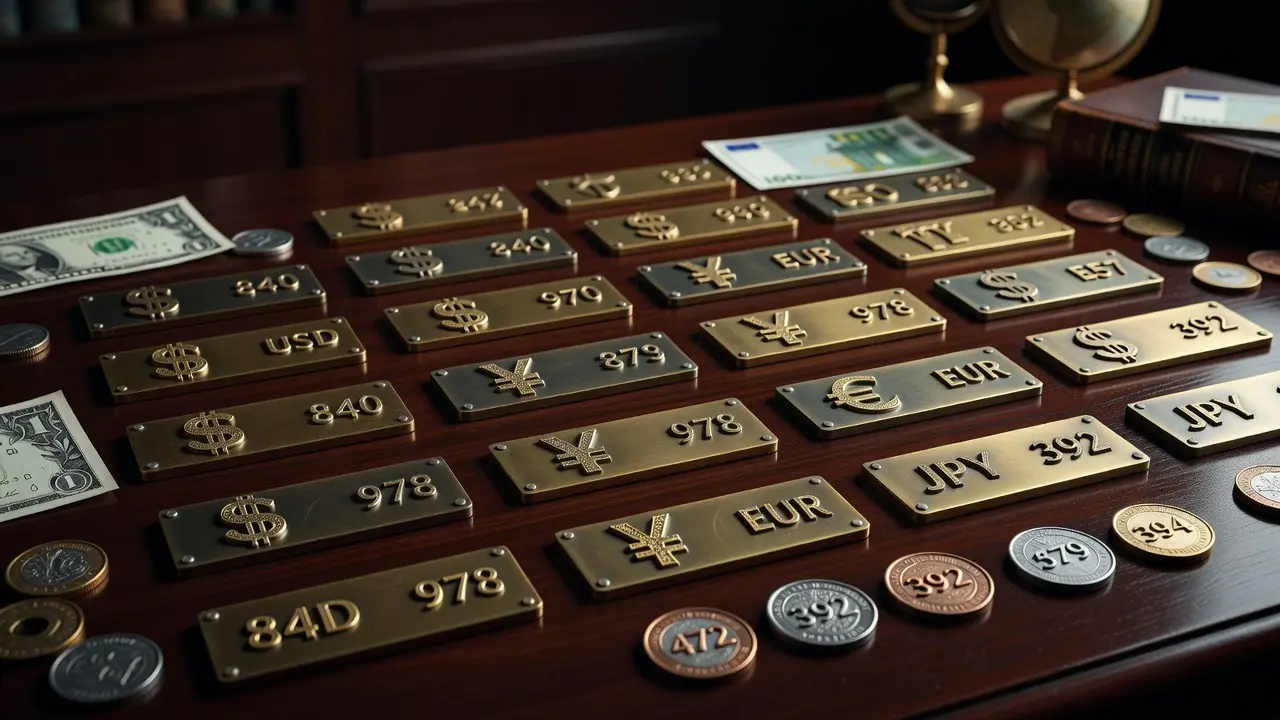
What is a currency code?
A currency code is a short, unique label for a currency, defined by ISO 4217 so that the same currency is written the same way everywhere. The alphabetic code has three letters; the numeric code has three digits. Banks use them in transfers, card networks in settlement, and exchange sites in their tables.
Codes solve a real problem: the sign "$" is used by more than 20 currencies, and "dollar" alone could mean US, Australian, Canadian, Singapore or many others. USD, AUD, CAD and SGD leave no doubt. The same applies to "¥", which covers both the Japanese yen (JPY) and the Chinese yuan (CNY).
Codes are labels for currencies, not for rates. The rate between two codes is a separate number, explained in our guide to currency conversion.
How ISO 4217 codes are built
Under iso 4217, the first two letters of an alphabetic code are usually the country's ISO 3166 code, and the third letter is usually the first letter of the currency's name. The numeric code usually matches the country's ISO 3166 numeric code. A third field, minor units, gives the number of decimal places.
- USD: US (United States) + D (dollar); numeric 840; 2 decimals.
- VND: VN (Viet Nam) + D (dong); numeric 704; 0 decimals.
- JPY: JP (Japan) + Y (yen); numeric 392; 0 decimals.
- GBP: GB (United Kingdom) + P (pound); numeric 826; 2 decimals.
- KWD: KW (Kuwait) + D (dinar); numeric 414; 3 decimals.
The usd code and the vnd code both follow this pattern. Some codes break it: the euro is EUR because it belongs to no single country, and the numeric code for currencies like the euro and the Turkish lira was set separately.
Currencies shared by several countries get one code. The euro is EUR in all 21 euro countries, and the West African CFA franc is XOF in all eight countries that use it, so the code identifies the currency, not the country where it is spent.
Minor units matter in software. VND has 0 decimals, so 25,000 dong is stored as 25000, while USD has 2, so $25.00 is stored as 2500 cents in many systems. Getting this wrong can multiply or divide amounts by 100.
Currency codes list: 40 widely used codes
The table below is a currency codes list of 40 widely used codes, with numeric codes and minor units from ISO 4217. The full, current list of about 180 active codes is published by SIX, the maintenance agency.
| Code | Numeric | Currency | Decimals |
|---|---|---|---|
| USD | 840 | US dollar | 2 |
| EUR | 978 | Euro | 2 |
| JPY | 392 | Japanese yen | 0 |
| GBP | 826 | Pound sterling | 2 |
| CNY | 156 | Chinese yuan renminbi | 2 |
| AUD | 036 | Australian dollar | 2 |
| CAD | 124 | Canadian dollar | 2 |
| CHF | 756 | Swiss franc | 2 |
| HKD | 344 | Hong Kong dollar | 2 |
| SGD | 702 | Singapore dollar | 2 |
| KRW | 410 | South Korean won | 0 |
| TWD | 901 | New Taiwan dollar | 2 |
| INR | 356 | Indian rupee | 2 |
| THB | 764 | Thai baht | 2 |
| VND | 704 | Vietnamese dong | 0 |
| MYR | 458 | Malaysian ringgit | 2 |
| IDR | 360 | Indonesian rupiah | 2 |
| PHP | 608 | Philippine peso | 2 |
| LAK | 418 | Lao kip | 2 |
| KHR | 116 | Cambodian riel | 2 |
| MMK | 104 | Myanmar kyat | 2 |
| BND | 096 | Brunei dollar | 2 |
| NZD | 554 | New Zealand dollar | 2 |
| SEK | 752 | Swedish krona | 2 |
| NOK | 578 | Norwegian krone | 2 |
| DKK | 208 | Danish krone | 2 |
| PLN | 985 | Polish zloty | 2 |
| CZK | 203 | Czech koruna | 2 |
| HUF | 348 | Hungarian forint | 2 |
| RUB | 643 | Russian ruble | 2 |
| TRY | 949 | Turkish lira | 2 |
| BRL | 986 | Brazilian real | 2 |
| MXN | 484 | Mexican peso | 2 |
| ZAR | 710 | South African rand | 2 |
| AED | 784 | UAE dirham | 2 |
| SAR | 682 | Saudi riyal | 2 |
| QAR | 634 | Qatari riyal | 2 |
| KWD | 414 | Kuwaiti dinar | 3 |
| BHD | 048 | Bahraini dinar | 3 |
| ILS | 376 | Israeli new shekel | 2 |
The decimals column is the ISO standard, not always daily practice. ISO gives the rupiah and the kip 2 decimals, for example, but prices in Indonesia and Laos are almost always whole numbers.
Special X codes: gold, SDR and test codes
Codes starting with X are reserved for items that are not the currency of a single country. They cover precious metals, supranational units such as the IMF's Special Drawing Right, currencies shared by several countries, and codes for testing and "no currency".
- XAU (959): gold, one troy ounce.
- XAG (961): silver, one troy ounce.
- XDR (960): IMF Special Drawing Right.
- XOF (952): West African CFA franc, used by eight countries.
- XAF (950): Central African CFA franc, used by six countries.
- XCD (951): East Caribbean dollar.
- XPF (953): CFP franc, used in French Pacific territories.
- XTS (963): reserved for testing.
- XXX (999): no currency involved in a transaction.
Gold prices quoted as XAU/USD use this code; a quote of 2,400 means one troy ounce of gold costs 2,400 US dollars.
Fund codes and other unusual entries
A few countries have extra codes for accounting units that are not cash. These "fund codes" let banks and governments index amounts to inflation or to a fixed value. They appear in ISO 4217 alongside the normal currency code.
- CLF: Chilean unidad de fomento, an inflation-linked unit used in contracts and mortgages.
- MXV: Mexican unidad de inversión, an inflation-linked unit.
- BOV: Bolivian Mvdol, linked to the US dollar.
- USN: US dollar "next day" funds, used in some money market settlements.
Most people never see these codes, but they explain why a full ISO 4217 list is longer than the number of countries with their own currency.
How the dong's code is written in Vietnam
In Vietnam, banks and accounting software use VND, while shops and price tags use the sign ₫, the letter đ, or simply "đồng". Invoices for foreign partners usually show VND before the amount. Because VND has no decimals, amounts like VND 1,250,000 are written without cents, and any decimals in a conversion are rounded to whole dong.
How currency codes change
A code changes when a currency is replaced, redenominated or abolished. The new currency gets a new code, often with a new numeric code, and the old one is withdrawn after a transition period so that historical records stay unambiguous.
- Croatia's kuna (HRK) was withdrawn after Croatia adopted the euro in 2023.
- Bulgaria's lev (BGN) is being withdrawn after Bulgaria adopted the euro on 1 January 2026.
- Sierra Leone's new leone (SLE) replaced SLL after a 1,000 to 1 redenomination in 2022.
- Venezuela's bolívar changed from VEF to VES in 2018 after five zeros were removed.
- Zimbabwe Gold (ZWG) was introduced in 2024.
- The Caribbean guilder (XCG) replaced the Netherlands Antillean guilder (ANG) in Curaçao and Sint Maarten in 2025.
Systems that store codes should keep old codes for historical records and follow SIX's published amendments for new ones.
Using currency codes correctly
Put the code before the amount with a space, as in USD 1,250.00 or VND 25,000,000, in invoices, contracts and bank forms. In everyday text a symbol is fine when the currency is clear, but use the code whenever two currencies appear together or the reader might be abroad.
A worked example with an assumed rate: an invoice reads "EUR 2,000 payable in VND at 28,000". The buyer pays 56,000,000 dong. Writing "€2,000" alone in a contract with a Vietnamese partner leaves no doubt about the euro, but adding the code avoids errors when the amount is copied into banking software. Banks then convert at their own rate, explained in our guide on the exchange rate margin.
For what money and currency are in the first place, see what is currency. To convert between any two codes, use the currency converter.






