
What is money and what are its functions?
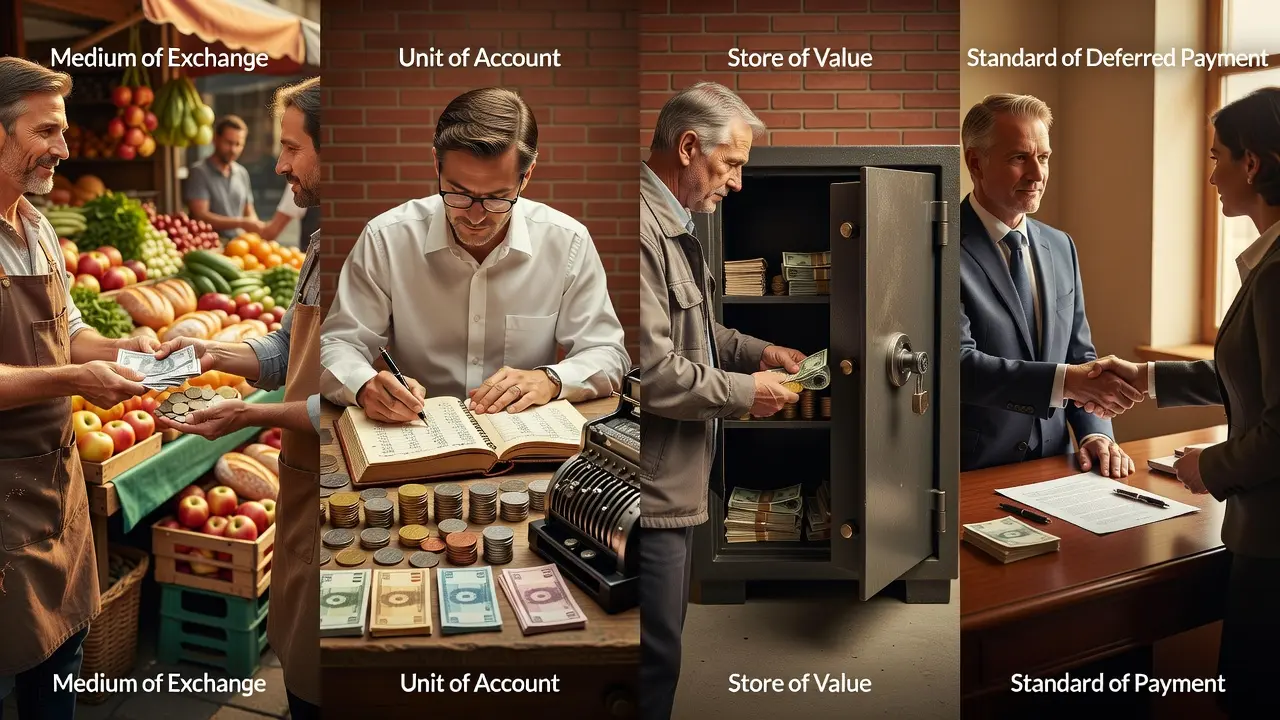
Money is anything widely accepted as payment for goods, services and debts. Economists define it by what it does: it must work as a medium of exchange, a unit of account, a store of value and a standard of deferred payment. If an asset does only some of these jobs, it is not fully money.
- Medium of exchange: a baker accepts dong for bread instead of asking for eggs in return. Without money, every trade would need a "double coincidence of wants".
- Unit of account: prices in a Hanoi market are written in dong, so a 30,000 dong bowl of pho can be compared with a 50,000 dong coffee at once.
- Store of value: money saved today can be spent next month. The function works well only when inflation is low.
- Standard of deferred payment: a loan of 100 million dong is written and repaid in dong, so both sides know what is owed.
Vietnamese economics textbooks, following Karl Marx's analysis, often list five functions instead: measure of value, means of circulation, means of storing value, means of payment, and world money. The ideas overlap; the five-function list adds money's role in international trade.
Money vs currency: what is currency?
The money vs currency difference is about scope. Money is the broader idea: anything that performs the functions above, including bank deposits and digital balances. Currency is the physical or official form of money in a country, its notes and coins, and in everyday use also the national unit, such as the dong, the dollar or the yen.
- A bank balance is money but not currency in the narrow sense, because it is not notes or coins.
- A US dollar note is both money and currency.
- Gold is a store of value, but in most countries it is not a medium of exchange today, so it is not money in daily life.
Each currency has a three-letter code used by banks, such as VND for the dong or USD for the US dollar; see our guide to the currency code system.
Fiat money and legal tender
Fiat money is currency that has value because a government declares it legal tender and people trust the issuer, not because it can be exchanged for gold or silver. Nearly every currency today is fiat money. The US ended the dollar's link to gold in 1971, and the other major currencies followed.
In Vietnam, the State Bank of Vietnam is the only body allowed to issue notes and coins, and the dong is the legal tender for payments inside the country. Cryptocurrencies are not legal means of payment in Vietnam.
Fiat money works as long as the issuer keeps its value fairly stable. That is why central banks target low inflation, often around 2% a year in advanced economies.
When a currency stops working as money
A currency loses its functions one by one when inflation gets out of control. The store of value goes first, as people spend their wages at once. Then the unit of account goes, as shops price in a foreign currency. Finally the medium of exchange goes, as people refuse local notes.
Zimbabwe in 2008 is the best-known recent case. Monthly inflation reached many billions of percent in late 2008, the central bank issued a 100 trillion dollar note in January 2009, and within months the country effectively abandoned its own currency in favour of the US dollar and the South African rand.
A milder version happens in many countries: people keep savings in dollars or gold while still paying for daily goods in the local currency. In that case, the local currency still works as a medium of exchange and unit of account, but not fully as a store of value.
Money across borders and exchange rates
When money crosses a border, its value is measured against another currency through the exchange rate. A Vietnamese tourist in Tokyo needs yen, because the dong is not a medium of exchange in Japan. The rate decides how much yen each dong buys; our guide on how exchange rates work explains the basics.
A worked example with an assumed rate: if 1 yen = 170 dong, a ¥1,000 lunch costs 170,000 dong. Banks add a margin when they convert, which is explained in Buy Rate vs Sell Rate: What Banks Don't Tell You. To check any amount, use the currency converter.






