
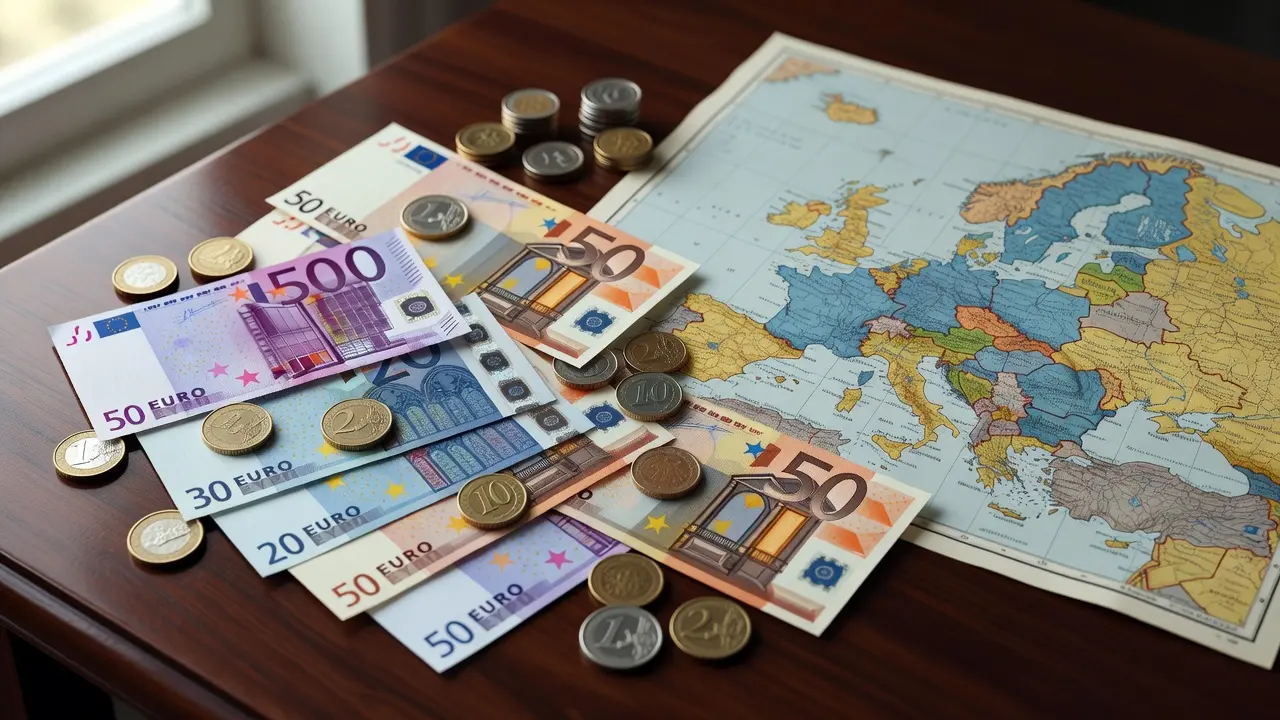
Euro countries at a glance
The euro countries are the EU members that have replaced their national currency with the euro, together called the euro area or eurozone. The European Central Bank in Frankfurt sets interest rates for all of them, while each national central bank issues notes and coins as part of the Eurosystem.
- Currency: euro
- Code and numeric code: EUR, 978
- Sign: € (Unicode U+20AC)
- Subunit: 100 cents
- Notes: €5, €10, €20, €50, €100, €200 (and €500, no longer issued)
- Coins: 1, 2, 5, 10, 20 and 50 cents; €1 and €2
- Central bank: European Central Bank, with 21 national central banks
The 21 eurozone countries, with the year each adopted the euro:
| Year | Countries |
|---|---|
| 1999 | Austria, Belgium, Finland, France, Germany, Ireland, Italy, Luxembourg, Netherlands, Portugal, Spain |
| 2001 | Greece |
| 2007 to 2015 | Slovenia (2007), Cyprus and Malta (2008), Slovakia (2009), Estonia (2011), Latvia (2014), Lithuania (2015) |
| 2023 | Croatia |
| 2026 | Bulgaria |
Six EU members still use their own currency: Czechia, Denmark, Hungary, Poland, Romania and Sweden. Denmark has a legal opt-out and keeps its krone pegged to the euro. Live rates against every currency are on the euro exchange rate page.
Euro banknotes in circulation
Euro banknotes are the same in every euro country, with no national designs. The current Europa series, issued from 2013 to 2019, shows windows and doorways on the front and bridges on the back, in architectural styles from classical to modern, and carries a portrait of Europa from Greek mythology in the watermark and hologram.
| Note | Main colour | Architectural style |
|---|---|---|
| €5 | Grey | Classical |
| €10 | Red | Romanesque |
| €20 | Blue | Gothic |
| €50 | Orange | Renaissance |
| €100 | Green | Baroque and rococo |
| €200 | Yellow-brown | Iron and glass architecture |
| €500 | Purple | Modern 20th-century architecture |
The €500 note stopped being issued at the end of 2018 in most countries and in April 2019 in Germany and Austria, mainly over concerns about its use in crime. It remains legal tender and keeps its value permanently, but many shops refuse it, and even €200 notes are often turned down at small businesses.
Each note carries a serial number whose first letter shows which printing works produced it, not which country issued it. Collectors track these letters, but for spending they make no difference: a note printed in France is spent the same way in Lithuania.
The €200 note is the largest still issued, worth about 218.98 US dollars today. Older first-series notes remain legal tender and can always be exchanged at euro area central banks.
Euro coins and their national sides
Euro coins have one side shared by all countries, showing the value and a map of Europe, and one national side chosen by each issuing country. All euro coins are valid in every euro country, whatever their national side. There are eight coins: 1, 2, 5, 10, 20 and 50 cents, €1 and €2.
- Germany's €1 and €2 coins show the federal eagle.
- Italy's €1 shows Leonardo da Vinci's Vitruvian Man.
- Spain's €1 and €2 show the king.
- Monaco, San Marino and Vatican City also mint their own national sides, prized by collectors.
Each country may also issue commemorative €2 coins, which are legal tender everywhere. Several countries, including Finland, Ireland and the Netherlands, round cash totals to the nearest 5 cents, so 1 and 2 cent coins are rarely given as change there.
How to check a euro note is real
To check a euro note, use the ECB's "feel, look and tilt" method: feel the raised print on the front, look at the note against the light for the portrait watermark and the security thread, and tilt it to see the emerald number change colour and the hologram show a portrait of Europa.
- Raised print on the main image and the lettering, with short lines on the edges.
- Portrait watermark of Europa and the value, visible against light.
- A dark security thread showing the value and the € sign.
- The emerald number at the bottom left, which moves up and down and changes colour.
- A portrait window in the hologram on the €20, €50, €100 and €200 notes, which turns clear when held to the light.
Where to exchange euros and today's rate
For travellers from Vietnam, euros are easy to buy before the trip at major banks, which list the euro among the most traded currencies in their daily tables. Inside the euro area, ATMs are the cheapest source of cash for most visitors, as long as you decline any offer to convert the withdrawal into your home currency.
Today's mid-market rate, dated 25 November 2026, is 1 EUR = 1.09 USD. For readers in Vietnam, the eur to vnd converter shows the live rate in dong.
Cards work almost everywhere in northern Europe, and contactless payment is standard. Cash is still common in Germany, Austria, Italy and parts of southern and eastern Europe, especially in small cafés, markets and rural areas.
A worked example with an assumed rate: if 1 EUR = 1.10 USD, a €4 coffee in Paris costs about $4.40, and a €50 note about $55.
Euros outside the euro countries and cash limits
Euros are often accepted outside the euro area, but at a cost. In Czechia, Hungary, Poland and other neighbouring countries, tourist shops, hotels and petrol stations near borders may take euros, usually at a poor rate and with change given in the local currency. Paying in the local currency by card is almost always cheaper.
Several non-EU countries in the Balkans and elsewhere price hotels and tours in euros as well. Montenegro and Kosovo use the euro as their only currency, even though they cannot mint coins or issue notes.
Anyone entering or leaving the EU with €10,000 or more in cash, or the same value in another currency, must declare it to customs. The rule covers cash, cheques and other bearer instruments, and the threshold applies per traveller. Amounts below €10,000 need no declaration, but customs can still ask where the money came from.
- Declaration threshold: €10,000 or more, per person.
- Applies when crossing the EU's external border, not between euro countries.
- Failing to declare can lead to fines and the cash being held.
A short history of the euro
The euro was launched on 1 January 1999 as an accounting currency in 11 countries, and notes and coins replaced national currencies such as the German mark and French franc on 1 January 2002, by then in 12 countries including Greece. The euro area has grown in steps since, most recently with Croatia in 2023 and Bulgaria in 2026. The euro is the second most held reserve currency after the US dollar; see the most used currency in the world rankings.
The euro's value against the dollar since 1999 is covered in Euro to Dollar History Since 1999, and the € sign itself in our guide on how to type euro sign. For other currencies in this format, see our guides to the philippine peso and hkd notes. Every currency's code is in our world currencies list, and you can convert any amount with the currency converter.






