
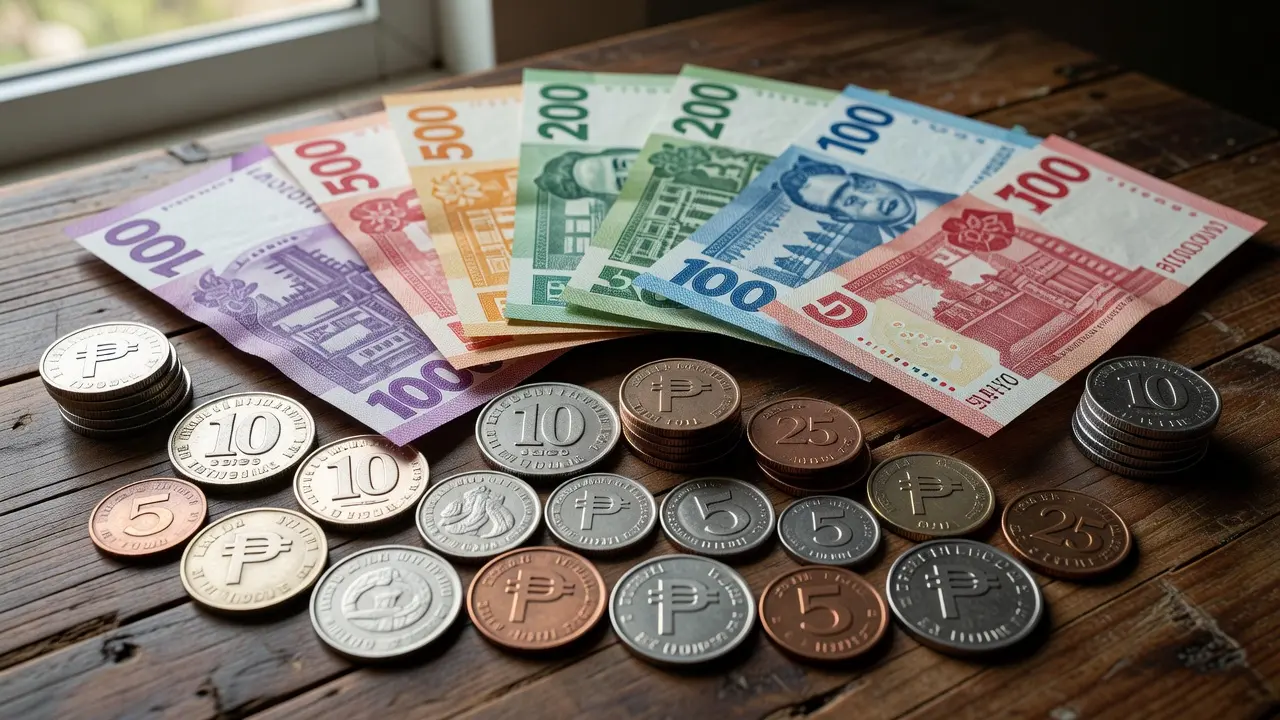
Philippine peso at a glance
The Philippines' currency is the peso, also called piso in Filipino, coded PHP, with the sign ₱. The Bangko Sentral ng Pilipinas, set up in 1993 to replace the old Central Bank of the Philippines, issues notes and coins and sets monetary policy.
- Currency: Philippine peso (piso)
- Code and numeric code: PHP, 608
- Sign: ₱, often written P or PHP
- Subunit: 100 sentimo (centavo)
- Notes: ₱20, ₱50, ₱100, ₱200, ₱500, ₱1,000
- Coins: 1, 5 and 25 sentimo; ₱1, ₱5, ₱10, ₱20
- Issuer: Bangko Sentral ng Pilipinas
The php currency code appears on bank and remittance statements, while shops write ₱ or simply P before the price. Live rates against every currency are on the philippine peso exchange rate page.
Philippine peso notes in circulation
Two series circulate together. The paper New Generation Currency (NGC) series, issued from 2010, shows former presidents and national heroes on the front and natural sites on the back. The polymer series, starting with the ₱1,000 note in 2022, shows native wildlife instead of people.
| Note | Main colour | Front (NGC paper series) |
|---|---|---|
| ₱20 | Orange | Manuel L. Quezon |
| ₱50 | Red | Sergio Osmeña |
| ₱100 | Violet | Manuel Roxas |
| ₱200 | Green | Diosdado Macapagal |
| ₱500 | Yellow | Corazon and Benigno Aquino Jr. |
| ₱1,000 | Blue | José Abad Santos, Vicente Lim, Josefa Llanes Escoda (paper); Philippine eagle (polymer) |
The First Philippine Polymer Series, released on 23 December 2024 for ₱50, ₱100 and ₱500, puts endangered animals on the front: a Visayan leopard cat on the ₱50, a Palawan peacock-pheasant on the ₱100 and a Visayan spotted deer on the ₱500. The BSP has said the paper notes with historical figures remain legal tender and will circulate alongside the polymer notes. Polymer notes last longer than paper and should not be folded hard, ironed or stapled.
The ₱1,000 note is the largest, worth about 15.69 US dollars today. The ₱20 note is being replaced by a ₱20 coin introduced in 2019, and the ₱200 note is rarely seen. Small vendors often cannot change ₱500 or ₱1,000 notes, so keep ₱20 to ₱100 for daily use.
Philippine coins
Coins of the NGC series are 1, 5 and 25 sentimo, and ₱1, ₱5, ₱10 and ₱20. The ₱20 coin is bimetallic, and the ₱10 coin has a gold-coloured ring. Sentimo coins are rarely used outside supermarkets.
Coins matter more in the Philippines than in many countries, because jeepney and tricycle fares are often paid in coins, and drivers may not have change for large notes.
How to check a peso note is real
To check a peso note, hold paper notes to the light to see the watermark and the security thread, tilt them to see the colour-shifting number and the shiny strip, and feel the raised print. For polymer notes, look through the clear window and check the shiny features inside it. The BSP's "feel, look, tilt" method covers both series.
- Paper: watermark of the portrait, embedded security thread, raised print.
- Paper: colour-shifting denomination and an optically variable patch on higher values.
- Polymer: a clear window with a shiny image, and printing that stays sharp at the edges.
- Both: fine lines and tiny printed text that blur on copies.
Where to exchange pesos and today's rate
In the Philippines, licensed money changers in malls usually give better rates than airport counters and hotels. Banks exchange currency mainly for their own customers. ATMs accept foreign cards, but many charge a fee of ₱200 to ₱250 per withdrawal on top of your bank's fees.
Today's mid-market rate, dated 25 November 2026, is 1 PHP = 0.0157 USD. For dollar budgets, see us dollar to philippine peso.
A worked example with an assumed rate: if 1 USD = 58 PHP, a ₱150 plate of adobo costs about $2.60, and a ₱1,000 note about $17.20.
Philippines money from remittances
Philippines money flows have a special feature: the country is one of the largest receivers of remittances in the world, from millions of Filipinos working abroad. Money sent home is a major source of household income, and the peso rate against the dollar matters to families every month.
The way money is sent home, and the costs involved, are explained in our guide to remittance meaning. Workers in Japan and Taiwan often use local services; see yen remittance and Sending Money From Taiwan: TWD Exchange Rates and Costs.
A short history of the peso
The peso comes from the Spanish silver dollar, the "peso de ocho", which circulated in the Philippines under Spanish rule. The Philippine peso was introduced in 1852, and under US administration it was fixed at 2 pesos to 1 dollar from 1903. The currency was renamed piso in Filipino in 1967. Since the 1970s it has floated. Unlike the euro, which is shared by many countries, the peso is used only in the Philippines; see Euro Banknotes and Coins: Which Countries Use the Euro for comparison.
For other currencies in this format, see the Hong Kong Dollar Guide. Every currency's code and sign is in our world currencies list, and you can convert any amount with the currency converter.






