
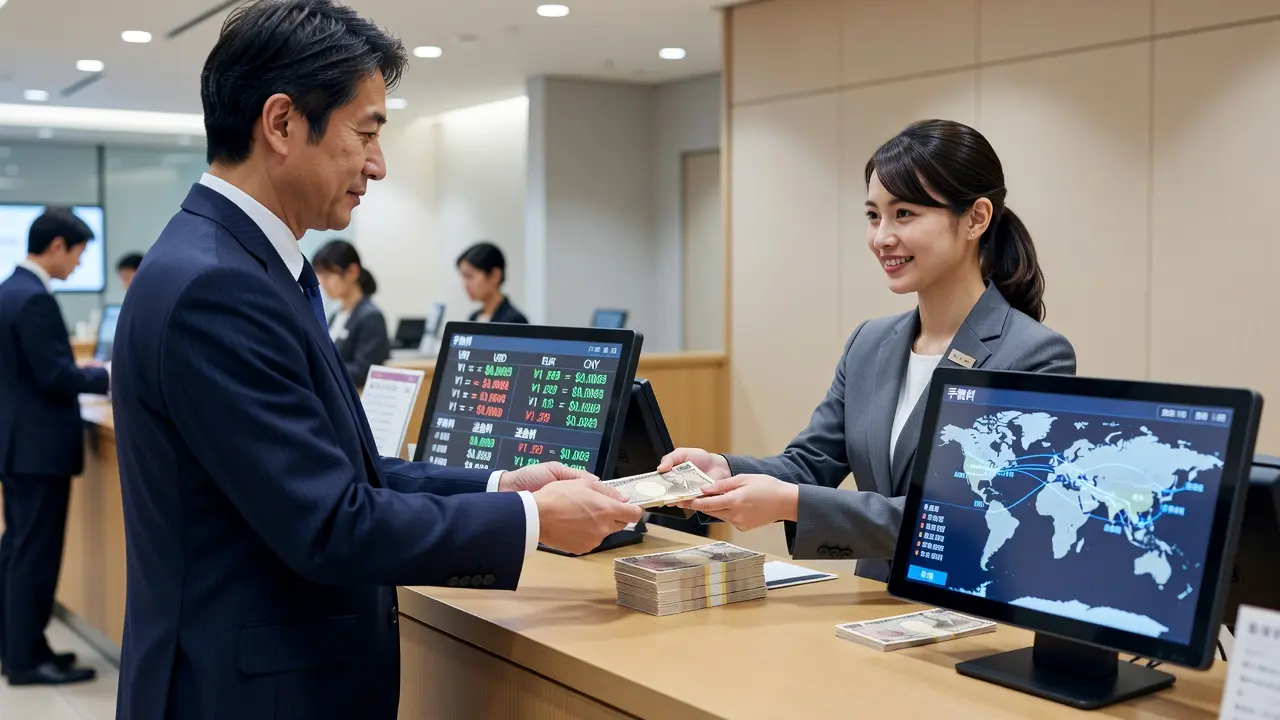
How sending money from Japan works
Sending money from Japan takes four steps: register with a bank or licensed remittance company, prove your identity and My Number, add the recipient, then pay yen into the service. The provider converts the yen at its own rate and pays the recipient in local currency or into a bank account, mobile wallet or cash pickup point.
Japan treats overseas transfers strictly. Under the Payment Services Act, only banks and funds transfer service providers registered with the FSA may send money abroad for others. Informal channels, such as handing yen to a contact who pays out in Vietnam, are illegal in Japan and give you no protection if the money disappears. The basic mechanics of any overseas payment are covered in our guide to international money transfer.
Every provider must check who you are. Expect to show a residence card (zairyu card) or passport, and to register your My Number, because Japanese law requires it for overseas remittances. Students and technical intern trainees go through the same checks as any other resident.
Ways to send: bank, transfer app or remittance company
There are three main channels: Japanese banks, including Japan Post Bank; funds transfer service providers that serve migrant workers, such as Kyodai Remittance and SBI Remit; and online apps such as Wise. Banks are slower and charge more. Remittance companies and apps are usually cheaper and faster for amounts under ¥1 million.
- Japanese banks: MUFG, SMBC, Mizuho and Japan Post Bank send SWIFT transfers to a bank account abroad. Fixed fees are often ¥2,000 to ¥5,000, and intermediary banks may take more.
- Remittance companies: send to bank accounts, e-wallets or cash pickup in Vietnam, the Philippines, Nepal, Indonesia and other countries. Many let you pay at a convenience store or ATM.
- Online apps: you pay by bank transfer inside Japan, the app converts at close to the mid-market rate and shows the fee before you confirm.
Registration matters for limits. Japan has three types of funds transfer licence. A Type 2 provider, the type most remittance companies hold, may send up to ¥1 million per transfer. Wise announced that it received a Type 1 licence, which allows larger amounts.
Fees and the JPY exchange rate margin: total cost
The JPY exchange rate you get decides most of the cost. A provider that charges a low fee but converts yen at a rate 2% worse than the market is more expensive than one with a ¥1,000 fee and a fair rate. Compare the amount the recipient receives, not the fee alone.
A worked example with an assumed rate: you send ¥100,000 to Vietnam when the market rate is 170 dong per yen, so ¥100,000 is worth 17 million dong.
| Option (example) | Fee | Rate used | Recipient gets | Total cost |
|---|---|---|---|---|
| Bank SWIFT transfer | ¥4,000 | 166.6 dong | about 16.0 million dong | about 5.9% |
| Remittance company | ¥1,000 | 168.3 dong | about 16.7 million dong | about 2.0% |
| Online app | ¥900 | 170 dong | about 16.8 million dong | about 0.9% |
The figures are an example to show the method, not quotes from named providers. Check today's rate for yen to vnd, yen to php or 1000 yen to usd before you send. Fixed fees hurt small transfers most: ¥1,000 on ¥20,000 is 5%, but on ¥200,000 it is 0.5%.
The yen's own moves can matter more than any fee. The yen weakened from about 115 per US dollar at the start of 2022 to about 150 by October 2022, so the same monthly wage bought far fewer dong, pesos or rupees. Nobody can time this reliably. Two habits help: send on a fixed day each month instead of waiting for a better rate, and set a rate alert in your app so you notice large moves. If you pay at a convenience store, check whether the rate is fixed when you book or when the money arrives, because the two can differ by a day.
Senders from India often think in Indian units. ¥500,000 at an assumed 0.57 rupees per yen is 2.85 lakh rupees; the units are explained in our guide to lakh to usd conversions.
How long a transfer from Japan takes
Remittance companies and apps often deliver to e-wallets, cash pickup points and Vietnamese bank accounts within minutes to a few hours on working days. Bank SWIFT transfers usually take 1 to 4 working days, longer if an intermediary bank is involved or if the bank asks you to confirm the purpose of the payment.
- Payment method: paying at a convenience store or by bank transfer can add a few hours before the provider receives the yen.
- Cut-off times: a transfer started on Friday evening in Japan may not move until Monday.
- Holidays: Japanese holidays such as Golden Week and New Year (1 to 3 January), and Tet in Vietnam, slow bank transfers.
- Checks: a first transfer, or one much larger than usual, may be held for review.
Documents and rules in Japan and Vietnam
In Japan you need a residence card or passport, your My Number, and the recipient's full name, address and bank or wallet details. In Vietnam the recipient needs a citizen ID card and, for cash pickup, the transfer code. Vietnam sets no limit on remittances received, and remittance income is not subject to personal income tax.
- Purpose checks in Japan: banks confirm the purpose of remittances over ¥1 million and may ask for proof, such as a tuition invoice or a contract.
- Tax reporting in Japan: banks report overseas remittances over ¥1 million to the tax office.
- Name matching: the recipient's name must match their ID exactly, including Vietnamese spelling without accents if the provider asks for it.
- Your own money only: sending money for other people through your account can lead to the account being closed.
The legal meaning of remittance and how it is recorded in each country is explained in our remittance definition guide.
How to send money from Japan, step by step
The first transfer takes longest because of identity checks; later transfers take a few minutes. Plan for 3 to 7 days to open a remittance account by post or app, then use the same steps each month.
- Choose a provider and compare what the recipient gets for ¥100,000 today.
- Register with your residence card, My Number and a Japanese phone number.
- Add the recipient: full name as on ID, bank name, account number or e-wallet number.
- Enter the amount in yen and check the rate, fee and amount received.
- Pay by bank transfer, ATM or convenience store using the reference number.
- Send the tracking number to the recipient and keep the receipt.
Banknotes and coins you pay in are covered in the Japanese Yen Guide: Banknotes, Coins and Value, and the ¥ sign itself in our page on the yen symbol. Track the japanese yen exchange rate over time, and compare with a twd remittance if family members also work in Taiwan. Any amount can be checked on the currency converter.






