
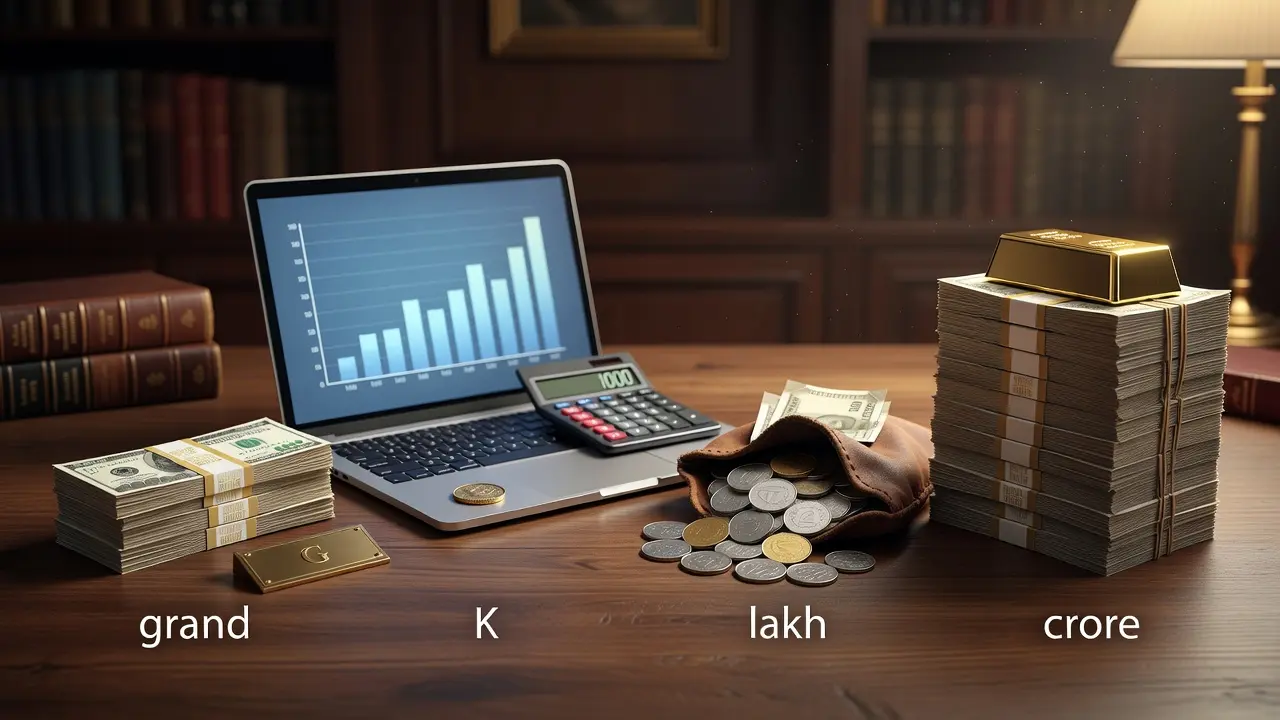
What lakh to usd means
Converting lakh to usd means turning an amount counted in lakhs of Indian rupees into US dollars. Multiply the number of lakhs by 100,000 to get rupees, then multiply by the INR/USD rate. Today 1 lakh rupees is 1,079.1 dollars, so 5 lakh is five times that.
The lakh and the crore belong to the Indian numbering system, which groups digits differently from the international system. After the first three digits on the right, commas fall every two digits instead of every three:
- One lakh: 1,00,000 (international: 100,000)
- Ten lakh: 10,00,000 (international: 1,000,000, one million)
- One crore: 1,00,00,000 (international: 10,000,000, ten million)
- One hundred crore: 1,00,00,00,000 (international: 1,000,000,000, one billion), sometimes called an arab
A salary of "12 LPA" in an Indian job advert means 12 lakh per annum, or ₹12,00,000 a year. A house priced at "1.5 Cr" costs 1.5 crore rupees, which is ₹1,50,00,000. A car listed at "6.5 lakh" costs ₹6,50,000, and a donation of "51 thousand" is simply ₹51,000. To convert any of these amounts live, use the inr to usd converter.
The same method works for any currency, including dirhams, riyals and pounds. Many people searching for lakh conversions earn abroad and send money home, so the rate they need is dirhams, riyals or pounds to rupees. A worked example with assumed rates: if 1 UAE dirham = 23 rupees, then 1 lakh rupees is 1,00,000 ÷ 23 = about 4,348 dirhams. If £1 = 110 rupees, 1 lakh is about £909, and 1 crore about £90,909.
A quick mental check helps catch mistakes. At around 85 rupees to the dollar, one lakh is a little over 1,000 dollars and one crore a little over 100,000 dollars. If your result is far from those figures, a zero has probably moved.
Lakh and crore conversion table
The table converts common lakh and crore amounts into US dollars at today's mid-market rate, dated 25 November 2026. Each row also shows the number in Indian and international digit grouping, so you can check the zeros.
| Amount | Indian grouping (₹) | International grouping | US dollars |
|---|---|---|---|
| 1 lakh | 1,00,000 | 100,000 | 1,079.1 |
| 5 lakh | 5,00,000 | 500,000 | 5,395.5 |
| 10 lakh | 10,00,000 | 1,000,000 | 10,791 |
| 25 lakh | 25,00,000 | 2,500,000 | 26,977.5 |
| 50 lakh | 50,00,000 | 5,000,000 | 53,955 |
| 1 crore | 1,00,00,000 | 10,000,000 | 107,910 |
| 10 crore | 10,00,00,000 | 100,000,000 | 1,079,100 |
| 100 crore | 1,00,00,00,000 | 1,000,000,000 | 10,791,000 |
Going the other way, a dollar amount becomes lakhs by converting to rupees and dividing by 100,000. Our dollar to inr page gives the rupee figure; the guide to 1 crore in dollars works through large sums in both directions.
Worked examples with lakh and crore
The quickest way to check a conversion is to do it in two steps: first turn lakhs or crores into plain rupees, then apply the exchange rate. The examples use an assumed rate so the arithmetic is easy to follow; use the live converter for the real figure.
A salary of 18 LPA
With an assumed rate of 1 USD = 85 INR: 18 lakh is 18 × 1,00,000 = ₹18,00,000. Divided by 85, that is about $21,176 a year, or about $1,765 a month before tax.
A flat priced at 1.2 crore
1.2 crore is 1.2 × 1,00,00,000 = ₹1,20,00,000. At 85 rupees per dollar, that is about $141,176. A buyer abroad also pays transfer costs, so the real dollar cost is a little higher.
A film's box office of 500 crore
Indian film news often reports takings in crores. 500 crore is ₹5,00,00,00,000, five billion rupees, or about $58.8 million at 85 rupees per dollar.
The general formula is amount in rupees × rate, or amount in rupees ÷ rupees per dollar, depending on how the rate is quoted. Our page on the currency conversion formula explains which way round to use it.
Lakh and crore in salaries, prices and news
In India, salaries are usually quoted per year in lakhs, property in lakhs or crores, and company results and government budgets in crores. Reading these figures correctly is mostly about knowing the abbreviations that come with them.
- LPA: lakh per annum, the yearly salary. "8 LPA" is ₹8,00,000 a year.
- CTC: cost to company, the employer's total yearly cost, including benefits. Take-home pay is lower.
- L or Lac: lakh, as in "₹45 L" or "45 lacs".
- Cr: crore, as in "₹2.3 Cr".
- Lakh crore: one lakh crore is 1,00,000 × 1,00,00,000 rupees, a trillion rupees. Budgets and GDP figures use it.
When converting these to dollars for a job offer abroad, use the same rate for every part of the package, and convert the take-home pay rather than the CTC if you want a fair comparison with a foreign salary. A worked example with an assumed rate of 85 rupees per dollar: a CTC of 24 LPA is ₹24,00,000, about $28,235 a year. If take-home pay is 19 lakh after tax and deductions, that is about $22,353.
Writing lakh and crore in spreadsheets
Excel and Google Sheets can show numbers in Indian grouping, so 1234567 displays as 12,34,567. The simplest way is to set the spreadsheet's region or locale to India; the number format then uses lakh and crore commas automatically.
In Google Sheets, open File, then Settings, and set the locale to India. In Excel on Windows, the Currency or Number format follows the Windows region settings, so choosing English (India) in the system's region options applies Indian grouping. A custom number format can force it in a single file without changing system settings.
When sharing a sheet with people outside South Asia, add a column with the amount in international grouping or in millions. A reader used to 1,234,567 can misread 12,34,567, and a short note such as "amounts in lakh" at the top of the column prevents mistakes.
The same care applies to currency conversion columns. Keep the rupee amount as a plain number, put the rate in its own cell, and calculate dollars with a formula, so the figures update when you change the rate.
What is a grand, and what do K and M mean?
A grand is 1,000 units of money: "five grand" is $5,000 in the US or £5,000 in the UK. K means thousand, from kilo, so a "60K salary" is 60,000 a year. M means million, as in "$2M", and finance often writes MM for million and bn for billion.
These shortcuts are informal. They appear in speech, job ads, headlines and social media, but not in contracts or invoices, where the full number and the currency code are written out. A few related terms:
- Grand: 1,000, used in the US, UK, Australia and New Zealand.
- K: 1,000. A price of 2.5K is 2,500.
- M or MM: 1,000,000. Investment banks often use MM to avoid confusion with M for thousand in Roman numerals.
- Bn or B: 1,000,000,000. In modern English a billion is a thousand million.
- Quid and buck: one pound and one dollar, not multiples.
The number of zeros in each of these is a common source of mistakes, especially between languages; our explainer on how many zeros in a billion lists them all.
How the same amounts are said in other languages
Different languages group large numbers in different steps. English groups in thousands, Indian English adds lakh and crore, and Chinese, Japanese and Korean group in ten-thousands. The same number can therefore sound very different in each language.
| Number | English | Indian system | Japanese | Chinese | Korean |
|---|---|---|---|---|---|
| 10,000 | ten thousand | ten thousand | 1万 (ichi-man) | 一万 (yí wàn) | 1만 (man) |
| 100,000 | one hundred thousand | 1 lakh | 10万 (jū-man) | 十万 (shí wàn) | 10만 (sib-man) |
| 1,000,000 | one million | 10 lakh | 100万 (hyaku-man) | 一百万 (yìbǎi wàn) | 100만 (baek-man) |
| 10,000,000 | ten million | 1 crore | 1000万 (sen-man) | 一千万 (yìqiān wàn) | 1000만 (cheon-man) |
| 100,000,000 | one hundred million | 10 crore | 1億 (ichi-oku) | 一亿 (yí yì) | 1억 (eok) |
Japanese prices are often written with 万, such as 3万円 for ¥30,000. The page Japanese Yen Units: Man (万) and Sen (千) Explained shows how to read them, and our guide to japanese money covers the notes and coins. Korean uses the same grouping, which is why Korean salaries and rents are quoted in man; see how much 1 million won to usd is worth.
Chinese also writes amounts with 万 and 亿, and prices inside China often end in 元. Our page on the yuan symbol explains when you will see ¥ and when 元.
Vietnamese groups in thousands like English, but everyday speech uses its own shortcuts: "50k" for 50,000 dong, and slang such as lít for 100,000 and củ for 1,000,000. Readers in Vietnam can check yen and dollar amounts on the jpy / vnd and usd vnd converters.
Where lakh and crore come from
Lakh and crore come from Sanskrit. Lakh derives from lakṣa, meaning one hundred thousand, and crore from koṭi, ten million. Both words passed into Hindi, Urdu, Bengali, Nepali and other South Asian languages, then into Indian English, where they are written in newspapers, laws and official statistics.
Indian rules for writing numbers follow the same system. Cheques, bank statements and many government documents print amounts in Indian grouping, such as ₹12,34,567. Indian English speakers read that number as "twelve lakh, thirty-four thousand, five hundred and sixty-seven". The same number in international style is 1,234,567, read as "one million, two hundred thirty-four thousand...".
Larger Sanskrit units exist: arab for 100 crore (one billion) and kharab for 100 arab (100 billion). They appear in some school books and in Pakistan and Nepal, but most Indian media prefer "1,000 crore" or "1 lakh crore" to arab and kharab. A government budget of "48 lakh crore" means 48 × 1,00,000 × 1,00,00,000 rupees, which is 48 trillion rupees.
Lakh and crore outside India
Lakh and crore are used across South Asia, beyond India. Pakistan, Bangladesh, Nepal and Sri Lanka all use them in everyday speech and in the press, with each country's own currency.
- Pakistan: property and car prices are quoted in lakh and crore of Pakistani rupees, such as "Rs 45 lakh".
- Bangladesh: amounts in taka are reported in lakh and crore in Bengali and English newspapers.
- Nepal: lakh and crore of Nepalese rupees are standard, and arab appears in budget reports.
- Sri Lanka: English-language media mix lakhs and millions; banks use international grouping.
A lakh is the same number everywhere, 100,000, but the money it represents differs because each rupee or taka has its own value. One lakh Pakistani rupees is worth far less in dollars than one lakh Indian rupees, so always check which currency an amount is in before converting.
The South Asian diaspora carries these words abroad. A family in the Gulf or the UK may talk about saving "two lakh" for a wedding at home, meaning rupees, while earning in dirhams or pounds.
Money slang around the world
Every English-speaking country has its own slang for amounts and notes, mostly informal and never written on prices. Knowing a few terms helps when reading forums, listening to podcasts or talking to people abroad.
United Kingdom
- Quid: one pound. "Twenty quid" is £20.
- Fiver and tenner: a £5 and a £10 note.
- Pony: £25, and monkey: £500, both from Cockney and London usage.
- Grand: £1,000.
United States
- Buck: one dollar.
- C-note or Benjamin: a $100 note, after the Roman numeral C and the portrait of Benjamin Franklin.
- Grand, K or G: $1,000.
Australia
- Pineapple: the yellow $50 note.
- Lobster: the red $20 note.
Slang is local and changes over time. A word that is common in one city can be unknown in another, so in any formal message write the number and currency in full.
Common mistakes when converting lakh, crore and grand
The most common mistake is moving the comma to the wrong place when switching between Indian and international grouping. ₹10,00,000 looks like it might be ten thousand to someone used to international grouping, but it is one million rupees, ten lakh.
Three more mistakes come up often:
- Reading "crore" as a million. One crore is ten million, so 2 crore is 20 million, not 2 million.
- Applying the rate the wrong way. If the rate is 85 rupees per dollar, divide rupees by 85 to get dollars; multiplying gives a figure 7,225 times too large.
- Mixing billion definitions. Older British usage once called a million million a billion; today almost all English sources use a thousand million.
When a number matters, write it in full digits with the currency code and repeat it in words: "INR 1,20,00,000 (1.2 crore)" or "USD 141,176". That leaves no room for a misread.
Guides in this topic
These pages cover the units and conversions that come up most often with large amounts:
- 1 crore in dollars and 1 million dollars in rupees
- How many zeros in a million, billion and trillion
- Japanese yen units: man and sen
- 1 million won to usd and Korean number units
- The currency conversion formula and worked examples
To convert any amount between rupees, dollars, yen, won or dong, use the currency converter. Type the full number without lakh or crore commas, for example 2500000 for 25 lakh, and the converter returns the result in the other currency.






