
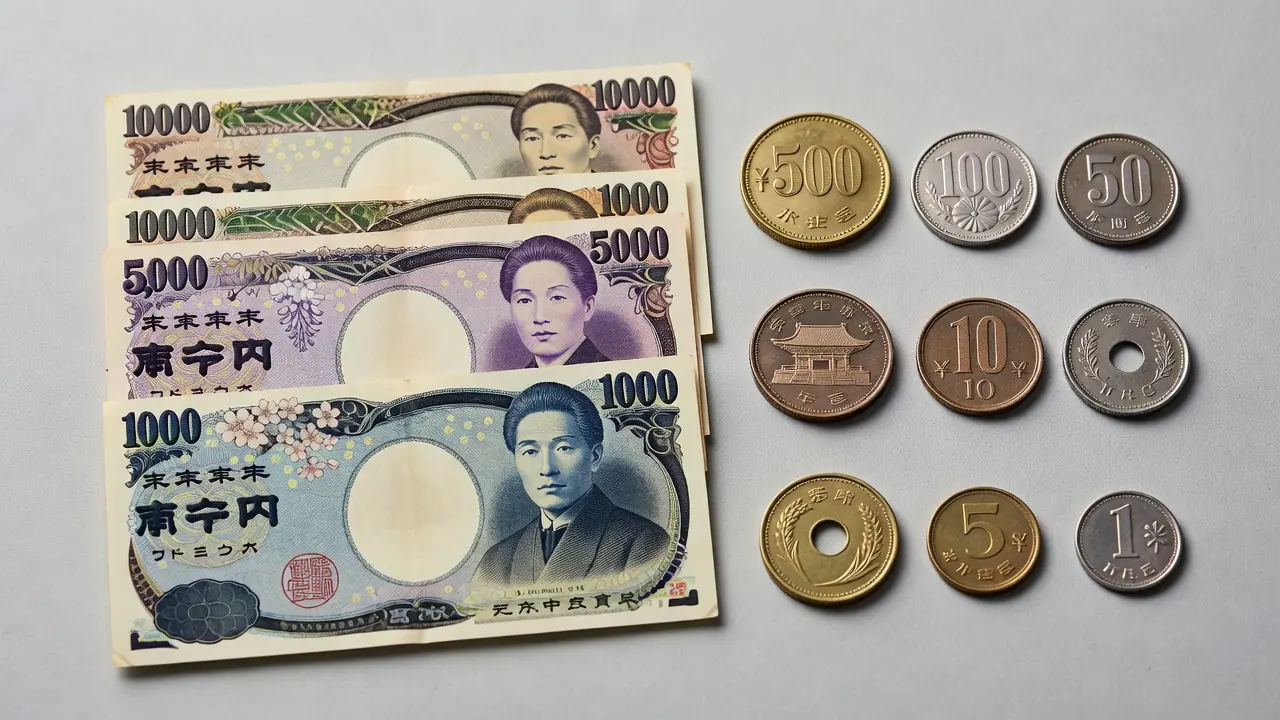
Currency of japan at a glance
Japan's currency is the yen (円, pronounced "en" in Japanese), with the ISO code JPY and the sign ¥. The Bank of Japan, founded in 1882, issues the banknotes, while the Japan Mint makes the coins. The yen floats freely against other currencies and is one of the most traded currencies in the world.
- Currency: Japanese yen
- Code and numeric code: JPY, 392
- Signs: ¥ (international), 円 (in Japan)
- Subunit: sen (1/100 yen), no longer used in payments
- Banknotes: ¥1,000, ¥2,000, ¥5,000, ¥10,000
- Coins: ¥1, ¥5, ¥10, ¥50, ¥100, ¥500
- Note issuer: Bank of Japan
- Exchange rate regime: floating
On 25 November 2026, ¥1 is worth 0.0063 US dollars. Because one yen is worth less than a US cent, Japanese prices look large to visitors: a convenience store lunch can cost ¥600 and a train fare ¥200. The sign ¥ is shared with the Chinese yuan, which causes some confusion in shops and on websites; our page on the yen symbol explains how to tell them apart.
Japanese counts large numbers in units of ten thousand, called man (万). A price of ¥30,000 is often written 3万円, and ¥10,000 is ichi-man en. The same grouping exists in Korean and Chinese.
Yen banknotes in circulation
The yen banknotes you will see most often are the 2024 series, issued on 3 July 2024 and showing Shibusawa Eiichi on the ¥10,000, Tsuda Umeko on the ¥5,000 and Kitasato Shibasaburō on the ¥1,000. The previous series, issued in 2004, is still legal tender and still common in change, so both designs circulate together.
| Note | 2024 series portrait | Who they were | 2024 series back | Previous portrait (2004) |
|---|---|---|---|---|
| ¥10,000 | Shibusawa Eiichi | Industrialist who helped found hundreds of Japanese companies and banks | Tokyo Station, Marunouchi building | Fukuzawa Yukichi |
| ¥5,000 | Tsuda Umeko | Educator who founded what is now Tsuda University | Wisteria flowers | Higuchi Ichiyō |
| ¥1,000 | Kitasato Shibasaburō | Bacteriologist known for his work on tetanus and plague | Hokusai's "The Great Wave off Kanagawa" | Noguchi Hideyo |
| ¥2,000 | Shureimon gate, Okinawa (no portrait) | Issued in 2000 for the G8 summit in Okinawa | Scene from The Tale of Genji | Not redesigned |
The 2024 notes are the first redesign in 20 years. Their main new feature is a 3D hologram that shows the portrait turning as you tilt the note, which the Bank of Japan described as the first use of this technology on a banknote. Large numerals on both sides make the value easier to read, and the notes have tactile marks in different positions for each value.
The ¥2,000 note is legal tender but rarely seen outside Okinawa. Many Japanese people have never used one, and some vending machines do not accept it.
The ¥10,000 note is worth 62.77 US dollars today. That is the most convenient note for hotels and larger purchases; for vending machines, buses and small shops, carry ¥1,000 notes and coins.
Yen coins
Japan has six coins in use: ¥1, ¥5, ¥10, ¥50, ¥100 and ¥500. The ¥5 and ¥50 coins have a hole in the middle, which makes them easy to tell apart by touch. The ¥500 coin was redesigned in November 2021 as a two-colour bimetallic coin to make it harder to counterfeit.
| Coin | Metal and look | Design |
|---|---|---|
| ¥1 | Aluminium, light and silver | A young tree |
| ¥5 | Brass, gold-coloured, with a hole | Rice ear, water and gear |
| ¥10 | Bronze, copper-coloured | Phoenix Hall of Byōdō-in temple |
| ¥50 | Cupronickel, silver, with a hole | Chrysanthemum |
| ¥100 | Cupronickel, silver | Cherry blossoms |
| ¥500 | Bimetallic (since 2021), gold and silver tones | Paulownia flower and leaves |
Coins matter more in Japan than in many countries because of vending machines, coin lockers, shrine offerings and rural buses that take exact change. A ¥500 coin is worth more than many low-value banknotes elsewhere, so check your change before you leave the counter. The ¥5 coin, pronounced go-en, sounds like the word for good fortune, which is why people often throw it into offering boxes at shrines.
Japanese money and cash habits
Japanese money is still used in cash more than in most rich countries, although cards and phone payments are growing fast. METI's figure of 42.8% cashless spending in 2024 means a visitor will pay cash regularly, especially at small restaurants, temples, local shops and in the countryside.
In big cities, most chain stores, department stores, hotels and convenience stores take international cards. IC transport cards such as Suica and PASMO pay for trains, buses and many convenience store purchases, and can be loaded with cash at stations. Some small family-run restaurants and ramen shops with ticket machines accept cash only.
Withdrawing yen is easy. ATMs in 7-Eleven stores and Japan Post offices accept most foreign cards, and convenience store ATMs are open 24 hours in most locations. Check your card's foreign fee before travelling, and always choose to be charged in yen when the machine asks.
Cash is handled with care. Shops place change on a small tray, and people rarely hand over crumpled notes. Tipping is not customary in Japan, so the price on the bill is the price you pay.
Prices and wages in yen
Prices in Japan are written as whole yen, usually with the 円 character after the number (980円) or the ¥ sign before it (¥980). Since October 2019, Japan's consumption tax has been 10%, or 8% for most food and drinks bought to take away, and shops must show the price including tax.
Two official figures help put yen amounts in perspective. Tokyo's minimum wage rose to ¥1,226 an hour in October 2025, the highest of any prefecture, according to the Ministry of Health, Labour and Welfare. A full-time job at that rate, eight hours a day for 21 days, pays about ¥206,000 a month before tax. That is roughly "20 man", the way Vietnamese workers in Japan often describe a monthly salary.
A worked example with an assumed rate shows how a wage converts. If 1 yen = 170 dong, then ¥206,000 is about 35 million dong. A worker who sends home ¥50,000 a month (5 man) sends about 8.5 million dong before fees. The live figure for any amount is on the yen to dong converter above.
Small amounts add up quickly. A ¥150 drink from a vending machine, a ¥200 bus fare and a ¥500 bowl of rice in a chain restaurant are typical daily costs that are paid in coins, which is why yen coins wear out wallets faster than in countries with low-value coins.
Yen for Vietnamese workers and students in Japan
Vietnamese technical interns, specified skilled workers and students are paid in yen into a Japanese bank account, usually once a month. Opening an account at Japan Post Bank or a regional bank needs a residence card and a registered address, and each bank sets its own rules for people who have just arrived.
Three habits help with yen in daily life. Keep a ¥1,000 note and some coins for places that take cash only, since a ¥10,000 note can be hard to break at small shops or on buses. Load an IC card such as Suica or ICOCA for trains and convenience stores. And check the yen rate on the day before sending money home, because the yen moves by several percent over a few months.
When sending money to Vietnam, use a bank, Japan Post or a transfer service registered with Japan's Financial Services Agency. Informal channels that promise a better rate are illegal in Japan and can lead to the money being lost or seized.
How to check a yen note is real
To check a yen note, tilt it to see the hologram move, hold it to the light for the watermark portrait, and feel the raised ink on the numerals and the portrait. On the 2024 notes, the 3D hologram portrait that turns as you tilt the note is the quickest test, because it is very hard to copy.
- 3D hologram: on the 2024 ¥10,000 and ¥5,000 notes it is a strip, on the ¥1,000 a patch; the portrait in it appears to rotate when tilted.
- Watermark: a portrait and a fine bar pattern visible against light, with no printing over it.
- Raised print: the large numerals and the characters for "Nippon Ginko" (Bank of Japan) feel rough.
- Pearl ink: a pink pearly pattern appears on the edges of the notes when tilted.
- Microprinting: tiny letters "NIPPON GINKO" that a copier cannot reproduce clearly.
Counterfeit yen are rare in daily circulation. Exchanging at banks, licensed money changers and ATMs removes almost all risk. Be careful with yen bought from unofficial sellers outside Japan, and with old ¥500 coins of the pre-2021 design offered at a discount.
Where to exchange yen and today's rate
The cheapest ways to get yen are usually withdrawing from a 7-Eleven or Japan Post ATM in Japan with a low-fee card, or exchanging at a licensed money changer in a big city. Japanese airport counters run by banks often give rates close to their city branches, unlike airport counters in many other countries.
Today's mid-market rate, dated 25 November 2026, is ¥1 = 0.0063 US dollars. You can check any amount on the yen to usd converter and the live japanese yen exchange rate against all currencies.
For travellers and workers from Vietnam, the yen is one of the currencies Vietnamese banks quote every day. The yen to vnd page shows the live mid-market rate in dong. Banks add their own margin, so their buying and selling prices differ from it.
To work out what a counter really charges, compare its rate with the mid-market figure. A worked example with an assumed rate: if the mid-market rate is 150 yen per dollar and a counter gives you 145 yen, you lose about 3.3%, or ¥5,000 on every $1,000 exchanged. Our guide on how to calculate exchange rate costs walks through the formula.
Exchange machines in some Tokyo stations and hotels sell yen for US dollars, euros and other currencies. They are convenient late at night, but compare their rate with a bank counter first.
Plan for leftover cash before you fly home. Banks outside Japan almost never buy yen coins, and some pay a poor rate for yen notes, so spend the coins at the airport or on the last day. Keeping a few ¥1,000 notes for the next trip costs nothing, since older designs stay valid.
One more cost to check is the ATM fee. Japanese ATMs that accept foreign cards usually charge a fixed fee of a few hundred yen per withdrawal, and your own bank may add its fee on top, so taking out larger amounts less often is cheaper.
A short history of the yen
The yen was created by the New Currency Act of 1871, which replaced Japan's complex system of feudal coins with a decimal currency of 100 sen and 1,000 rin per yen. The Bank of Japan was founded in 1882 and began issuing banknotes in 1885.
After the Second World War, high inflation cut the yen's value sharply. In 1949 the yen was fixed at 360 per US dollar, a rate that held until 1971, when the United States ended the dollar's link to gold. The sen and rin stopped being used in payments in 1953.
The yen rose strongly after the Plaza Accord of 1985, when the major economies agreed to weaken the dollar, and reached below 80 per dollar at its strongest in 2011. In recent years it has weakened again: in 2024 it passed 160 per dollar, its weakest level in more than three decades, which made Japan cheaper for foreign visitors.
Interest rates explain much of the yen's recent path. The Bank of Japan kept a negative policy rate from 2016 until March 2024, when it raised rates for the first time in 17 years, then lifted them to 0.25% in July 2024 and 0.5% in January 2025. While Japanese rates stayed near zero and US rates rose, investors borrowed in yen to invest in higher-yielding currencies, a trade known as the yen carry trade, which pushed the yen down. The yen also has a long record as a safe-haven currency: in sharp market sell-offs it often rises, as investors close those trades and bring money home.
New note designs have followed every 20 years or so. The 2004 series replaced notes from 1984, and the 2024 series replaced the 2004 notes, adding the 3D holograms and larger numerals.
Guides in this topic
These guides cover other currencies in the same format, plus the units and symbols that confuse travellers:
- uk currency: pound notes, coins and the King Charles III designs
- korean currency: won notes, coins and what things cost
- Money slang such as lakh, crore and what is a grand
The code, sign and country of every other currency are in our world currencies list, and any amount can be converted with the currency converter.






