
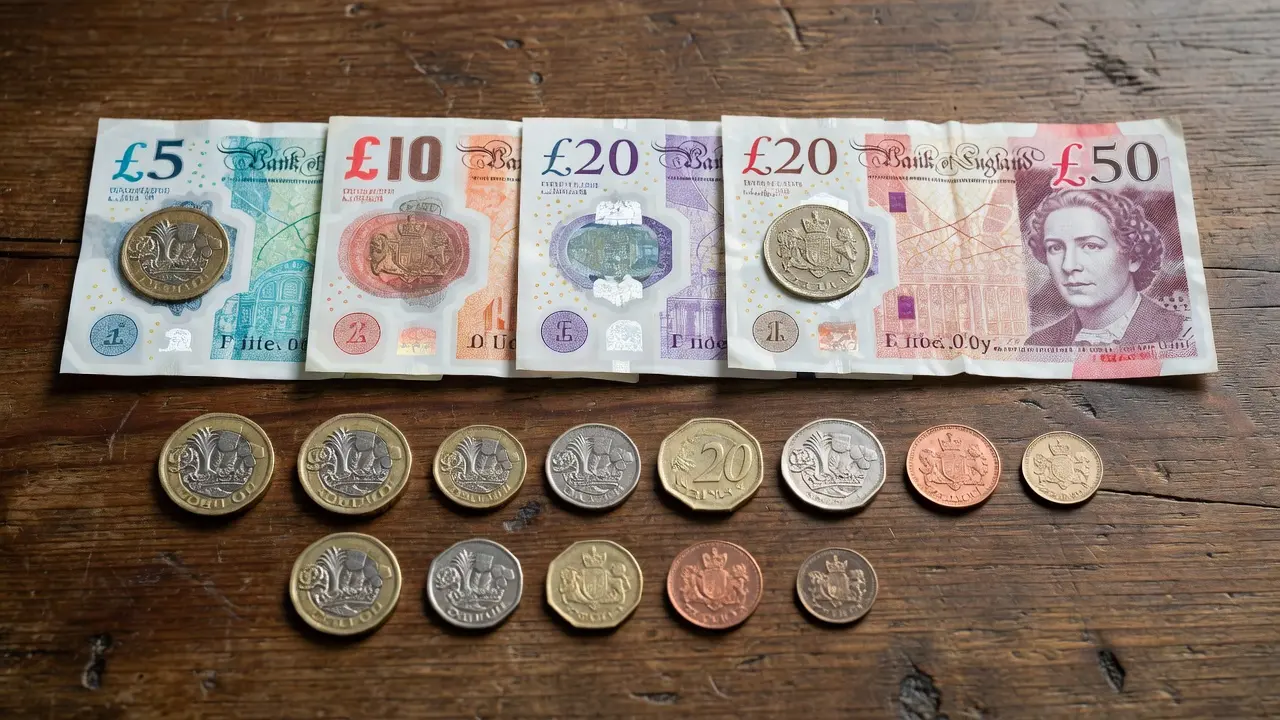
UK currency at a glance
The United Kingdom's currency is the pound sterling, shown with the sign £ and the ISO code GBP. One pound is 100 pence, written p (50p). The Bank of England, founded in 1694, is the central bank; it issues notes for England and Wales, while the Royal Mint makes the coins.
- Currency: pound sterling (often just "pound")
- Code and numeric code: GBP, 826
- Sign: £; pence written as p
- Bank of England notes: £5, £10, £20, £50
- Coins: 1p, 2p, 5p, 10p, 20p, 50p, £1, £2
- Central bank: Bank of England
- Exchange rate regime: floating
On 25 November 2026, £1 is worth 1.31 US dollars. Live rates against every currency are on the british pound exchange rate page. "Quid" is everyday slang for a pound, as in "ten quid", and the name sterling is mostly used in finance and news.
The £ sign comes from a stylised letter L for libra, the Latin word for a pound weight. Its history and keyboard shortcuts are on our pound sign page.
Bank of England banknotes in circulation
Four Bank of England notes are in circulation: £5, £10, £20 and £50, all polymer. Each shows the monarch on the front and a famous figure from British history on the back. Notes with Queen Elizabeth II and notes with King Charles III are both legal tender and circulate together.
| Note | Main colour | Figure on the back | Polymer issued |
|---|---|---|---|
| £5 | Turquoise and blue | Winston Churchill, wartime prime minister | September 2016 |
| £10 | Orange and brown | Jane Austen, novelist | September 2017 |
| £20 | Purple | J.M.W. Turner, painter | February 2020 |
| £50 | Red | Alan Turing, mathematician and computer pioneer | June 2021 |
The King Charles III notes keep the same designs, colours and figures; only the portrait and a few details changed. The Bank of England said it would print the new notes only to replace worn ones and meet demand, so Queen Elizabeth II notes will stay in circulation for years.
Paper £20 and £50 notes stopped being legal tender on 30 September 2022, following paper £5 and £10 notes in 2017 and 2018. They can no longer be spent in shops, but the Bank of England still exchanges them, including by post, and some UK banks accept them as deposits from their customers.
On 25 November 2026, the £50 note is worth 65.45 US dollars. Many smaller shops are wary of £50 notes and may refuse them, so £10 and £20 notes are easier for daily spending.
Scottish and Northern Irish notes
Seven commercial banks in Scotland and Northern Ireland are allowed to issue their own sterling banknotes. They are worth exactly the same as Bank of England notes, but they look completely different and are less familiar to shops in England.
- Scotland: Bank of Scotland, Royal Bank of Scotland and Clydesdale Bank.
- Northern Ireland: Bank of Ireland, AIB, Danske Bank and Ulster Bank.
These notes are backed by Bank of England funds held by the issuing banks. Technically they are "legal currency" rather than legal tender, which means shops anywhere can choose whether to accept them. In Scotland and Northern Ireland they are used every day; in England most large shops accept them, but some small businesses do not. The Royal Bank of Scotland still issues a £1 note, and some Scottish and Northern Irish banks issue £100 notes, denominations the Bank of England no longer prints.
Travellers leaving the UK should spend or exchange Scottish and Northern Irish notes before departure, because currency exchanges abroad often refuse them or give a lower rate.
British coins
Eight coins are in use: 1p, 2p, 5p, 10p, 20p, 50p, £1 and £2. The current £1 coin, introduced in March 2017, has twelve sides and two colours; the old round pound stopped being legal tender on 15 October 2017. Coins with King Charles III have been issued since December 2022, alongside coins with Queen Elizabeth II.
- 1p and 2p: copper-coloured, mostly used as change.
- 5p and 10p: small and large silver-coloured round coins.
- 20p and 50p: seven-sided silver-coloured coins. The 50p often carries special commemorative designs.
- £1: twelve-sided, gold-coloured outer ring and silver-coloured centre.
- £2: round, silver-coloured centre with a gold-coloured outer ring.
Cash use in the UK has fallen sharply. Contactless card and phone payments are accepted in most shops, pubs, taxis and on London buses, which have not taken cash since 2014. A traveller can spend a week in London with very little cash, though markets and some rural businesses still prefer it.
How to check a British banknote is real
To check a polymer Bank of England note, look at the see-through windows, tilt the note to see the holograms change, and feel the raised print. The Bank of England publishes these as the main security features on all its current notes.
- See-through window: a clear panel with the monarch's portrait printed on it, and on the £20 and £50 a second, smaller window.
- Holograms: metallic patches whose images change as you tilt the note.
- Raised print: the words "Bank of England" on the front feel rough; the £10 and higher notes also have tactile dots for blind and partially sighted users.
- Ultraviolet: under UV light, the number on the front glows in bright colours.
Polymer notes are harder to copy than the old paper ones. If a note feels like paper, it is either an old paper note, which shops no longer take, or a fake.
Where to exchange pounds and today's rate
The best rates for pound sterling are usually from banks, licensed currency exchange shops in city centres and cards without foreign transaction fees. Airport and hotel desks charge wider margins. Order currency online for collection if you need a large amount of cash before you travel.
Today's mid-market rate, dated 25 November 2026, is £1 = 1.31 US dollars. Compare every quote with this figure; a counter offering 4% less is taking 4 pounds on every 100 pounds you buy.
For readers in Vietnam, the pound is one of the main currencies that Vietnamese banks quote every day, and the gbp to vnd converter shows the live mid-market rate in dong. Bank buying and selling prices will differ from it by the bank's margin.
When paying by card in the UK, always choose to pay in pounds if the terminal asks. Paying in your home currency lets the shop's provider set the exchange rate, which is usually worse than your card's.
A short history of British money
Pound sterling is the oldest currency still in use. It dates back to Anglo-Saxon England, when 240 silver pennies weighed one pound of silver, and the name "sterling" may come from those silver pennies. For centuries a pound was 20 shillings and a shilling was 12 pence.
The UK switched to decimal currency on 15 February 1971, Decimal Day, when the pound became 100 new pence. Shillings disappeared, although the old one shilling and two shilling coins stayed in use for years as 5p and 10p.
The Bank of England stopped issuing £1 notes in 1984 and replaced them with the £1 coin, which itself was redesigned in 2017. The move from paper to polymer notes began in 2016 and finished in 2021 with the £50. After Queen Elizabeth II died in September 2022, the Bank and the Royal Mint began a gradual change to King Charles III.
The UK kept the pound when the euro was created in 1999. For a comparison with other popular currencies, our guides to japanese money and korean money follow the same format. Every currency is listed in our world currencies list, and you can convert any amount with the currency converter.






