
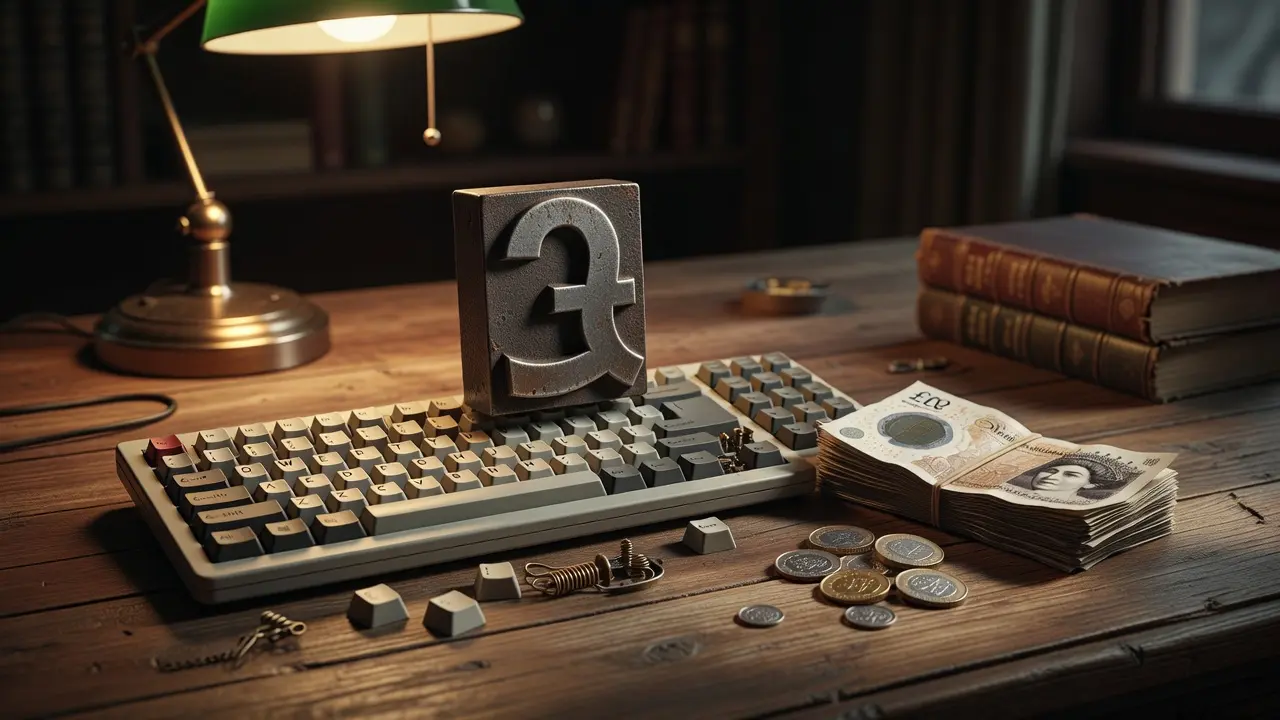
What the pound symbol looks like and what it means
The pound sign is a stylised capital L, usually written with a curl at the top and one or two horizontal strokes across the middle. Modern fonts and the Bank of England's banknotes use a single bar. It means pounds sterling, the money of the UK, and in British text it is read as "pounds".
Pence, the hundredths of a pound, use the letter p rather than a separate sign: 50p, 99p. A price under one pound is written either £0.75 or 75p, never £0.75p. In informal speech a pound is a "quid", so "ten quid" means £10, but the word is never written with the sign.
The symbol has a few close relatives that look similar and are easy to confuse:
- ₤ (U+20A4) is the lira sign, with two bars. It was used for the Italian lira before the euro and still appears in some older texts. It is a different character from £, although many people treat them as the same.
- # is called the "pound sign" in American English, because it was once used as an abbreviation for pounds of weight (lb). In the UK it is the hash sign.
- lb is the abbreviation for the pound as a unit of weight. It comes from the same Latin word libra.
The pound sign is one of the few currency signs that has its own key on a national keyboard, which is why British users rarely need shortcuts. The full list of signs for other currencies is on our page of money symbols.
Where the pound sign comes from
The pound sign comes from the Latin phrase librae pondo, "a pound by weight". Under the Anglo-Saxon kings, 240 silver pennies were struck from one pound of silver, so a pound of money and a pound of silver were the same. Accountants wrote "li" or "L" for libra, and the letter gained a bar to show it was an abbreviation.
For more than a thousand years British money was counted as pounds, shillings and pence, written £sd or Lsd after the Latin libra, solidus and denarius. A pound was 20 shillings and a shilling 12 pence, so a price of one pound, five shillings and sixpence was written £1 5s 6d.
The switch to decimal currency on 15 February 1971 kept the pound and the £ sign but replaced shillings and old pence with 100 new pence. Since then the letter p has stood for pence, and "d" for old pence has dropped out of use.
The sign was in early typewriter and computer character sets in the UK. It is code 163 in the Latin-1 and Windows-1252 character sets, which is why Alt+0163 still works on Windows, and Unicode keeps it at the same position, U+00A3. The euro and dollar have their own histories, covered in our guides to the euro sign and the dollar symbol.
How to type the pound sign on Windows, Mac, iPhone and Android
On a UK keyboard, press Shift+3. On a US keyboard in Windows, hold Alt and type 0163 on the number pad; on a US Mac, press Option+3. On iPhone and Android, open the number keyboard and hold the $ key until £ appears. In HTML, write £ or £.
| Device or format | How to type £ |
|---|---|
| Windows, UK keyboard | Shift+3 |
| Windows, US keyboard with number pad | Hold Alt, type 0163 on the number pad, release Alt |
| Windows, US International layout | AltGr+Shift+4 |
| Microsoft Word | Type 00A3, then press Alt+X |
| Mac, US layout | Option+3 |
| Mac, UK layout | Shift+3 |
| Linux (GNOME, KDE) | Ctrl+Shift+U, then a3, then Space or Enter |
| iPhone and iPad | Tap 123, hold $, choose £ |
| Android (Gboard) | Tap ?123, hold $, choose £ |
| HTML | £ or £ |
| Unicode | U+00A3 |
| CSS content | "\00A3" |
A common problem is a UK keyboard that types # instead of £ when you press Shift+3. That means Windows is set to a US layout. Switch the input language to English (United Kingdom) in Settings, or press Windows key + Space to cycle between layouts.
Laptops without a number pad will not accept Alt+0163. Use the symbol panel (Windows key + full stop, then the Ω tab), or copy the sign from here: £.
In Excel and Google Sheets, apply the Currency format and choose £ English (United Kingdom). The sign then appears before every value and the numbers still add up, which they do not if you type £ into the cell as text.
Where to put the pound symbol: before or after the amount
In British and international English, the pound symbol goes directly before the amount with no space: £5, £1,250.50. Pence amounts under a pound are usually written with a p after the number and no space: 50p. Writing the sign after the number, as in 5£, is wrong in English.
Other conventions follow from that rule:
- Large sums use commas for thousands and a full stop for decimals: £2,500,000 or £2.5m.
- Whole pounds can drop the decimals: £20 rather than £20.00, unless the document lists other amounts with pence.
- Ranges repeat the sign: £10 to £20, or £10-£20.
- Negative amounts in accounts put the minus before the sign or use brackets: -£50 or (£50).
Languages that normally write currency signs after the number, such as French and German, still often put £ after it in their own texts: 25 £. A British reader understands both, but British style guides use £25.
A worked example with an assumed rate: if £1 = 1.30 USD, a hotel bill of £180 is about $234. Written for a British guest it is £180; written in an invoice for a US company it would usually be GBP 180.00, so the currency is unmistakable.
GBP symbol vs ISO code: when to use which
Use the £ sign for prices shown to people in the UK, such as shop labels, menus, websites and receipts. Use the ISO code GBP in banking, invoices to other countries, contracts, spreadsheets with several currencies and payment systems, because the code is unique and £ is shared by other pounds.
People often search for a "gbp symbol", but GBP itself is the code, not a symbol. It follows the ISO 4217 pattern: GB for Great Britain and P for pound. The numeric code is 826. You may also see:
- Sterling or "stg", used in financial news and on foreign exchange desks.
- Cable, traders' nickname for the GBP/USD exchange rate, from the transatlantic telegraph cable once used to send its price.
- GBp or GBX, used on stock exchanges to show prices in pence rather than pounds. A share price of 250 GBX is £2.50.
- UKP, which is not an ISO code but appears in some old systems.
Exchange rate tables always use codes, such as GBP/USD or GBP/INR. Our british pound exchange rate page lists sterling against every currency. For two of the most searched pairs, see pound to inr and gbp to vnd.
Currencies that use the British pound symbol
The British pound symbol £ is used by the pound sterling and by several currencies called pound. Some are fixed one-to-one to sterling, while others are separate currencies with their own value, which is why the code matters when prices could be in either.
| Currency | Code | How it relates to sterling |
|---|---|---|
| Pound sterling | GBP | The UK currency |
| Gibraltar pound | GIP | Fixed at par with sterling |
| Falkland Islands pound | FKP | Fixed at par with sterling |
| Saint Helena pound | SHP | Fixed at par with sterling |
| Egyptian pound | EGP | Separate currency, often written E£ |
| Lebanese pound | LBP | Separate currency, often written LL |
| Syrian pound | SYP | Separate currency, often written £S |
| South Sudanese pound | SSP | Separate currency |
Jersey, Guernsey and the Isle of Man issue their own pound notes and coins. They are local issues of sterling, not separate ISO currencies, and are worth exactly the same. Our guide to british money covers Bank of England, Scottish and Northern Irish notes.
Every currency's code and sign is in our world currencies list, and you can convert pounds to any currency with the currency converter.






