
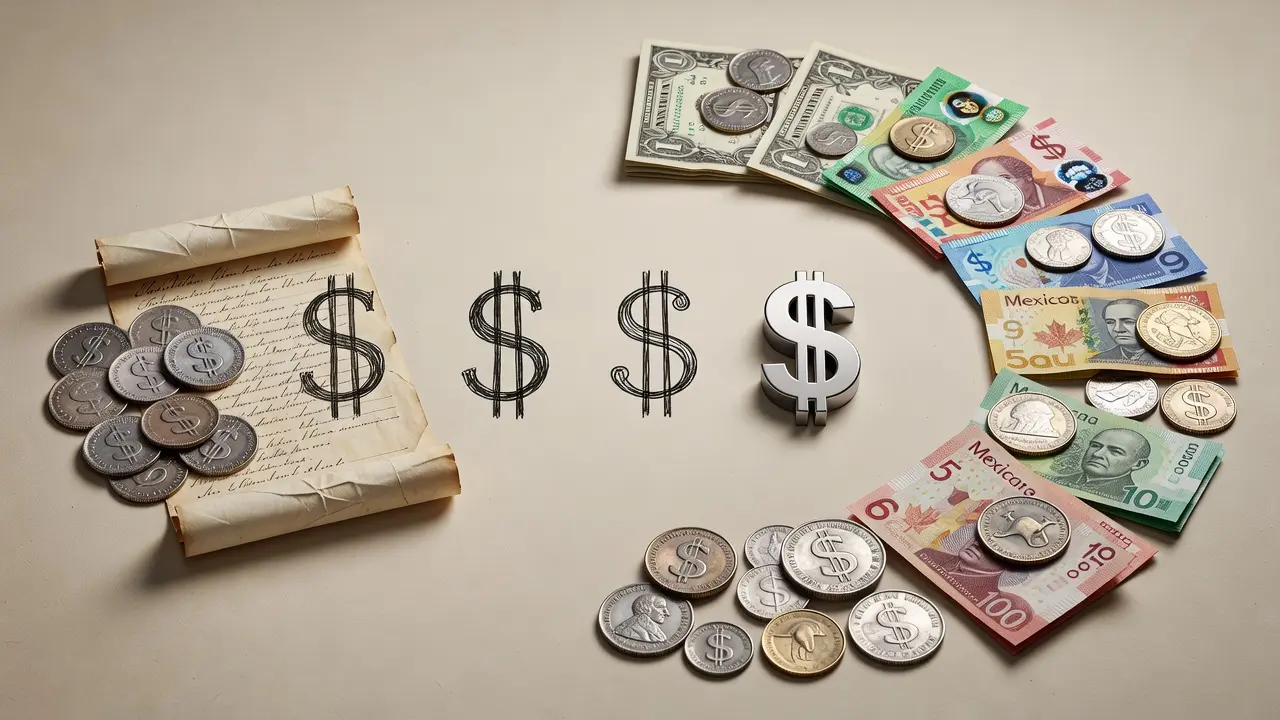
What the dollar symbol looks like and what it means
The dollar symbol is a capital S with one vertical stroke through it, or sometimes two. Both forms mean the same thing in modern use; fonts choose one or the other. It means "dollars" in English-speaking countries and "pesos" in much of Latin America.
The two-stroke form has a separate name in Portuguese, the cifrão. It was used for the Portuguese escudo and the old Brazilian currencies, and Brazil's real is written R$ today. Unicode does not encode the two-stroke version separately, so it depends on the font.
In everyday English, $ is often called a money sign, and it appears far beyond prices: in programming languages, in spreadsheet cell references such as $A$1, and in slang spellings. In each of these uses the character is the same U+0024, even though it has nothing to do with currency.
The cent sign ¢, a c with a line through it, is the dollar's companion for amounts under one dollar, as in 99¢. It is common on US price tags but rarely used elsewhere.
Where the dollar sign comes from
The dollar sign most likely developed from "ps", the abbreviation merchants used for the Spanish peso, also called the Spanish dollar or piece of eight. Written quickly, the p and s merged, and the loop of the p became a vertical line through the s. Spanish dollars were the main silver coin in British North America, so the abbreviation came into English use with them.
By the 1770s the sign appears in American business letters and account books. The merchant Oliver Pollock is often credited with an early use in 1778. The US Congress adopted the dollar as the national unit in the Coinage Act of 1792, and the sign followed the name.
Several other stories about the sign are popular but have no good evidence behind them. One claims it comes from the letters U and S placed on top of each other; that cannot be right, because the sign was in use before the United States existed. Another links it to the Pillars of Hercules on Spanish coins, which show two columns wrapped in a banner. That design may have influenced the two-stroke form, but the "ps" explanation is the one most historians accept.
The word dollar itself is older than the sign. It comes from the thaler, a silver coin first minted in the 16th century in Joachimsthal, in what is now the Czech Republic. English speakers used "dollar" for any large silver coin, including the Spanish peso, which is how the name reached America.
For the origins of other signs, see our guide to the british pound symbol and the page Yen ¥ vs Yuan ¥: Same Symbol, Two Currencies.
Currencies that use the dollar sign
More than 20 currencies use the dollar sign, including the US, Canadian, Australian, New Zealand, Singapore, Hong Kong and Taiwan dollars, and the Mexican, Chilean, Colombian and Argentine pesos. Several more countries, such as Ecuador, El Salvador and Timor-Leste, use the US dollar itself as their currency.
| Currency | Code | Common prefix |
|---|---|---|
| US dollar | USD | US$ or $ |
| Canadian dollar | CAD | C$ or CA$ |
| Australian dollar | AUD | A$ or AU$ |
| New Zealand dollar | NZD | NZ$ |
| Singapore dollar | SGD | S$ |
| Hong Kong dollar | HKD | HK$ |
| New Taiwan dollar | TWD | NT$ |
| Brunei dollar | BND | B$ |
| Mexican peso | MXN | Mex$ or $ |
| Chilean peso | CLP | CLP$ or $ |
| Colombian peso | COP | COL$ or $ |
| Argentine peso | ARS | AR$ or $ |
| Jamaican dollar | JMD | J$ |
| East Caribbean dollar | XCD | EC$ |
| Fijian dollar | FJD | FJ$ |
| Brazilian real | BRL | R$ |
Countries that adopted the US dollar write prices with the plain $ and mean US dollars. Ecuador switched to the dollar in 2000 and El Salvador in 2001; Panama uses the dollar alongside its own balboa coins.
Inside each country, the bare $ is normal: a price of $5 in Sydney means Australian dollars, and $5 in Mexico City means pesos. The prefix matters only when readers could be in more than one country, such as on international websites, in travel guides and in invoices.
A worked example with assumed rates shows why. If 1 USD = 1.38 CAD = 1.52 AUD, then "$1,000" is 1,000 US dollars to an American, about 725 US dollars to a Canadian reading it as Canadian dollars, and about 658 US dollars to an Australian. Writing US$1,000 or USD 1,000 removes the doubt.
How to type the dollar sign on Windows, Mac, iPhone and Android
The dollar sign is on the 4 key of almost every keyboard: press Shift+4 on Windows, Mac and Linux. On phones it is on the number keyboard. In HTML, type it directly or use $ or the HTML5 entity $.
| Device or format | How to type $ |
|---|---|
| Windows, Mac, Linux (most layouts) | Shift+4 |
| Windows Alt code | Alt+36 on the number pad |
| UK keyboard | Shift+4 |
| iPhone and iPad | Tap 123, then $ |
| Android (Gboard) | Tap ?123, then $ |
| HTML | $, $ or $ |
| Unicode | U+0024 |
| Cent sign ¢ | Alt+0162 on Windows, Option+4 on Mac |
On some European keyboards the 4 key shows a different symbol, but $ is still available, usually with Shift+4 or AltGr+4. On a phone keyboard set to another country, the main currency key may show €, £ or ₫; hold it down to reach $.
In Excel and Google Sheets, choose the Currency format to add $ automatically. Typing $ yourself inside a formula has a different meaning: it fixes a cell reference, so =$A$1 always points to cell A1 when copied.
Where to put the dollar sign: before or after the amount
In English, the dollar sign goes before the amount with no space: $5, $1,250.50. French-speaking Canada writes it after the amount with a space, 1 250,50 $, and Spanish-speaking countries usually put it before, sometimes with a space: $ 1.250,50.
- Large amounts: $2.5 million, $2.5M or $2,500,000. Write "$2.5 million", not "$2.5 million dollars".
- Ranges: $10 to $20, or $10-$20.
- Negative values in accounts: -$50 or ($50).
- Cents: $0.99 or 99¢, but never $0.99¢.
The decimal separator changes with the language. A US price of $1,250.50 appears as $1.250,50 in many Latin American countries. In international documents, the safest form is the ISO code before the number with English separators: USD 1,250.50.
Dollar sign vs ISO code: when to use which
Use the dollar sign for prices shown to people in one country, such as shop labels, menus and local websites. Use ISO codes such as USD, CAD and AUD in banking, invoices, contracts and anywhere several dollar currencies could appear, because the codes are unique and the sign is not.
ISO 4217 codes follow a pattern: two letters for the country and one for the currency. US + D is the US dollar, CA + D the Canadian dollar, AU + D the Australian dollar. Exchange rate tables always use them: USD/VND, AUD/USD. Our us dollar exchange rate page lists the dollar against every currency. Two of the most searched pairs are 1 dollars in rupees and 100 usd to vnd.
Signs and codes for every currency are in the Currency Symbols of the World: Full List (with Copy & Paste) and our world currencies list. To convert any dollar amount, use the currency converter.






