
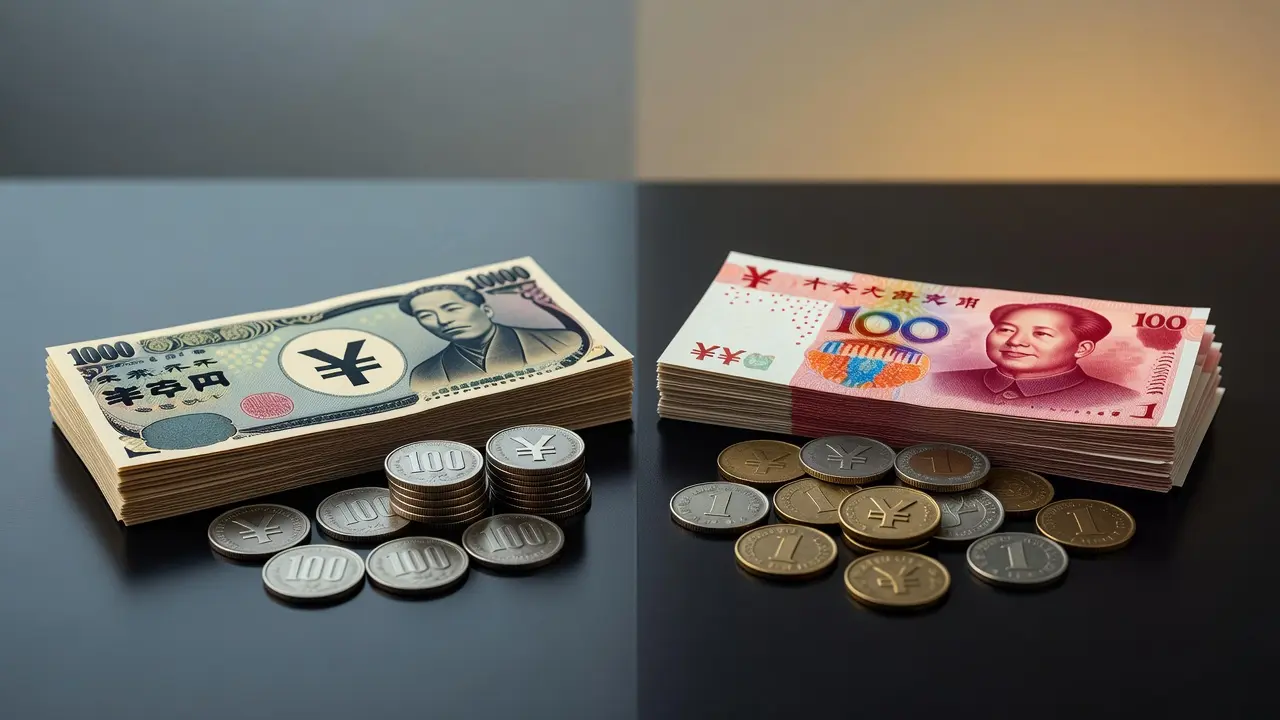
What the yen and yuan symbols look like
The Japanese yen symbol and the Chinese yuan symbol are both a capital Y crossed by horizontal lines. Japan usually shows one or two bars depending on the font; China generally uses two bars, and Chinese input methods often produce a full-width version, ¥ (U+FFE5). All of these mean the same thing to a reader in each country: their own currency.
| Form | Character | Unicode | Where you see it |
|---|---|---|---|
| Yen/yuan sign | ¥ | U+00A5 | International text, both currencies |
| Full-width yen/yuan sign | ¥ | U+FFE5 | Chinese and Japanese text typed with Asian input methods |
| Japanese yen character | 円 | U+5186 | Prices and signs in Japan |
| Chinese yuan character | 元 | U+5143 | Prices and signs in China |
| Formal/traditional character | 圓 | U+5713 | Banknotes and formal writing in Taiwan and Hong Kong |
The Korean won uses a different sign, ₩, although its name comes from the same character. That story is told in Korean Won Symbol ₩, KRW Code and Banknotes.
Why Japan and China share the ¥ sign
Japan and China share the ¥ sign because both currency names come from the Chinese character 圓 (or its simpler form 元), meaning "round" or "round coin". In Japanese the character is read en, written 円 today; in Mandarin Chinese it is read yuán. The Latin letter Y, crossed to mark it as money, became the sign for both.
The spelling "yen" comes from older European romanisations of Japanese, which wrote the sound as "yen" although modern Japanese pronounces it "en". The yen was created in 1871. China's modern yuan dates from the founding of the renminbi system in 1948 to 1949, and the same character had been used for silver dollars in China long before that.
The ISO codes tell them apart where the sign cannot. JPY is the yen and CNY is the yuan. Banks, airlines and payment systems always use these codes, and international websites often write JP¥ and CN¥ when they need a sign.
Yen vs yuan: how to tell prices apart
The quickest way to tell yen from yuan on a price is to look at the country, the character after the number and the size of the number. A price of ¥980 for lunch is normal in Japan; in China, ¥980 is an expensive dinner. Chinese prices often end in 元 or use the colloquial 块 (kuài), while Japanese prices end in 円.
- Country and language: a Japanese website or receipt means yen; a Chinese one means yuan.
- Native character: 円 means yen, 元 means yuan.
- Code: JPY or CNY on invoices, card statements and booking sites.
- Size: the yuan is worth many times more than the yen, so yuan prices have fewer digits for the same goods.
A worked example with an assumed rate: if 1 CNY = 21 JPY, a ¥1,000 hotel night in Shanghai is about ¥21,000 in Japanese terms. Reading a Chinese price as yen would make it look 21 times cheaper. Live rates for both are on the japanese yen exchange rate and chinese yuan exchange rate pages.
Card statements are the most common place for confusion. If you see a charge in "¥" with no code, check the merchant's country. Our page on how to do the currency calculator maths by hand shows how to convert either one.
Renminbi, yuan, CNY and CNH
China's currency is officially the renminbi (RMB), meaning "people's currency", and the yuan is its unit, in the same way that sterling is the currency and the pound its unit. Prices are quoted in yuan; the currency as a whole is called renminbi. The ISO code is CNY.
You may also see CNH, used in markets for yuan traded outside mainland China, mainly in Hong Kong. It is not an ISO code and usually trades very close to CNY. Hong Kong and Macau have their own currencies, the Hong Kong dollar and the pataca, and Taiwan uses the New Taiwan dollar, written NT$ but also called yuan (元) in Chinese.
A yuan is divided into 10 jiao (角, colloquially mao) and 100 fen (分). A yen has no subunit in use; the sen and rin disappeared from payments in 1953.
How people pay also differs. In Japan, cash and IC cards such as Suica are still common, so the ¥ sign appears on price tags, receipts and ticket machines everywhere. In China, most payments in cities go through mobile apps such as Alipay and WeChat Pay, which show amounts with ¥ or 元 on screen. Both apps have allowed visitors to link foreign cards since 2023, which makes the yuan amount and the converted charge on your card statement easy to compare.
How to type the yen symbol and 円, 元
On Windows, type ¥ with Alt+0165 on the number pad; on a Mac, press Option+Y. On a Japanese keyboard the ¥ key sits where the backslash key is on US layouts. Japanese input methods turn "en" into 円, and Chinese input methods turn "yuan" into 元 and Shift+4 into ¥.
| Device or format | How to type |
|---|---|
| Windows, US keyboard | Alt+0165 for ¥ |
| Mac, US keyboard | Option+Y for ¥ |
| Japanese keyboard | The ¥ key; type "en" in Japanese input for 円 |
| Chinese Pinyin input | Type "yuan" and choose 元; Shift+4 gives ¥ |
| iPhone and Android | Hold the $ key on the number keyboard, choose ¥ |
| HTML | ¥ or ¥ |
| Unicode | U+00A5 (¥), U+5186 (円), U+5143 (元) |
One quirk: on many Japanese computers, the backslash character in file paths and code is displayed as ¥ because of the old Japanese character set. A Windows path such as C:\Users may appear as C:¥Users on Japanese systems. The character underneath is still a backslash.
Where to put the yen and yuan symbols
Both Japan and China put ¥ before the number with no space: ¥1,500. When the native character is used, it goes after the number: 1,500円 or 1500元. Writing both together, such as ¥1,500円, repeats the currency and should be avoided. Decimals are rare in Japan, where prices are whole yen, but Chinese prices can include jiao, as in ¥12.50.
- Japan: ¥1,500 or 1,500円. Large sums are often written with 万 (10,000): 3万円 is ¥30,000.
- China: ¥1,500 or 1500元. Large sums use 万 and 亿 (100 million).
- English documents: JPY 1,500 or CNY 1,500, which removes any doubt.
Units of ten thousand make large amounts look different from English: 100万円 is one million yen. Other number shortcuts, from grand to lakh, are covered in our guide to what is a grand and other money units.
Symbol vs ISO code: when to use which
Use ¥ or the native character for prices shown to customers in Japan or China. Use JPY or CNY in invoices, contracts, booking systems and anywhere both currencies might appear, because the shared sign cannot tell them apart.
The rest of the world's signs are listed in our page of currency symbols, and the dollar's own shared sign is explained in the guide to the dollar sign. For the yen's notes and coins, see Japanese Yen Guide: Banknotes, Coins and Value. Every currency's code is in our world currencies list, and you can convert yen or yuan with the currency converter.






