
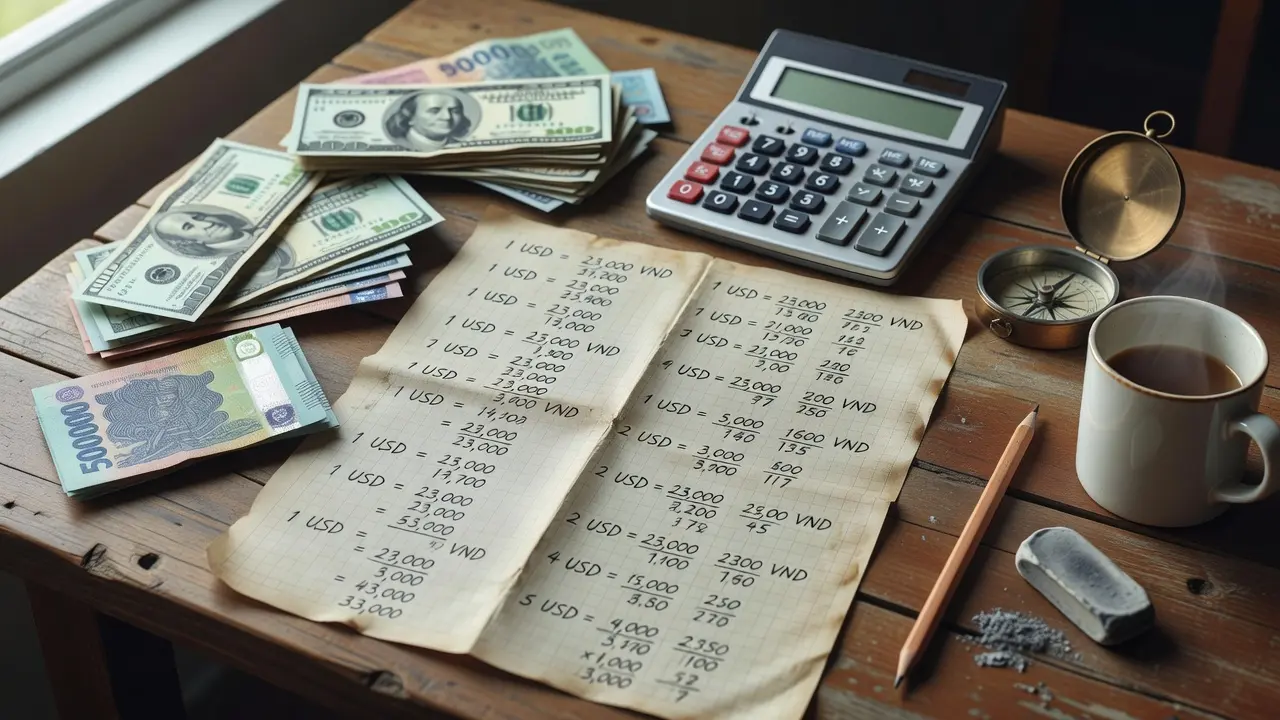
How do you calculate an exchange rate conversion?
To calculate a currency conversion, first read the rate as "1 unit of the first currency = X units of the second". To convert from the first currency to the second, multiply by X. To convert from the second currency back to the first, divide by X. Every currency calculator does exactly this.
The currency conversion formula in its two forms:
- Amount in B = amount in A × rate (when the rate is B per 1 A)
- Amount in A = amount in B ÷ rate
The code order shows which way the rate runs. USD/VND = 26,000 means 1 US dollar = 26,000 dong. EUR/USD = 1.10 means 1 euro = 1.10 dollars. If you are not sure, check that the answer makes sense: converting dollars to dong should give a much bigger number, and converting dong to dollars a much smaller one. The idea of a rate itself is explained in our guide to exchange rate meaning.
Four worked examples
The examples use assumed rates so the arithmetic is easy to check; use the live converter for real amounts. Each one shows the rate, the operation and the result.
Example 1: dollars to dong
Assumed rate: 1 USD = 26,000 VND. Converting $250: 250 × 26,000 = 6,500,000 dong. The live figure for any amount is on the 1 usd to vnd page.
Example 2: dong to yen
Assumed rate: 1 JPY = 170 VND. Converting 3,400,000 dong to yen: 3,400,000 ÷ 170 = 20,000 yen. Because the rate is quoted as dong per yen, going from dong to yen is a division. See jpy to vnd for today's rate.
Example 3: euros to dollars
Assumed rate: EUR/USD = 1.10. A €80 dinner costs 80 × 1.10 = $88. To go the other way, $88 ÷ 1.10 = €80. The same rate quoted the other way round is USD/EUR = 1 ÷ 1.10 = 0.909.
Example 4: rupees in lakh to dollars
Assumed rate: 1 USD = 85 INR. A salary of 12 lakh rupees is ₹12,00,000; divided by 85, that is about $14,118. Indian number units are explained in our guide to lakh to usd conversions.
How to calculate a cross rate
A cross rate is the exchange rate between two currencies worked out from their rates against a third, usually the US dollar. To get yen per won, for example, divide the yen per dollar rate by the won per dollar rate. Banks use this method for pairs that are rarely traded directly.
The formula: if 1 USD = A units of currency X and 1 USD = B units of currency Y, then 1 X = B ÷ A units of Y.
A worked example with assumed rates: 1 USD = 1,380 KRW and 1 USD = 26,000 VND. Then 1 KRW = 26,000 ÷ 1,380 = about 18.84 VND. A ₩50,000 note is therefore about 942,000 dong. The full method, including how bank margins stack in a cross rate, is in Cross Rates: How to Convert Between Two Non-USD Currencies.
How to find the hidden fee in an exchange rate
The hidden fee in any exchange is the gap between the rate you are offered and the mid-market rate. Divide the offered rate by the mid-market rate and subtract the result from 1: the answer is the percentage you are paying. Add any fixed fee to get the total cost.
A worked example: the mid-market rate is 1 USD = 26,000 VND and a counter buys dollars at 25,480. 25,480 ÷ 26,000 = 0.98, so the hidden cost is 2%. On $500, that is $10, or 260,000 dong, even if the counter advertises "no fee".
The same check works when you buy foreign currency. If a bank sells yen at 176 dong when mid-market is 170, divide 170 by 176: 0.966, a cost of about 3.4%.
| Term | What it means | Used for |
|---|---|---|
| Mid-market rate | Midpoint between buying and selling prices in the market | Benchmark for any calculation |
| Buying rate | Rate at which a bank buys foreign currency from you | Selling dollars or yen for dong |
| Selling rate | Rate at which a bank sells foreign currency to you | Buying dollars or yen with dong |
| Cross rate | Rate between two currencies, calculated via a third | Pairs such as KRW/VND or JPY/INR |
| Spread | Gap between buying and selling rates | Measuring a bank's margin |
For a wider look at why rates differ between banks, apps and websites, and how foreign exchange is priced, see our other guides.
Quick mental shortcuts for travellers
Mental shortcuts let you check prices without a phone: round the rate to an easy number, then multiply or divide. The answer will be close enough to judge whether a price is fair.
| Assumed rate | Shortcut | Example |
|---|---|---|
| 1 USD = 26,000 VND | Dong to dollars: drop three zeros, divide by 26 | 520,000 VND ≈ 520 ÷ 26 = $20 |
| 1 JPY = 170 VND | Yen to dong: multiply by 170, or yen × 0.17 = thousand dong | ¥1,000 ≈ 170,000 VND |
| 1 USD = 150 JPY | Yen to dollars: divide by 150, or drop two zeros and divide by 1.5 | ¥3,000 ≈ $20 |
| 1 EUR = 1.10 USD | Euros to dollars: add 10% | €50 ≈ $55 |
| 1 USD = 85 INR | Rupees to dollars: divide by 85, or by 100 and add 18% | ₹1,000 ≈ $11.8 |
Japanese prices often use the unit man (万, 10,000), so 3万円 is ¥30,000; our guide to the currency of japan covers it. The ¥ sign is shared with the Chinese yuan, so check the country before converting; see the yen symbol page.
What it means for travellers, senders and savers
For travellers, doing the sum by hand is a quick test of any offer: if the shop or counter rate is more than 3% worse than mid-market, look elsewhere. For people sending money, comparing the amount received at two providers is a division and a subtraction. For savers holding foreign currency, the same arithmetic shows the break-even point: with a 2% spread each way, the currency must rise about 4% before you gain. Writing the rate, the amount and the result on a note before you pay also makes it easy to check your card statement later.
Common mistakes and how to avoid them
The most common mistake is multiplying when you should divide. If converting dollars to dong gives you a small number, or dong to dollars gives a huge one, the operation is the wrong way round.
- Using the wrong rate: a bank's buying rate applies when you sell currency, its selling rate when you buy.
- Mixing number formats: 1.250 is one thousand two hundred fifty in Vietnam and one and a quarter in English.
- Rounding too early in a cross rate: keep four decimal places until the final step.
- Forgetting fixed fees: on small amounts, a $5 fee can cost more than the rate margin.
For exact figures with live rates, use the currency converter, which applies the same formula automatically.






