
What does foreign currency mean?
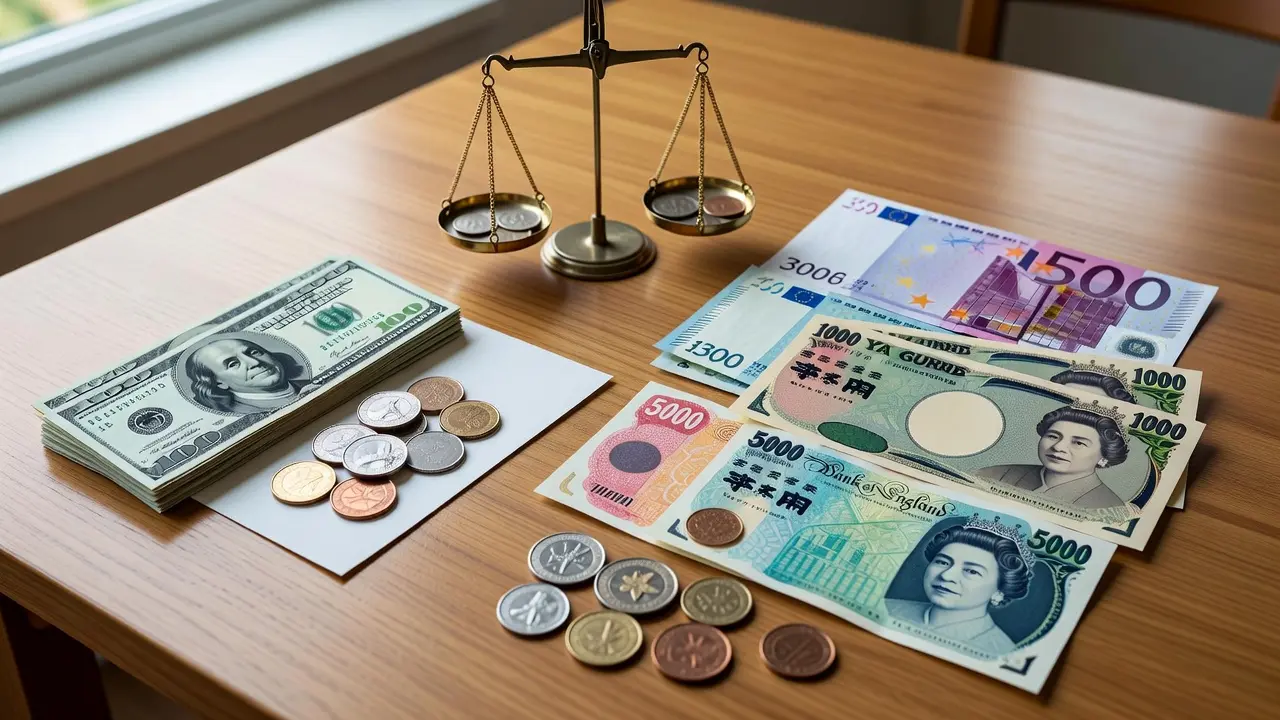
Foreign currency means money that is not the legal currency of your own country. It includes banknotes and coins, but also balances in bank accounts, cards and transfers denominated in another currency. Whether a currency is "foreign" depends on where you stand: the yen is domestic in Japan and foreign everywhere else.
In accounting, the idea is the same at company level. A Vietnamese company that keeps its books in dong treats any invoice in dollars or euros as a foreign currency transaction and converts it at an exchange rate on the transaction date.
A hard currency, sometimes called a strong foreign currency, is one that is freely convertible, widely held as a reserve and stable over time. The five currencies in the International Monetary Fund's Special Drawing Right basket are the US dollar, euro, Chinese yuan, Japanese yen and British pound.
How foreign currency is priced: a worked example
Foreign currency is priced by the exchange rate, which says how many units of your currency one unit of the foreign currency costs. Banks quote two prices, one for buying and one for selling, around the market midpoint known as the mid-market rate.
A worked example with assumed rates: the mid-market rate is 1 USD = 26,000 VND. A bank buys dollars from customers at 25,850 and sells them at 26,250. If you sell $200 you receive 5,170,000 dong; if you buy $200 you pay 5,250,000 dong. The 80,000 dong gap is the bank's margin on a round trip.
The way exchange rates are set and quoted is explained in What Is an Exchange Rate? How Currency Conversion Works, and the arithmetic of converting any amount is in our guide on how to convert currency.
Foreign currency vs foreign exchange and forex
Foreign currency is the money itself; foreign exchange is the act or market of swapping one currency for another. The forex meaning is the same as foreign exchange: "forex" and "FX" are short forms used by banks and traders. The table sets out related terms.
| Term | Meaning | Example |
|---|---|---|
| Foreign currency | Money of another country | US dollars held by someone in Vietnam |
| Foreign exchange (FX, forex) | Converting one currency into another, or the market where it happens | Selling dollars for dong at a bank |
| Exchange rate | The price of one currency in another | 1 USD = 26,000 VND (assumed) |
| Hard currency | A widely accepted, freely convertible currency | USD, EUR, JPY, GBP, CHF |
| Local currency | The legal currency of the country you are in | Dong in Vietnam, baht in Thailand |
What it means for travellers, senders and savers
For travellers, foreign currency is something to buy as cheaply as possible and spend before going home, because selling it back usually costs more. For people receiving money from abroad, it is often worth comparing whether to take it in dollars or local currency. For savers, holding foreign currency adds exchange rate risk: its value in your own money rises and falls every day.
Rules differ by country. In Vietnam, individuals may buy and sell foreign currency only at licensed banks and foreign currency agents, and buying it requires a permitted purpose such as study, medical treatment or travel. Trading at unlicensed places, such as many gold shops, can be fined and the currency confiscated.
Common mistakes with foreign currency
The most common mistake is exchanging at the first counter you see, often at an airport, where the margin can be several times higher than at a bank in town. Compare the offered rate with the mid-market rate before you hand over money.
- Paying by card in your home currency abroad, which lets the shop's provider set a worse rate.
- Keeping large amounts of foreign cash at home, where it earns nothing and can be lost.
- Selling to unlicensed dealers because their rate looks better, despite the legal risk.
- Forgetting that coins can rarely be sold back outside their own country.
To check what any amount is worth at today's mid-market rate, use the currency converter.






