
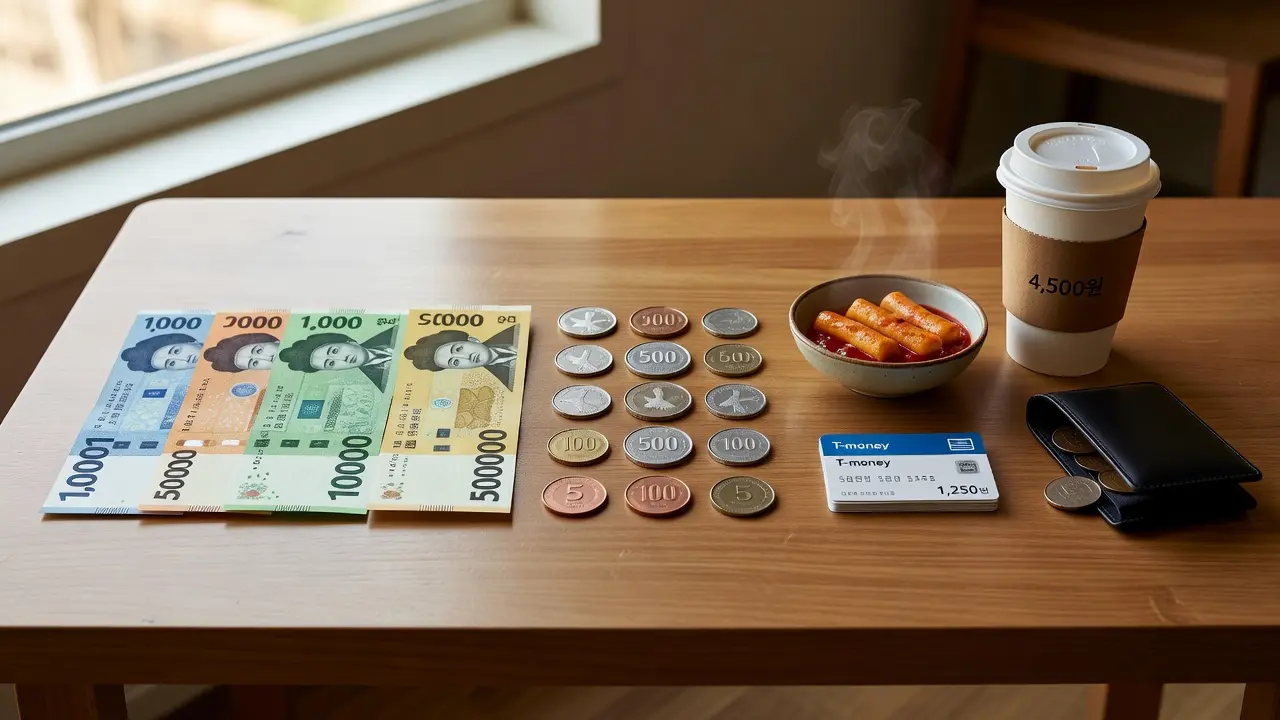
Korean money at a glance
South Korea's currency is the won (원), shown with the sign ₩ and the ISO code KRW. The Bank of Korea, the central bank founded in 1950, issues all notes and coins and sets monetary policy. The won is divided into 100 jeon, but jeon have not been used in daily payments for decades.
- Currency: South Korean won
- Code and numeric code: KRW, 410
- Sign: ₩ (in Korean text, 원 after the number)
- Banknotes: ₩1,000, ₩5,000, ₩10,000, ₩50,000
- Coins in use: ₩10, ₩50, ₩100, ₩500
- Issuer: Bank of Korea
- Exchange rate regime: floating
On 25 November 2026, one won is worth 0.0007 US dollars. For live rates against every currency, see the south korean won exchange rate page. The origin of the ₩ sign and how to type it are covered on our krw symbol page.
Won banknotes in circulation
There are four won banknotes in circulation, each with a historical figure from the Joseon dynasty on the front. The ₩10,000 note is the one people handle most. The ₩50,000 note, issued in June 2009, is the largest and the first to show a woman.
| Note | Main colour | Portrait | Who they were | Current series |
|---|---|---|---|---|
| ₩1,000 | Blue | Yi Hwang (Toegye) | Confucian scholar of the 16th century | 2007 |
| ₩5,000 | Orange and red | Yi I (Yulgok) | Confucian scholar and statesman | 2006 |
| ₩10,000 | Green | King Sejong the Great | Fourth Joseon king, who created the Hangul alphabet | 2007 |
| ₩50,000 | Yellow | Shin Saimdang | Artist and calligrapher, mother of Yi I | 2009 |
The notes grow in size with their value, so you can tell them apart by touch as well as colour. Shin Saimdang and Yi I were mother and son, so the ₩50,000 and ₩5,000 notes form a family pair.
Older series of these notes, from before 2006, are still legal tender and can be exchanged at the Bank of Korea or commercial banks, but you will rarely see them in change.
A quick sense of scale: a ₩10,000 note is worth 7.44 dollars today, and the 10000 won to usd figure for any amount is on our 10000 won to usd converter. Larger sums such as salaries are explained on our page about 2 million won to usd and other big amounts.
Korean coins
Four coins are in everyday use: ₩10, ₩50, ₩100 and ₩500. The ₩500 coin, worth less than half a US dollar, is the most useful for vending machines and lockers. The ₩1 and ₩5 coins still exist as legal tender but are no longer made for circulation.
- ₩10: the Dabotap pagoda of Bulguksa temple in Gyeongju. Since 2006 it has been a small copper-coloured coin, after an older larger version.
- ₩50: an ear of rice.
- ₩100: Admiral Yi Sun-sin, the naval commander famous for his turtle ships.
- ₩500: a red-crowned crane.
Coins matter less every year. The Bank of Korea has run trials of a "coinless" system in which shops add small change to a prepaid card instead of handing back coins.
What things cost in Korea
Prices in Korea are written in won without decimals, usually with a comma for thousands (₩4,500) or with 원 after the number. Two official figures give a sense of scale: a Seoul subway ride and the minimum wage.
The adult base fare on the Seoul metropolitan subway rose to ₩1,550 on 28 June 2025 when paid with a transport card such as T-money. That is about 1.15 US dollars today. The 2026 minimum wage, set by Korea's Minimum Wage Commission, is ₩10,320 an hour, or ₩2,156,880 a month for a full-time worker. An hour of work at the minimum wage pays for about six subway rides.
Card payment is normal for almost any amount, including a single coffee. Taxis, convenience stores and most restaurants take foreign cards, though some small market stalls prefer cash or local transfers. A T-money card, sold and topped up at convenience stores and subway stations, pays for subways, buses and many taxis, and is the easiest way to avoid carrying coins.
How to check a won note is real
To check a won note, hold it to the light for the portrait watermark, tilt it to see the hologram and colour-shifting number change, and run a finger over the portrait to feel the raised ink. The Bank of Korea lists these as the main features on every current note.
- Watermark: a faint copy of the portrait in the blank area, visible from both sides against light.
- Hologram: on the ₩5,000, ₩10,000 and ₩50,000 notes, a shiny patch or strip that changes image as you tilt the note.
- Colour-shifting ink: the number on the back of the higher notes changes colour when tilted.
- Security thread: a thin line embedded in the paper; on the ₩50,000 note it is a wide strip whose pattern moves as you tilt the note.
- Raised printing: the portrait and the denomination feel rough to the touch.
Counterfeit won are uncommon, and the ₩50,000 note is the most copied because it is the largest. If a note looks dull, has no watermark or feels smooth all over, ask for another. Exchanging at banks and licensed money changers avoids the risk almost entirely.
Where to exchange Korean currency and today's rate
The best places to exchange Korean currency are Korean bank branches and their apps, and licensed money changers in central Seoul. Airport counters at Incheon are convenient but usually charge a wider margin. Outside Korea, won is less common, so bringing US dollars and exchanging after arrival is often cheaper.
Today's mid-market rate is the benchmark to compare against: on 25 November 2026, 1 won = 0.0007 US dollars. A counter that offers 3% less is charging you 3 dollars for every 100 dollars of won you buy.
For travellers from Vietnam, won is usually priced through the dollar as a cross rate: the bank takes KRW/USD and USD/VND and combines them. Our guide to cross currency rates shows the steps, and the krw / vnd converter gives the result directly.
Cards are the cheapest option for many visitors. A card without foreign transaction fees, paying in won rather than in your home currency, usually beats any cash exchange. If a terminal offers to charge you in dollars or dong, choose won.
A short history of the won
The won first appeared in 1902 under the Korean Empire. After Japanese rule ended and Korea was divided, South Korea used the won from 1945, switched to the hwan in 1953, and returned to the won in June 1962, at a rate of 10 hwan to 1 new won.
For years the won was pegged to the US dollar, then managed against a basket. During the Asian financial crisis of 1997, it lost about half of its value against the dollar within weeks, and Korea moved to a free float. The won has floated ever since, and today it is one of the more actively traded Asian currencies.
The current note designs date from 2006 and 2007, when the Bank of Korea redesigned the ₩1,000, ₩5,000 and ₩10,000 notes with stronger security features, followed by the new ₩50,000 note in 2009. Talk of a redenomination, removing three zeros so that ₩1,000 would become 1 new won, has come up several times but has never been put into effect.
If you are comparing Korean money with its neighbours or other popular destinations, our guides to the currency of japan and to british money follow the same format. Every other currency is in the world currencies list, and you can convert any amount with our currency converter.






