
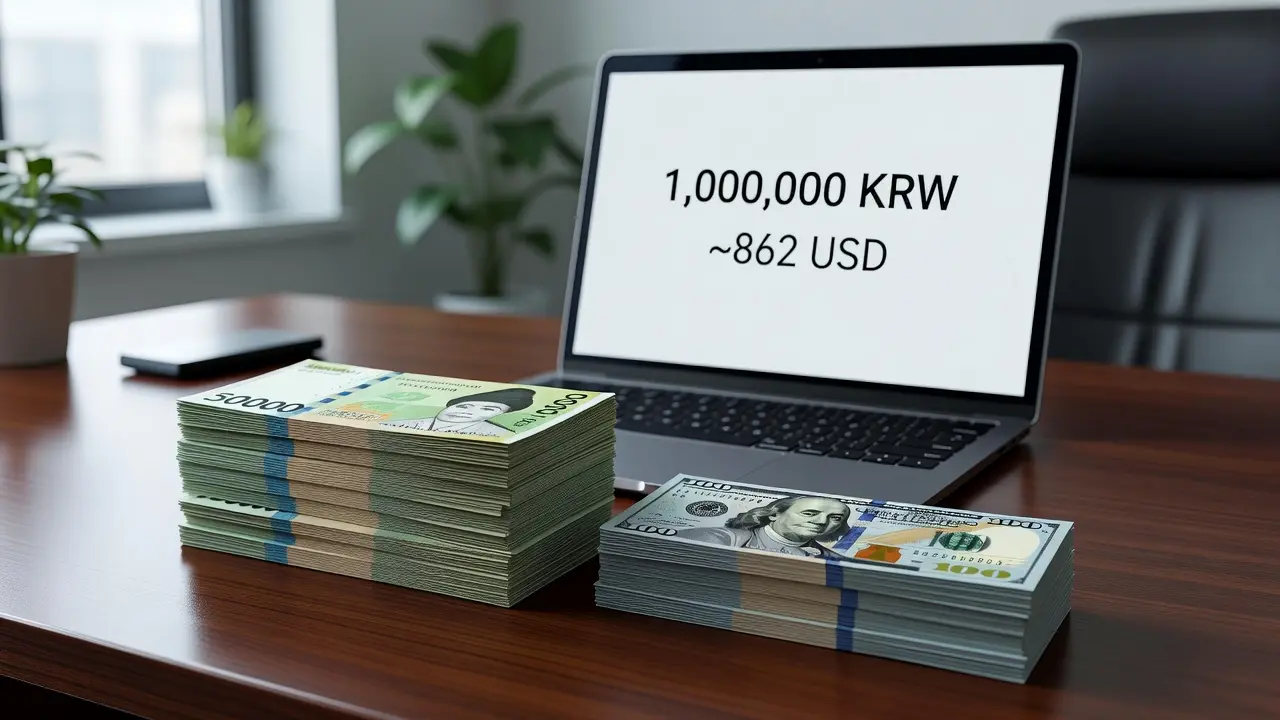
What 1 million won to usd means
Converting 1 million won to usd means multiplying 1,000,000 by the current KRW/USD rate. Today that gives 744.4 dollars. Because one won is worth a fraction of a US cent, large round numbers like a million are how Koreans talk about rent, salaries and prices, and the dollar figure is small in comparison.
The figure above is the mid-market rate, the midpoint between what banks pay and charge. A bank or exchange booth will give you a little less when you sell won and charge a little more when you buy. To see the live rate for any amount, use the won to usd converter, which updates through the day.
The amount itself has a few fixed facts that do not change with the rate:
- Digits: 1,000,000, a one followed by six zeros.
- Written in Korea: 1,000,000원, ₩1,000,000 or 100만 원.
- In banknotes: 20 notes of ₩50,000, or 100 notes of ₩10,000.
- Spoken: baek-man won (백만 원).
The ₩ sign and the code KRW both mean South Korean won. Where the sign comes from, and how to type it, is covered on our korean won symbol page.
Korean won to USD and VND conversion table
The table below converts common won amounts into US dollars and Vietnamese dong at today's mid-market rate, dated 25 November 2026. It runs from ₩100,000 to ₩100,000,000 and includes 2 million won to usd, a frequent search for monthly salaries and rent deposits.
| Korean won | How Koreans say it | US dollars | Vietnamese dong |
|---|---|---|---|
| ₩100,000 | 10만 원 (sib-man) | 74.44 | 1,923,091 |
| ₩500,000 | 50만 원 (o-sip-man) | 372.2 | 9,615,454 |
| ₩1,000,000 | 100만 원 (baek-man) | 744.4 | 19,230,908 |
| ₩2,000,000 | 200만 원 (i-baek-man) | 1,488.79 | 38,461,817 |
| ₩3,000,000 | 300만 원 (sam-baek-man) | 2,233.19 | 57,692,725 |
| ₩5,000,000 | 500만 원 (o-baek-man) | 3,721.98 | 96,154,542 |
| ₩10,000,000 | 1,000만 원 (cheon-man) | 7,443.97 | 192,309,083 |
| ₩50,000,000 | 5,000만 원 (o-cheon-man) | 37,219.83 | 961,545,417 |
| ₩100,000,000 | 1억 원 (il-eok) | 74,439.66 | 1,923,090,834 |
Each row is a straight multiple of the first, so you can scale it yourself: 2 million won is double the 1 million row, and 1 billion won is ten times the ₩100,000,000 row. Readers in Vietnam can check smaller amounts, such as 1000 won = vnd, on the won to dong converter.
Won to dong is usually priced as a cross rate. Few banks quote KRW/VND directly in volume, so the rate is worked out from KRW/USD and USD/VND. Our guide to the cross rate shows the calculation step by step.
Worked examples with real Korean figures
The quickest way to judge what a million won is worth is to set it against figures published in Korea. The examples below use official numbers where they exist, and today's rate for the dollar value, so the results change as the rate moves.
Korea's minimum wage in 2026
Korea's Minimum Wage Commission set the 2026 minimum wage at ₩10,320 an hour, and the Ministry of Employment and Labor confirmed it. For a full-time worker paid for 209 hours a month (40 hours a week plus paid weekly rest), that is ₩2,156,880 a month, or 1,605.57 US dollars at today's rate. One million won is about 46% of that monthly figure.
A part-time job
A student working 20 hours a week at the minimum wage earns ₩206,400 a week before any weekly holiday allowance. Four weeks of that is ₩825,600, a little under one million won, or about 614.57 dollars.
Paying in banknotes
A payment of ₩1,000,000 in cash is a thin stack: twenty yellow ₩50,000 notes. The same sum in ₩10,000 notes is a stack of one hundred. Shops and landlords in Korea rarely take cash at this size; bank transfers are normal.
2 million and 1 billion won
Two million won converts to 1,488.79 dollars today. One billion won, written ₩1,000,000,000 or 10억 원 (sib-eok), converts to 744,396.55 dollars. Korean news reports quote apartment prices and business deals in eok, so 1 billion won to usd is a common search when reading Korean property headlines.
What you actually get when you exchange 1 million won
When you exchange 1 million won at a bank or counter, you get the mid-market amount minus the provider's margin. At a margin of 2%, every $100 of mid-market value becomes $98 in your hand; at 5%, it becomes $95. The table and examples above show mid-market values, so treat them as the ceiling, not the amount in your hand.
Margins vary by where you exchange:
- Korean bank branches and their apps usually give the best rates for cash inside Korea, and many banks offer discounts on the margin through their mobile apps.
- Licensed money changers in central Seoul, around Myeong-dong for example, often compete with bank rates for US dollars, euros and yen.
- Airport counters at Incheon are open long hours but tend to have wider margins than city branches.
- Outside Korea, won is a less common currency, so banks abroad may hold little cash and quote wide spreads. Exchanging dollars into won after you arrive is often cheaper than buying won at home.
A worked example with an assumed rate makes the gap clear. Suppose 1 USD = 1,380 KRW. One million won is then $724.64 at mid-market. A counter with a 3% margin pays about $702.90, so you lose about $21.74 on the swap. On ₩5,000,000 the same margin costs about $109.
For transfers rather than cash, the comparison is the same: look at how many dollars or dong arrive for the same number of won, not at the advertised fee.
Common mistakes when reading Korean amounts
The most common mistake is misplacing a zero when converting from spoken Korean units to written digits. Because Korean counts in ten-thousands, "50 man" sounds small but is ₩500,000, and "1 eok" is ₩100,000,000, not one million.
Three slips come up again and again. Reading 100만 as 100 and forgetting the four zeros inside 만. Confusing 1,000만 (ten million) with 1억 (one hundred million), which differ by a factor of ten. And mixing number formats: Korea uses commas for thousands like the US (1,000,000), while Vietnam and much of Europe use dots (1.000.000), so a Vietnamese reader may see 1,000 and think of one with three decimals.
When an amount matters, such as a rent deposit, a salary offer or a money transfer, write it out in full digits and repeat it in words. "₩10,000,000 (ten million won)" leaves no room for a misread.
How to say and write 1 million won in other number systems
Korean groups large numbers in units of ten thousand, not one thousand. The unit 만 (man) is 10,000, so one million is 100 man (백만), and 억 (eok) is 100 million. English groups in thousands, so the commas fall in different places from the spoken Korean units.
| Number | Korean | Japanese | Indian system | Vietnamese |
|---|---|---|---|---|
| 10,000 | 만 (man) | 万 (man) | 10 thousand | mười nghìn |
| 100,000 | 10만 (sib-man) | 10万 (jū-man) | 1 lakh | một trăm nghìn |
| 1,000,000 | 100만 (baek-man) | 100万 (hyaku-man) | 10 lakh | một triệu |
| 10,000,000 | 1,000만 (cheon-man) | 1000万 (sen-man) | 1 crore | mười triệu |
| 100,000,000 | 1억 (il-eok) | 1億 (ichi-oku) | 10 crore | một trăm triệu |
Japanese uses the same ten-thousand grouping, with 万 (man) and 億 (oku) in the same places as Korean 만 and 억. If you have seen prices like "3万円" in Japan, the man yen meaning page explains how to read them.
India groups differently again: a lakh is 100,000 and a crore is 10,000,000, so one million is "10 lakh". Our explainer on lakh to usd covers these units, and the page on 1 million dollars in rupees shows how large dollar sums are written in Indian style.
When writing for an international reader, put the full number with commas and the code: KRW 1,000,000. That avoids any confusion between 100만 and 1,000,000. For the banknotes, coins and everyday prices behind these amounts, see our guide to korean currency.
To convert any other amount between won, dollars, dong or another currency, use the currency converter on our home page.






