
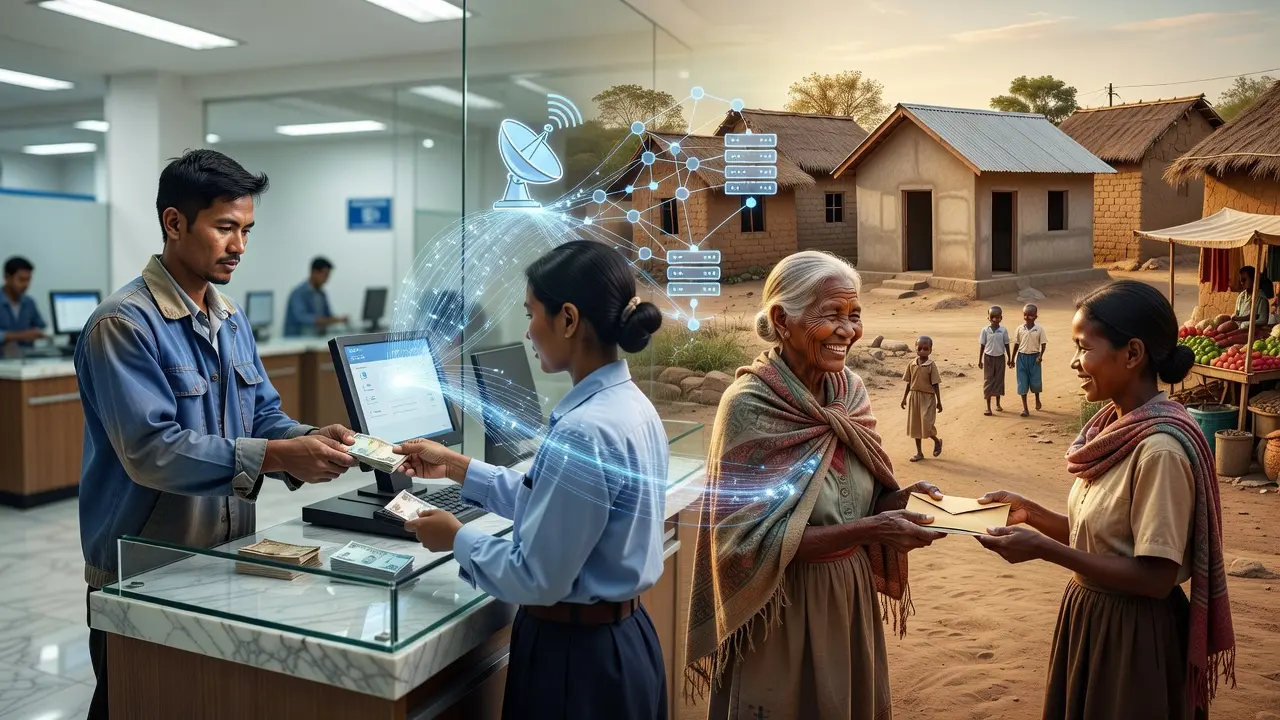
What does remittance mean?
A remittance is a transfer of money, usually from a migrant worker to relatives in another country. The word comes from "remit", meaning to send money in payment. In economic statistics, remittances also include the earnings of workers who cross borders for short jobs, but in daily use the term means money sent home to support a family.
A simple remittance definition has three parts: a sender abroad, a recipient at home, and a provider that moves and converts the money. The sender pays in the currency where they work, such as yen or dirhams, and the recipient receives the money in local currency or in dollars.
What is remittance and what is not? A business paying a supplier abroad is a commercial payment, not a remittance. A student's parents paying tuition overseas is an outward transfer for education. A remittance is personal money moving to support a household, which is why many countries treat it differently for tax and reporting.
How a remittance moves from sender to receiver
A remittance moves in four steps: the sender pays a provider, the provider checks identity and converts the currency, the provider or its partner pays out in the recipient's country, and the recipient collects the money in an account, a mobile wallet or as cash. The whole process can take minutes or a few days.
- The sender chooses a provider and enters the recipient's details and the amount.
- The provider checks the sender's identity, as anti-money laundering rules require, and quotes a fee and an exchange rate.
- The money is converted and either sent through the bank network SWIFT or paid out from the provider's own funds in the destination country.
- The recipient gets a bank deposit, a mobile wallet credit, cash at an agent or, in some countries, cash delivered to the door.
Many remittance companies do not move the money across borders transfer by transfer. They hold balances in each country, pay recipients from local funds and settle with partners later, which is why they can be faster than a bank wire. The step-by-step process from the sender's side is covered in our guide on how to send money internationally.
Remittance channels
The main remittance channels are bank transfers, online transfer apps, money transfer operators with agent networks, and mobile wallets. Each suits a different sender and recipient, and the cost and speed vary widely between them.
- Banks: send by SWIFT wire to a bank account. Reliable, but fixed fees and intermediary charges make them expensive for small amounts.
- Online transfer apps: pay into bank accounts or wallets, usually with clear fees and rates close to mid-market.
- Money transfer operators: companies such as Western Union, MoneyGram and Ria, with agents who pay out cash, useful where many recipients have no bank account.
- Mobile wallets: in countries such as the Philippines, Kenya and Bangladesh, money can arrive straight into a phone wallet.
- Informal channels: hand-carried cash or unlicensed networks. They can look cheaper but are illegal in many countries, offer no protection if money is lost and can be seized.
Each corridor has its own habits. Workers in Japan often use the post office or licensed apps; our guide to send money from japan compares them. In Taiwan, licensed services and banks compete for workers' wages, covered in send money from taiwan.
Remittances by the numbers
According to the World Bank, remittances to low- and middle-income countries reached an estimated $685 billion in 2024, up 5.8% from 2023. The bank notes that informal transfers are not counted, so the true total is higher. For many countries, remittances bring in more foreign currency than foreign direct investment or development aid.
| Rank (2024 estimate) | Country | Remittances received |
|---|---|---|
| 1 | India | $129 billion |
| 2 | Mexico | $68 billion |
| 3 | China | $48 billion |
| 4 | Philippines | $40 billion |
| 5 | Pakistan | $33 billion |
Source: World Bank, People Move blog, December 2024 estimates. Figures are rounded and may be revised as countries report final data.
Vietnam is also a large recipient. Vietnamese press reports, citing the State Bank of Vietnam's Ho Chi Minh City branch, estimated that the city alone received about $9.6 billion in 2024, roughly 60% of the national total, which puts Vietnam's inflow at around $16 billion. Our page on usd to vnd shows what those dollars are worth in dong today.
The Philippines is one of the countries where remittances make up a large share of household income, and the peso is often bought in remittance transfers; see the usd to php rate and our philippine peso guide.
Costs: fees and exchange rate margin
The cost of a remittance is the fee plus the margin added to the exchange rate. The World Bank tracks these costs in its Remittance Prices Worldwide database and has long reported a global average of around 6% for sending $200, twice the 3% target in the United Nations Sustainable Development Goals for 2030.
A worked example with an assumed rate of 1 USD = 26,000 VND, sending $300:
- App with a $3 fee and a rate of 25,900: the family receives 7,692,300 dong, about 1.4% less than mid-market.
- Agent with no fee and a rate of 25,200: the family receives 7,560,000 dong, about 3.1% less.
- Bank wire with a $25 fee and a rate of 25,700: the family receives 7,067,500 dong, about 9.4% less.
Small, frequent transfers pay the most in fixed fees. Sending larger amounts less often, comparing the amount received rather than the fee, and paying by bank transfer instead of card all reduce the cost.
The exchange rate also changes how much a family receives over time. When the sender's currency strengthens against the recipient's, the same monthly amount buys more at home; when it weakens, the family receives less. A worker paid in yen sent home noticeably less in dong terms when the yen fell sharply in 2024. Comparing the amount received each month, and sending a little more or less when the rate moves a lot, helps keep the family's budget steady.
Rules for receiving remittances
Most countries do not limit how much a person may receive from family abroad, but banks and providers check identity and may ask about the source of large or unusual transfers under anti-money laundering rules. Tax treatment depends on the country.
- Vietnam: remittances from relatives are exempt from personal income tax, there is no limit on the amount received, and recipients can take dollars or convert to dong.
- India: money received from relatives abroad is generally not taxed as income; banks report large inflows.
- Philippines: remittances to families are not taxed as income for the recipient.
- United States and other sending countries: providers must verify the sender, and large cash transactions are reported to the authorities.
Rules change, so check with your bank before a large transfer. To compare amounts in any currency, use the currency converter.






