
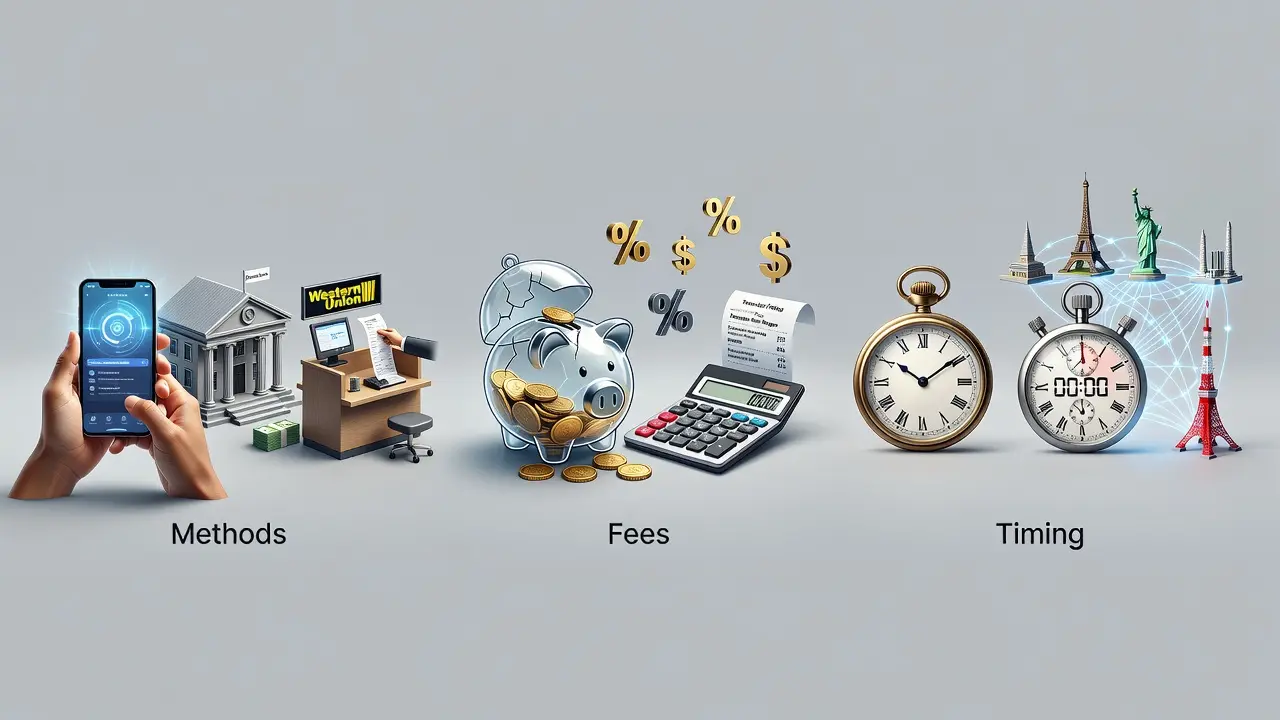
How sending money internationally works
An international money transfer moves value from your account or cash in one country to a recipient in another, converting the currency on the way. You pay the provider; the provider either sends the money through the bank messaging network SWIFT or pays the recipient from its own funds in the destination country, then settles with its partners later.
That second model, used by most transfer apps and remittance companies, is why they can be faster and cheaper than banks. The money does not physically cross the border at the moment you send it. The provider holds balances in many countries and moves them in bulk.
For the recipient, a transfer can arrive in one of four ways:
- A deposit to a bank account, the most common option.
- A deposit to a mobile wallet, common in the Philippines, Kenya and Bangladesh.
- Cash pickup at an agent location, using a reference number.
- Home delivery of cash, offered in a few countries including Vietnam.
A cross-border payment from a person working abroad to family at home is called a remittance. The term and its role in national economies are explained in our page on remittance meaning.
Ways to send money abroad: bank, transfer app, remittance company
There are three main ways to send money abroad: a bank wire, an online transfer app, and a remittance company with agent locations. Banks are widely trusted but usually the most expensive for small amounts. Apps tend to be cheapest for bank-to-bank transfers. Remittance companies cover cash pickup and countries with few bank accounts.
Bank wire transfer
A bank wire transfer sends money from your bank to the recipient's bank, usually through SWIFT. You need the recipient's name, account number or IBAN, the bank's name and its SWIFT/BIC code, which our guide on what is swift code explains how to find. Banks charge a fixed fee, often $15 to $50 for outgoing wires, plus a rate margin of 2% to 5%. Intermediary banks along the route may deduct their own fees, so the recipient can get less than expected.
Online transfer apps
Apps such as Wise, Remitly and similar services quote the fee and rate before you pay. Several use the mid-market rate and charge a visible fee, while others add a margin to the rate and advertise "zero fees". Bank-to-bank transfers through apps commonly cost 0.5% to 2% in total for major routes. Our comparison of the cheapest way to transfer money internationally ranks options by route and amount.
Remittance companies
Companies such as Western Union, MoneyGram and Ria run networks of agent shops where the sender pays cash and the recipient collects cash. They reach places without banks and are fast, often minutes. Costs are higher, usually 3% to 8% combined, and vary a lot by corridor.
Fees and exchange rate margin: the total cost
The total cost of an international money transfer is the upfront fee plus the margin hidden in the exchange rate. To compare providers, look only at one number: how much the recipient gets in their currency for the same amount you send.
A worked example with an assumed mid-market rate of 1 USD = 26,000 VND, sending $1,000:
| Provider type | Fee | Rate offered | Recipient gets | Total cost |
|---|---|---|---|---|
| Mid-market (reference) | $0 | 26,000 | 26,000,000 VND | 0% |
| Transfer app, visible fee | $7 | 26,000 | 25,818,000 VND | 0.7% |
| App with "no fee" | $0 | 25,610 | 25,610,000 VND | 1.5% |
| Remittance company | $5 | 25,220 | 25,094,000 VND | 3.5% |
| Bank wire | $35 | 25,350 | 24,462,750 VND | 5.9% |
The "no fee" app looks cheapest on its advert but delivers less than the app that shows its fee. Use our currency converter to check the mid-market rate at the moment you compare, then work out each provider's gap.
Three habits keep the cost down. Send larger amounts less often, so fixed fees matter less. Pay by bank transfer instead of credit card, since card funding often adds 1% to 3% and some card issuers treat it as a cash advance. And send in the recipient's currency, so your bank does not convert first at its own rate.
How long an international money transfer takes
An international money transfer takes anywhere from a few minutes to five working days. Cash pickup and transfers through large apps on popular routes often arrive within minutes or hours. SWIFT bank wires usually take one to three working days, and longer when intermediary banks, weekends or public holidays are involved.
Delays usually come from four sources: compliance checks on the first transfer to a new recipient, a cut-off time missed by a few minutes, different weekends (Friday and Saturday in some Gulf countries, Saturday and Sunday elsewhere), and mistyped details. Double-check the recipient's name exactly as it appears on their account.
Documents and rules in the sending and receiving country
To send money abroad you need valid photo ID, the recipient's full name and payout details, and sometimes a reason for the transfer. Larger amounts can trigger extra questions about the source of funds. Both the sending and the receiving country set rules, and providers apply both.
- United States: providers must verify identity, and banks report cash transactions above $10,000 to the authorities. Gifts to one person above the annual exclusion (US$19,000 for 2025) may need a gift tax return, though tax is rarely due.
- India: residents can send up to US$250,000 a year abroad under the Reserve Bank of India's Liberalised Remittance Scheme, with tax collected at source above a threshold.
- Vietnam: individuals receiving remittances face no limit and pay no personal income tax on them; sending money out of Vietnam requires a permitted purpose, such as tuition or medical costs, with supporting documents.
- Gulf countries: remittances usually go through licensed exchange houses that ask for the worker's residency card.
Rules change. Check with the provider before a large transfer, and keep receipts.
How to send money abroad, step by step
- Decide how the recipient wants the money: bank account, mobile wallet or cash pickup.
- Collect their details: full legal name, account number or IBAN, bank name and SWIFT code, or their phone number for a wallet.
- Check the mid-market rate for your currency pair, for example on usd to inr or usd to vnd.
- Get quotes from two or three providers for the same amount and compare the amount received.
- Create an account with the chosen provider and verify your ID; this can take a day the first time.
- Pay by bank transfer or debit card, and send in the recipient's currency.
- Share the tracking or reference number with the recipient and keep the receipt.
Which method suits which amount
The best way to send money abroad depends mostly on the amount. For a few hundred dollars, a fixed bank fee of $35 is a large share, so an app or remittance company usually wins. For tens of thousands, the rate margin matters far more than the fee, and a bank, a specialist currency broker or an app with volume discounts can all compete.
A rough guide by size:
- Under $500: a transfer app paying into a bank account or wallet. Cash pickup if the recipient has no account. Avoid bank wires; the fixed fee alone can be 7% or more of $500.
- $500 to $10,000: compare two or three apps on the amount received. Fees here are often under 1%, and a difference of 0.5% on $5,000 is $25.
- Over $10,000: ask your bank for a better rate (many will negotiate for large amounts), and get a quote from a currency broker. Expect more identity and source-of-funds questions, and plan for a day or two.
- Regular payments, such as monthly support for parents: pick one provider, save the recipient, and send on the same day each month to make tracking easier.
Timing matters less than people think. Rates move every day, but nobody can reliably predict the direction, and waiting a week for a better rate can cost more than it saves. If an amount is large and the date is flexible, splitting it into two or three transfers spreads the risk.
The hidden costs most people miss
Four costs rarely appear in the headline fee: the rate margin, intermediary bank deductions, receiving bank fees and card funding charges. Together they can double the real price of a transfer, so check each one before you send.
Dynamic currency conversion
Some banks and websites offer to convert the amount into your home currency before sending, and show it as a convenience. The rate on that conversion is usually worse than the provider's own rate. Choose to send in the recipient's currency, and let the provider convert.
Intermediary and receiving fees
A SWIFT wire can pass through one or two correspondent banks, each taking $10 to $30. The sender can choose who pays these charges with a code on the wire form: OUR (sender pays all), SHA (shared) or BEN (recipient pays). With SHA or BEN the recipient gets less than you sent. Some receiving banks also charge a fee to credit incoming foreign transfers.
Card funding
Paying for a transfer with a credit card is fast, but providers often add 1% to 3%, and card issuers may code it as a cash advance with interest from day one. A debit card or bank transfer avoids both.
Common mistakes and money transfer scams
The most expensive mistakes are wrong recipient details and sending to a scammer. A transfer to the wrong account is hard to reverse, and money sent to a fraudster is rarely recovered, so both are worth a minute of checking.
Details that cause failed or delayed transfers:
- The recipient's name does not match the bank account (missing middle name, wrong spelling, or a nickname).
- A SWIFT code for the bank's head office when the transfer needs a branch code, or the reverse.
- Account numbers copied with a missing digit, especially long IBANs.
- The wrong currency chosen, so the recipient's bank converts at its own rate.
Scams follow a few common patterns. Someone met online asks for money for an emergency, a visa or a plane ticket. An email that looks like it came from a supplier changes the bank details on an invoice. A caller claims to be from the tax office or police and demands payment by transfer. Transfer providers' own guidance says not to send money to anyone you have not met in person, and to confirm changed bank details by phone using a number you already have.
If you spot an error or a scam right after sending, contact the provider at once. Apps can sometimes cancel a transfer that has not been paid out yet. A bank can send a recall request for a SWIFT wire, but the receiving bank needs the recipient's consent to return funds already credited.
Sending money to family every month
Most international transfers are regular payments from workers abroad to family at home. For these, the biggest saving comes from routine: one provider, one saved recipient, one fixed day, and a quick check of the amount received each time.
A worker in Seoul sending ₩1,000,000 home every month pays the fee 12 times a year. If one app takes 1% less than another, the gap over a year is about ₩120,000. Sending every two months halves the number of fixed fees, if the family can plan around it.
Ask the family how they prefer to receive. Money credited straight to a local bank account in the local currency is usually cheapest. Cash pickup costs more but helps relatives in rural areas or without accounts. Some recipients prefer to keep US dollars; in that case send dollars to a foreign currency account and let them choose when to convert.
Keep a simple record of each transfer: date, amount sent, amount received and provider. After three or four months you will see which provider gives the family the most, and you will have the receipts if a bank or tax office ever asks. Many apps keep this history for you and export it as a statement.
Students and parents paying tuition follow a different pattern: a few large payments a year, often to a university account with a fixed reference. Use the university's own payment portal if it offers a good rate, and compare it with an app before paying.
Money transfer guides by route
Costs and habits differ by country. These guides go deeper on specific routes and uses:
- send money from japan: post office, banks and licensed apps for workers paid in yen
- krw remittance: sending wages home from South Korea
- Sending Money From Taiwan: TWD Exchange Rates and Costs
- uae exchange houses and apps for sending from the Emirates
- Paying Tuition Abroad: Exchange Rates and Fees for Students






