
What is a SWIFT code?
A SWIFT code is a standard identifier for banks and financial institutions, defined by the international standard ISO 9362. Banks use it to address payment messages sent over the SWIFT network, so an international transfer reaches the right bank. It identifies the bank, and sometimes the branch, but never the individual account.
The swift meaning comes from the organisation behind the network: the Society for Worldwide Interbank Financial Telecommunication, a cooperative founded in 1973 and based in Belgium. More than 11,000 institutions in over 200 countries and territories use its messaging network. SWIFT does not move money itself; it carries the payment instructions that banks then settle between their accounts.
BIC code is the official name in the standard. In practice, banks and apps use "SWIFT code", "BIC" and "SWIFT/BIC" interchangeably.
How to read the 8 or 11 characters
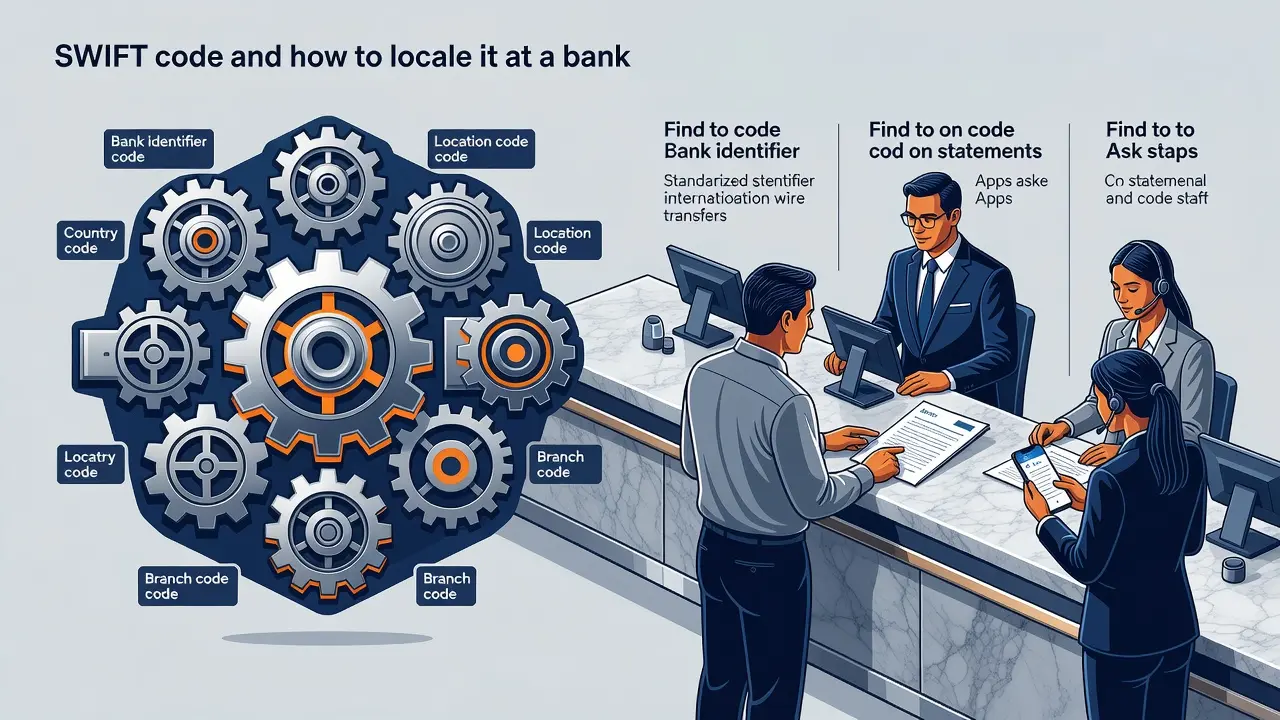
A SWIFT code has four parts: a 4-letter bank code, a 2-letter country code, a 2-character location code and an optional 3-character branch code. An 8-character code points to the bank's main office; an 11-character code points to a specific branch or department.
| Part | Length | Example in BFTVVNVX | Meaning |
|---|---|---|---|
| Bank code | 4 letters | BFTV | Bank for Foreign Trade of Vietnam, Vietcombank's English name |
| Country code | 2 letters | VN | Vietnam, from ISO 3166 |
| Location code | 2 characters | VX | Where the bank's head office is registered |
| Branch code | 3 characters, optional | XXX or e.g. 108 | XXX means head office; other codes mean a branch |
So BFTVVNVX and BFTVVNVXXXX both mean Vietcombank's head office, while codes such as BFTVVNVX108 point to particular branches. If your bank tells you to use the 8-character code, the money reaches the head office and is passed to your branch automatically.
How to find your bank's SWIFT code
The most reliable place to find your bank's SWIFT code is the bank itself: its official website, its mobile banking app, or your branch. Many banks show the code on the page for receiving international transfers or print it on statements. Codes for major Vietnamese banks are listed below for reference.
| Bank | SWIFT code (head office) |
|---|---|
| Vietcombank | BFTVVNVX |
| BIDV | BIDVVNVX |
| VietinBank | ICBVVNVX |
| Agribank | VBAAVNVX |
| Techcombank | VTCBVNVX |
| ACB | ASCBVNVX |
| Sacombank | SGTTVNVX |
| VPBank | VPBKVNVX |
Before sharing a code with a sender, confirm it on your bank's official channel. Online lists are convenient, but a bank can merge, rename or change its routing, and a wrong code can delay or return a transfer.
SWIFT code vs IBAN vs routing number
A SWIFT code identifies the bank, an IBAN identifies an account, and a routing number identifies a bank inside one country's domestic system. International transfers to Europe usually need both a SWIFT code and an IBAN; transfers to Vietnam need the SWIFT code and a normal account number, because Vietnam does not use IBAN.
| Code | Identifies | Format | Used in |
|---|---|---|---|
| SWIFT/BIC | A bank or branch | 8 or 11 characters | International transfers worldwide |
| IBAN | A specific bank account | Up to 34 characters, starting with a country code | Europe, the Middle East and some other regions |
| ABA routing number | A US bank | 9 digits | Domestic US transfers |
| Sort code | A UK bank branch | 6 digits | Domestic UK transfers |
| IFSC | An Indian bank branch | 11 characters | Domestic Indian transfers |
A sender abroad may ask for "routing number" or "IBAN" out of habit. For a Vietnamese account, give the SWIFT code, the account number, the account holder's name exactly as the bank records it, and the bank's name and address.
Using a SWIFT code to receive money
To receive an international bank transfer, give the sender five details: your full name as on the account, your account number, your bank's name, its SWIFT code and, if asked, the bank's address. The sender's bank then sends a SWIFT message and the money usually arrives in one to three working days.
A few points prevent most problems:
- Match the name exactly, without accents if the bank's records have none, because name mismatches are the most common cause of delays.
- Ask the sender to choose the currency you want to receive; your bank will convert it otherwise.
- Expect intermediary bank fees if the sender chooses the SHA or BEN charge option; OUR means the sender pays all fees.
- Keep the transfer reference, called the MT103 or UETR, to trace the payment if it is late.
A worked example with an assumed rate: a relative sends $500 with the SHA option. An intermediary bank deducts $15, so $485 arrives. If your bank converts it at 25,900 dong per dollar, you receive 12,561,500 dong.
Bank wires are one of several ways to send money abroad. Our guide to what is a wire transfer explains the process step by step, and the wider choice of channels is covered in our guide to international money transfer. For money sent home by family members, see the remittance definition and rules.
Scammers sometimes ask people to "confirm" their SWIFT code and account details by email to release a prize or inheritance. A real sender only needs your details once and never asks you to pay a fee to receive money. To check what a transfer is worth in dong or another currency, use the currency converter.
What happens if the SWIFT code or details are wrong
If the SWIFT code points to the wrong bank, or the name and account number do not match, the receiving bank usually holds the payment and asks for clarification, or returns it to the sender. A return can take one to two weeks, and both sides may lose part of the amount to fees and to exchange rate moves in each direction.
A wrong code that belongs to a real bank is the worst case, because the payment can reach that bank before anyone notices. The sender's bank can send a recall request, but the receiving bank needs the account holder's agreement to send money back once it has been credited. The fastest fix is to check the code on your bank's website or app before you send it to anyone.
When a transfer is late, ask the sender for the payment reference. With the UETR, a unique reference carried by modern SWIFT payments, banks can see exactly where the money is in the chain, including which intermediary bank is holding it.
Fees and currency when receiving a SWIFT transfer
A SWIFT transfer can carry three kinds of fee: the sender's bank fee, intermediary bank fees taken along the route, and a receiving fee charged by your own bank. Who pays the first two depends on the charge option the sender chooses: OUR (sender pays all), SHA (shared) or BEN (recipient pays).
The currency also matters. If a relative sends US dollars to an account in dong, your bank converts at its own buying rate on the day. If you hold a US dollar account, the dollars arrive as they are and you choose when to convert. Comparing your bank's buying rate with the mid-market rate shows how much the conversion costs; a gap of 1% on $1,000 is $10.
For regular payments from family abroad, a transfer app that pays straight into a dong account is often cheaper than a SWIFT wire, because it avoids intermediary banks. For large one-off sums, such as the sale of property abroad, a bank wire with the OUR option gives the most predictable result.






