
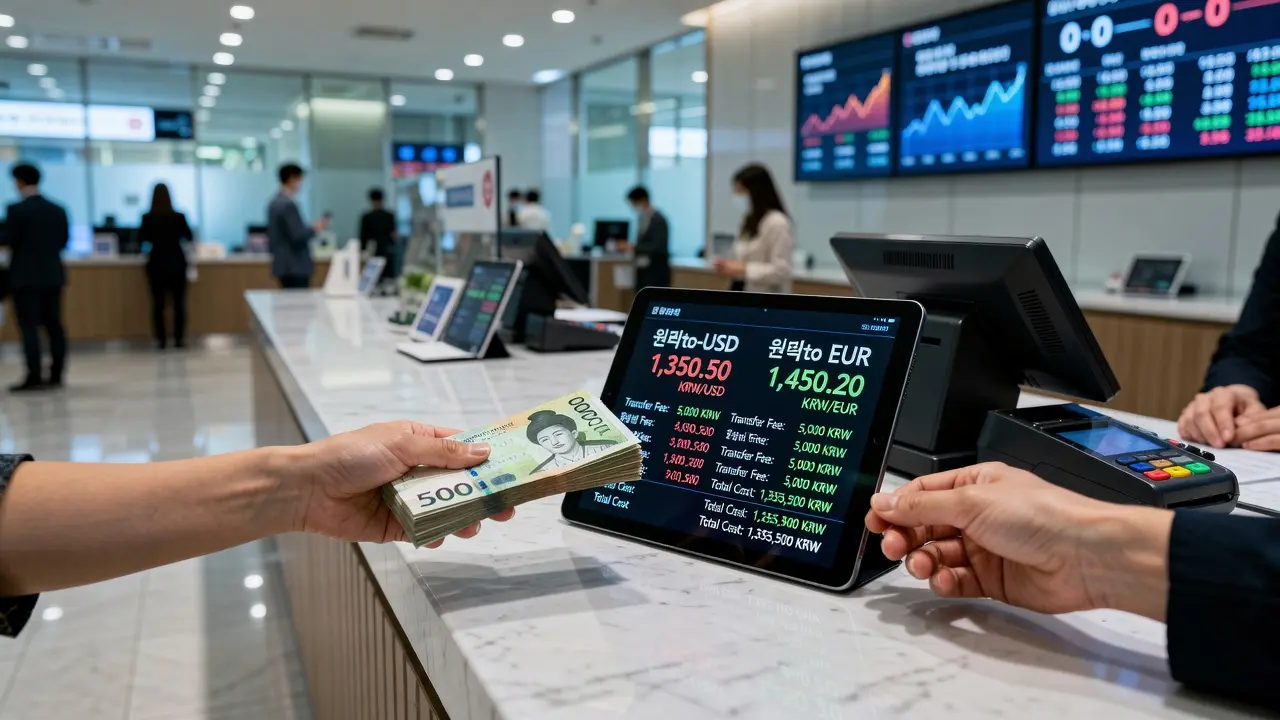
How sending money from Korea works
Sending money from Korea takes four steps: open an account with a bank or licensed remittance company, verify your identity, register the recipient, then pay in won. The provider converts won at its own rate and pays the recipient in local currency, into a bank account, mobile wallet or cash pickup point.
Korea's Foreign Exchange Transactions Act controls who may move money abroad. Banks, and companies registered for small overseas remittance, may do it legally. Informal "hwanchigi" networks, where cash is handed to a broker who pays out abroad, break Korean law, and both sender and broker can be penalised. The general steps for any cross-border payment are in How to Send Money Internationally: Methods, Fees and Timing.
Korean providers check identity closely. Expect to show an alien registration card (ARC) or passport, a Korean bank account and a mobile phone registered in your own name. Some apps verify you by a short video call or a one-won deposit to your bank account. Keep your phone contract in your own name; a borrowed number blocks verification.
Ways to send: bank, transfer app or remittance company
There are three main channels: Korean banks such as KEB Hana, Woori, Shinhan and KB Kookmin; small remittance companies built for migrant workers; and global apps. Banks suit large or regular transfers above remittance company limits. Remittance companies are usually cheaper and faster for monthly wages.
- Korean banks: SWIFT transfers to a bank account abroad, often with a fixed fee plus a cable charge. Many branches near industrial areas open on Sundays for foreign workers.
- Small remittance companies: apps with menus in Vietnamese, Nepali, Indonesian and other languages, paying into bank accounts, e-wallets or cash pickup.
- Global apps: show the fee and rate before you confirm, and convert close to the mid-market rate.
Each remittance company sets its own per-transfer and annual limits under its licence. Check the limit before you choose, especially if you send a year's savings before going home.
Fees and the won exchange rate margin: total cost
The won exchange rate a provider uses decides most of the cost. A provider with a ₩3,000 fee and a rate 2% worse than the market costs more than one with a ₩5,000 fee and a fair rate. Compare the amount the recipient receives for the same amount of won.
A worked example with assumed rates: you send ₩1,000,000 to Vietnam when the market rate is 18 dong per won, so ₩1,000,000 is worth 18 million dong.
| Option (example) | Fee | Rate used | Recipient gets | Total cost |
|---|---|---|---|---|
| Bank SWIFT transfer | ₩15,000 | 17.6 dong | about 17.3 million dong | about 3.7% |
| Small remittance company | ₩5,000 | 17.8 dong | about 17.7 million dong | about 1.6% |
| Global app | ₩6,000 | 18 dong | about 17.9 million dong | about 0.6% |
The figures show the method, not quotes from named providers. Check today's krw / vnd rate or the south korean won exchange rate against other currencies before you send. Fixed fees hurt small transfers: ₩5,000 on ₩200,000 is 2.5%, but on ₩2,000,000 it is 0.25%.
The won's value against the dollar moves too. Large sums are easier to picture in dollars; our page on How Much Is 1 Million Won in USD? works through common amounts, and 1 billion won to usd converts any figure at today's rate.
Exchange rate swings can outweigh fees. The won weakened past 1,400 per US dollar in late 2024, so a worker earning the same won salary sent home fewer dollars' worth that month than a year earlier. Nobody can time these moves reliably. Sending on a fixed day after payday, rather than waiting for a better rate, keeps the family budget steady. If you are leaving Korea and sending a large sum, splitting it into two or three transfers over a few weeks spreads the rate risk, as long as each transfer stays inside your provider's limits.
How long a KRW remittance takes
A KRW remittance through a small remittance company often reaches bank accounts and e-wallets in Vietnam, Nepal or the Philippines within minutes to a few hours. Bank SWIFT transfers usually take 1 to 3 working days, longer if an intermediary bank is involved, if names do not match, or if the bank asks about the purpose.
- Payment method: most apps ask you to transfer won from your Korean bank account to a virtual account; delays at your bank delay the remittance.
- Weekends and holidays: Chuseok and Seollal in Korea, and Tet in Vietnam, slow bank transfers.
- First transfer: identity checks on a new account can take one or two days.
- Large amounts: transfers near your annual limit may be held for documents.
Documents and rules in Korea and Vietnam
In Korea you need an ARC or passport, a Korean bank account and phone in your name, and the recipient's full name and account or wallet details. Above the US$100,000 annual no-document limit, banks ask for proof of income, such as an employment contract, payslips or a tax certificate. In Vietnam, remittances received have no upper limit and are not subject to personal income tax.
- Designated bank: for the no-document limit, you name one bank as your foreign exchange bank, and transfers through it count toward the yearly cap. The government announced in December 2025 a plan to extend the US$100,000 limit to all financial institutions from 2026.
- EPS workers going home: when you leave Korea for good, banks let you send your severance pay and departure guarantee insurance payout with proof from your employer or insurer.
- Name matching: the recipient's name must match their ID; many apps ask for it without Vietnamese accents.
- Your own money only: collecting and sending money for other workers can lead to account closure and penalties.
Families sending from more than one country can compare corridors. Our guides to yen remittance and how to send money from taiwan cover the same steps for those countries.
How to send money from Korea, step by step
The first transfer takes longest because of identity checks; later transfers take a few minutes in the app. Plan a day or two to open a remittance account, then repeat the same steps each payday.
- Compare what the recipient gets for ₩1,000,000 today on two or three providers.
- Register with your ARC, Korean phone number and bank account.
- Add the recipient: full name as on ID, bank and account number, or wallet number.
- Enter the won amount and check the rate, fee and amount received.
- Transfer won to the virtual account shown, using your own bank account.
- Send the reference number to the recipient and keep the receipt in the app.
The notes you may pay in at a bank are described in the South Korean Won Guide: Notes, Coins and What Things Cost, and the ₩ sign on receipts in our page on the korean won symbol. Any amount can be checked on the currency converter.






