
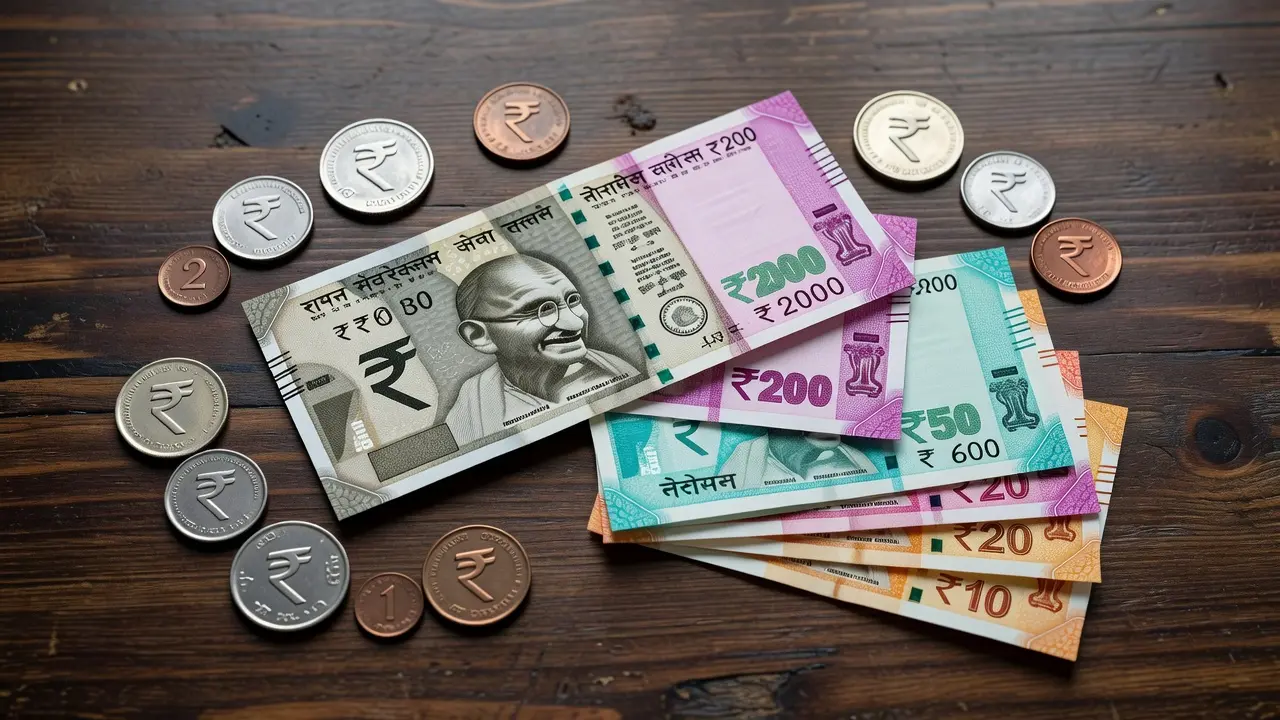
Indian money at a glance
India's currency is the Indian rupee (रुपया), coded INR, with the sign ₹. The Reserve Bank of India (RBI), founded in 1935, issues notes and sets monetary policy, while the Government of India mints the coins. One rupee is 100 paise, but paise coins below 50 have left circulation.
- Currency: Indian rupee
- Code and numeric code: INR, 356
- Sign: ₹ (Unicode U+20B9), also written Rs. or Rs
- Subunit: 100 paise
- Notes in daily use: ₹10, ₹20, ₹50, ₹100, ₹200, ₹500
- Coins: ₹1, ₹2, ₹5, ₹10, ₹20
- Issuer: Reserve Bank of India
The indian rupee symbol ₹ was adopted on 15 July 2010. It combines the Devanagari letter र (ra) with the Latin R, and the two horizontal lines at the top also suggest the Indian flag. Before 2010, prices were written Rs., which is still common on menus and receipts.
Live rates against every currency are on the indian rupee exchange rate page.
INR notes in circulation
INR notes in circulation belong to the Mahatma Gandhi New Series, introduced from November 2016. Every note shows Gandhi on the front and an Indian heritage site or national achievement on the back, and each value has a different size and colour. Older Mahatma Gandhi series notes of ₹10 to ₹100 are still legal tender.
| Note | Main colour | Back design |
|---|---|---|
| ₹10 | Chocolate brown | Konark Sun Temple |
| ₹20 | Greenish yellow | Ellora Caves |
| ₹50 | Fluorescent blue | Hampi with stone chariot |
| ₹100 | Lavender | Rani ki Vav stepwell |
| ₹200 | Bright yellow | Sanchi Stupa |
| ₹500 | Stone grey | Red Fort |
| ₹2,000 (withdrawn) | Magenta | Mangalyaan Mars orbiter |
The ₹500 note is the largest in daily use, worth about 5.40 US dollars today. On 19 May 2023 the RBI announced it would withdraw the ₹2,000 note. Shops no longer give it as change, and it can be exchanged or deposited only at RBI issue offices, so do not accept one from an exchange counter.
Small traders, auto-rickshaw drivers and street stalls often cannot change a ₹500 note. Keep ₹10 to ₹100 notes for small purchases.
Indian coins
Indian coins in use are ₹1, ₹2, ₹5, ₹10 and ₹20. The ₹10 and ₹20 coins are bimetallic, and the ₹20 coin, introduced in 2020, has a 12-sided shape. Several designs of each value circulate at the same time, so two ₹5 coins can look different.
The 50 paise coin is still legal tender but rarely used, and most prices are whole rupees. Coins are useful for buses, temple offerings and tips to porters.
How to check a rupee note is real
To check a rupee note, hold it to the light to see the Gandhi watermark and the denomination number, tilt it to see the security thread change from green to blue on ₹200 and ₹500 notes, and feel the raised print of Gandhi's portrait and the angled lines near the edges, which help people with poor eyesight.
- See-through register: part of the number appears on each side and lines up against light.
- Watermark of Gandhi and the denomination.
- Windowed security thread with "भारत" and "RBI", colour-shifting on higher notes.
- Colour-shifting ink on the number at the bottom right of ₹200 and ₹500 notes.
- Raised print on the portrait, the Ashoka Pillar emblem and the bleed lines.
Notes with writing on them are another common problem. The RBI has asked people not to write on banknotes, and while scribbled notes remain legal tender, many shops refuse them. Torn or soiled notes can be exchanged free at bank branches under the RBI's note refund rules.
Fake ₹500 notes do turn up, so take large notes only from banks, ATMs or licensed money changers.
Where to exchange rupees and today's rate
Rupees are best obtained inside India. Indian law limits how many rupees travellers can carry in or out of the country, and rupee cash is hard to find abroad. Banks, licensed money changers and airport counters exchange major currencies, and ATMs accept most foreign Visa and Mastercard cards.
Today's mid-market rate, dated 25 November 2026, is 1 INR = 0.0108 USD. For dollar budgets, see usd inr, and for readers in Vietnam, inr to vnd.
Keep the exchange receipt, called an encashment certificate. Banks may ask for it when you convert unused rupees back before leaving.
A worked example with an assumed rate: if 1 USD = 85 INR, a ₹250 thali lunch costs about $2.95, and a ₹500 note about $5.90.
How Indians write large amounts: lakh and crore
India counts large numbers in lakh and crore. One lakh is 100,000 and one crore is 10 million, and commas follow the same system, so ten million is written 1,00,00,000. Property prices, salaries and news reports use these units, and few Indians say "million" in daily speech.
- ₹1 lakh = ₹1,00,000 = ₹100,000
- ₹10 lakh = ₹10,00,000 = ₹1 million
- ₹1 crore = ₹1,00,00,000 = ₹10 million
- ₹100 crore = ₹1 billion
Payments in shops have changed fast. UPI, a national instant payment system, lets people pay by scanning a QR code, from street stalls to malls. Visitors from some countries can use the UPI One World wallet, launched in 2023, but most tourists still rely on cash and cards.
The rupee in Nepal and Bhutan
The Indian rupee is also used next door. Bhutan's ngultrum is pegged to the rupee at 1 to 1, and Indian rupees are widely accepted across Bhutan. Nepal's rupee is pegged at 1.6 Nepalese rupees to 1 Indian rupee, and Indian notes are common in towns near the border.
The rule of thumb for travellers combining India with Nepal or Bhutan is simple: smaller Indian notes are the easiest to spend outside India. Some Nepalese shops have refused larger Indian notes in the past, so check the current rules before you go.
Several countries call their currency the rupee, including Pakistan, Sri Lanka, Nepal, Mauritius and the Seychelles. Each is a separate currency with its own value, so always check the code: INR, PKR, LKR, NPR, MUR or SCR.
Tipping and paying in India
Tipping is not required in India but is common. Many restaurants add a service charge; where they do not, about 10% is normal. Porters, drivers and hotel staff are usually tipped ₹50 to ₹100. Card machines in shops often ask whether to charge in rupees or your home currency; choose rupees to avoid a poor conversion rate.
A short history of the rupee
The name rupee comes from the Sanskrit rupya, meaning wrought silver. Sher Shah Suri introduced a silver coin called the rupiya in the 16th century. The Reserve Bank of India began issuing notes in 1938, three years after it was founded. India decimalised the rupee in 1957, dividing it into 100 naye paise ("new paise"). On 8 November 2016, the government withdrew the old ₹500 and ₹1,000 notes overnight, and the new ₹500 and ₹2,000 notes replaced them.
For other currencies in this format, see our guides to the Cambodian Riel Guide: Riel vs Dollar in Cambodia and the hong kong currency. Every currency's code and sign is in our world currencies list, and you can convert any amount with the currency converter.






