
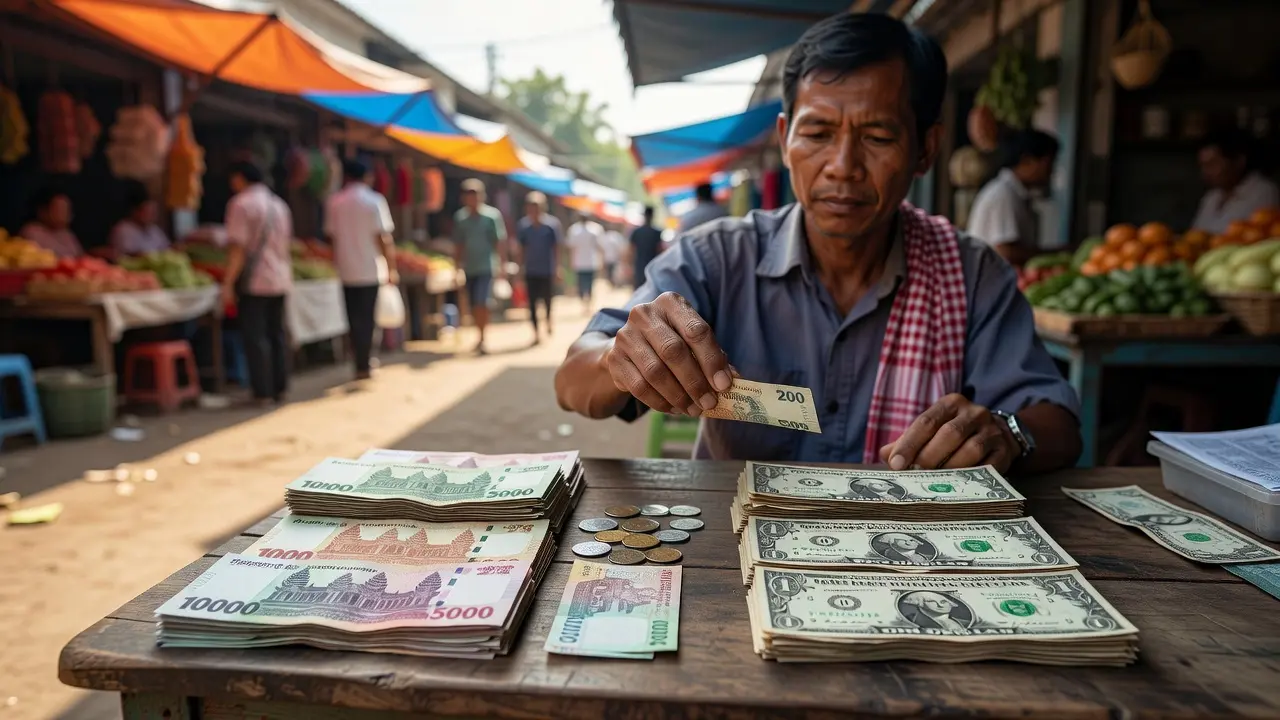
Cambodia currency at a glance
Cambodia's currency is the riel (រៀល), coded KHR, with the sign ៛ (Unicode U+17DB). The National Bank of Cambodia issues it. The riel was once divided into 10 kak and 100 sen, but inflation made these units disappear from daily use.
- Currency: Cambodian riel
- Code and numeric code: KHR, 116
- Sign: ៛, often written as R or KHR on price tags
- Subunits: kak and sen, not used
- Common notes: 100, 500, 1,000, 2,000, 5,000, 10,000, 20,000, 50,000, 100,000
- Issuer: National Bank of Cambodia
- Also in wide use: US dollar
On 25 November 2026, 1 riel is worth 0.0002 US dollars. Live rates against every currency are on the cambodian riel exchange rate page.
Riel banknotes in circulation
Riel banknotes in circulation come from several series, so you may see two different designs of the same value. Recent notes show King Norodom Sihamoni or his father, King Norodom Sihanouk, together with temples such as Angkor Wat, Banteay Srei and the Bayon.
| Note | Main colour (recent issue) | Typical use |
|---|---|---|
| 100 and 500 riel | Orange; red and pink | Small change, rarely enough to buy anything |
| 1,000 and 2,000 riel | Purple; green | Change from dollar payments, market snacks |
| 5,000 and 10,000 riel | Violet; blue | Street food, short tuk-tuk rides |
| 20,000 and 50,000 riel | Pink; brown | Larger purchases; about $5 and $12.50 at 4,000 riel per dollar |
| 100,000 riel | Green | Rarely seen in daily spending |
The 100,000 riel note, issued in 2013, is the largest regular note. Commemorative notes also exist, including a 15,000 riel note from 2019, a 30,000 riel note from 2021 and a gold-coloured 200,000 riel note issued on 16 October 2024 for the 20th anniversary of King Sihamoni's coronation. They are legal tender but mostly kept by collectors.
The National Bank of Cambodia issued coins of 50 to 500 riel from 1994, but they are almost never used, so you will handle notes only.
Riel vs dollar: how dual pricing works
In Cambodia, the khr riel and the US dollar are used side by side. Hotels, tours, restaurants and supermarkets usually quote dollars, while markets, street vendors and fuel stations often quote riel. Many receipts show both. Paying in either currency is normal, and change can come back as a mix.
- Shops count 4,000 riel to 1 dollar as a rule of thumb, even when the market rate is slightly different.
- Change under one dollar comes back in riel, because small dollar notes are scarce.
- Torn, marked or very old dollar notes are often refused; worn riel notes are rarely refused.
The scarcity of small dollar notes is deliberate. In 2020, the National Bank of Cambodia began withdrawing $1, $2 and $5 notes from wide circulation to encourage use of the riel.
A worked example with an assumed rate: a meal costs $3.50 and you pay with a $5 note. You receive $1 and 2,000 riel, because the 50 cents is given as 2,000 riel at the 4,000 rule.
How to check a riel note is real
To check a riel note, hold it to the light to see the watermark and security thread, tilt it to see colour-shifting ink or a shiny strip on higher values, and feel for raised print on the portrait. Fake riel notes are uncommon, partly because most notes are worth little. Fake or altered US dollar notes are a bigger risk, so take dollars only from banks and licensed exchange counters.
Where to exchange riel and today's rate
You rarely need to buy riel before arriving, because dollars work everywhere and change comes back in riel. In Phnom Penh, Siem Reap and border towns, licensed money changers and banks swap dollars, baht and dong for riel. ATMs in Cambodia usually dispense US dollars, and some also give riel.
Today's mid-market rate, dated 25 November 2026, is 1 KHR = 0.0002 USD. For readers in Vietnam, the khr to vnd converter shows the live rate in dong. Spend or exchange leftover riel before leaving, because it is hard to sell outside Cambodia and its neighbours.
A short history of the riel
The riel was first introduced in 1953, replacing the French Indochinese piastre. After the Khmer Rouge took power in 1975, they abolished money altogether, and Cambodia had no currency until the riel was reintroduced on 20 March 1980. Inflation in the 1980s and 1990s, and the arrival of United Nations forces in 1992 to 1993, pushed people towards the dollar. Since around 2000, the riel has stayed near 4,000 per dollar.
For other currencies in this format, see our guides to the New Taiwan Dollar Guide: TWD vs NTD and indian money. Every currency's code is in our world currencies list, and you can convert any amount with the currency converter.






