
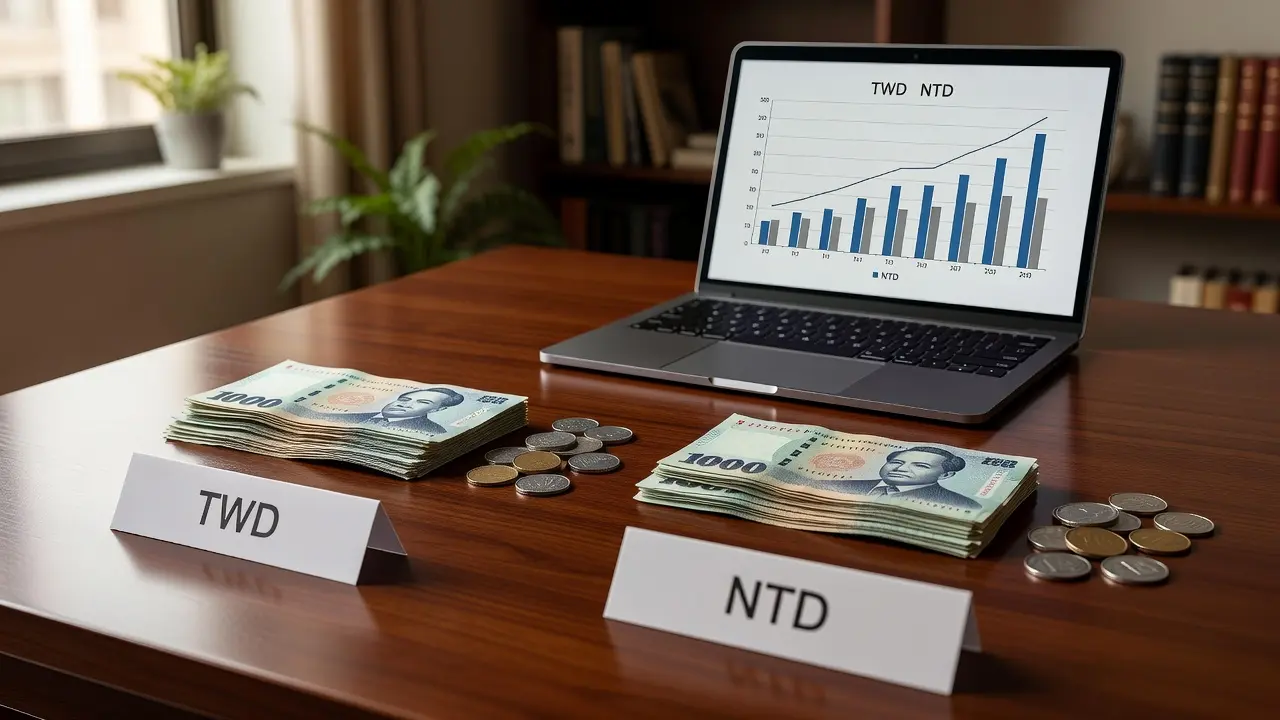
Taiwan currency at a glance
Taiwan's currency is the New Taiwan dollar (新臺幣), with the ISO code TWD and the sign NT$, often shortened to $ or written 元 (yuan) in Chinese. The Central Bank of the Republic of China (Taiwan) has issued it since July 2000; before that, the Bank of Taiwan printed the notes.
- Currency: New Taiwan dollar
- Code and numeric code: TWD, 901
- Signs: NT$, $, 元 or 圓 on notes
- Common abbreviation: NTD
- Subunit: 10 jiao (角) or 100 cents, not used in practice
- Notes: 100, 200, 500, 1,000, 2,000
- Coins: 1, 5, 10, 50 (also 1/2 and 20, rarely seen)
- Issuer: Central Bank of the Republic of China (Taiwan)
The ntd currency label shows up on travel sites, payroll slips and remittance apps, while banks and exchange tables use TWD. In speech, Taiwanese people say kuai (塊) for one dollar, so 300 kuai means NT$300. Live rates against every currency are on the new taiwan dollar exchange rate page.
Taiwan dollar banknotes in circulation
Taiwan dollar banknotes come in five values. The 100 and 200 notes show the political leaders Sun Yat-sen and Chiang Kai-shek, while the three larger notes show children, science and Taiwan's wildlife. Notes in the current series were first issued from 2000 and updated with stronger security features in 2004 and 2005.
| Note | Main colour | Front | Back |
|---|---|---|---|
| NT$100 | Red | Sun Yat-sen | Chung-Shan Building |
| NT$200 | Green | Chiang Kai-shek | Presidential Office Building |
| NT$500 | Brown | Youth baseball team | Formosan sika deer, Dabajian Mountain |
| NT$1,000 | Blue | Pupils studying a globe | Mikado pheasant, Jade Mountain |
| NT$2,000 | Purple | Formosat-1 satellite | Formosan landlocked salmon, Nanhu Mountain |
The 100, 500 and 1,000 notes do almost all the work. ATMs mostly give NT$1,000 notes, and the 200 and 2,000 notes are so rare that some shop staff check them twice. If an exchange counter offers 2,000 notes, ask for 1,000s and 100s instead, because small shops may not have change.
The NT$1,000 note is worth about 30.34 US dollars today, which makes it a handy size for daily spending in Taiwan.
Taiwan coins
Coins in daily use are NT$1, NT$5, NT$10 and NT$50. The 1, 5 and 10 dollar coins carry Chiang Kai-shek or Sun Yat-sen, and the NT$50 coin is gold-coloured. A NT$1/2 coin and a NT$20 coin exist but are rarely seen.
Coins are useful on buses that take exact fare, at night market stalls, in lockers and in the many vending machines. Most prices are whole dollars, so you will rarely need anything smaller than NT$1. Convenience stores such as 7-Eleven and FamilyMart give change in coins and also accept EasyCard and iPASS stored-value cards for small purchases.
How to check a Taiwan dollar note is real
To check a Taiwan dollar note, hold it to the light to see the watermark and the security thread, tilt it to see the colour-shifting number and the shiny strip or patch on the larger notes, and feel the raised ink on the portrait and the bank's name. The central bank lists these as the main features of the current series.
- Watermark of the portrait or image, with the denomination, against light.
- A security thread with tiny printed text, partly visible on the surface.
- Colour-shifting ink on the denomination number.
- A holographic strip on the NT$500 and NT$1,000 notes.
- Raised print that you can feel with a fingertip.
Older notes from before the 2004 and 2005 updates are still legal tender, but they have fewer features, so check them more carefully. Shops and banks in Taiwan often run large notes through counting machines that detect fakes, and a cashier holding a NT$1,000 note up to the light is normal practice, not a sign of suspicion.
Counterfeit notes are uncommon in Taiwan, but exchanging at banks or licensed counters removes the risk. Torn or damaged notes can be exchanged at banks under the central bank's rules.
Where to exchange Taiwan dollars and today's rate
In Taiwan, banks exchange major currencies, and the Bank of Taiwan counters at Taoyuan airport keep long opening hours with rates close to their city branches. Many hotels also exchange major currencies for guests, usually at a worse rate than banks. Outside Taiwan, Taiwan dollars are less common, and buying them in advance often costs more than exchanging on arrival.
Today's mid-market rate, dated 25 November 2026, is 1 TWD = 0.0303 USD. For readers in Vietnam, the twd to vnd converter shows the live rate in dong.
ATMs in convenience stores accept most foreign Visa and Mastercard cards. Fees for foreign cards vary by bank, so read the screen before confirming, and remember that your own bank may add a foreign transaction fee. For how much cash to bring for a trip, see our guide to taiwan travel money.
A worked example with an assumed rate: if 1 USD = 32 TWD, a NT$80 bowl of beef noodles is about $2.50, and a NT$1,000 note about $31.
Paying in Taiwan: cash, cards and transit cards
Taiwan is a mixed cash and card economy. Visa and Mastercard work in department stores, hotels, chain restaurants and most convenience stores, while night markets, small eateries and traditional markets usually want cash. Locals also pay with phone apps such as LINE Pay and JKOPay, but these generally need a Taiwanese phone number or bank account.
The EasyCard and iPASS are the most useful payment tools for visitors. Sold at metro stations and convenience stores, they pay for the MRT in Taipei and Kaohsiung, city buses, YouBike rentals and small purchases at 7-Eleven and FamilyMart. Top them up with cash at station machines or store counters.
Tipping is not expected in Taiwan. Many sit-down restaurants and hotels add a 10% service charge to the bill, so check before leaving extra.
Taiwan money for workers and remittances
Taiwan money matters to more than travellers. Vietnam is one of the largest sources of migrant workers in Taiwan, and many send part of their wages home each month. Wages are paid in Taiwan dollars, and the cost of sending them depends on the exchange rate and fees of the channel used: bank wires, licensed remittance companies or apps.
Because the dong and the Taiwan dollar are both priced against the US dollar, the rate between them moves with both. Comparing the rate a service offers with the mid-market rate shows the real cost; a 1% gap on NT$20,000 is NT$200. The options are covered in our guide to twd remittance.
A short history of the Taiwan dollar
The New Taiwan dollar was introduced on 15 June 1949, replacing the old Taiwan dollar at 40,000 to 1 after severe inflation. The Bank of Taiwan issued it for half a century. In July 2000, the Central Bank of the Republic of China (Taiwan) took over issue, and the current series of notes began the same year. Taiwan's central bank manages the rate as a managed float and holds one of the largest foreign exchange reserves in the world.
For other currencies in this format, see our guides to the Thai Baht Guide: Notes, Coins and Travel Tips and the cambodia currency. Every currency's code and sign is in our world currencies list, and you can convert any amount with the currency converter.






