
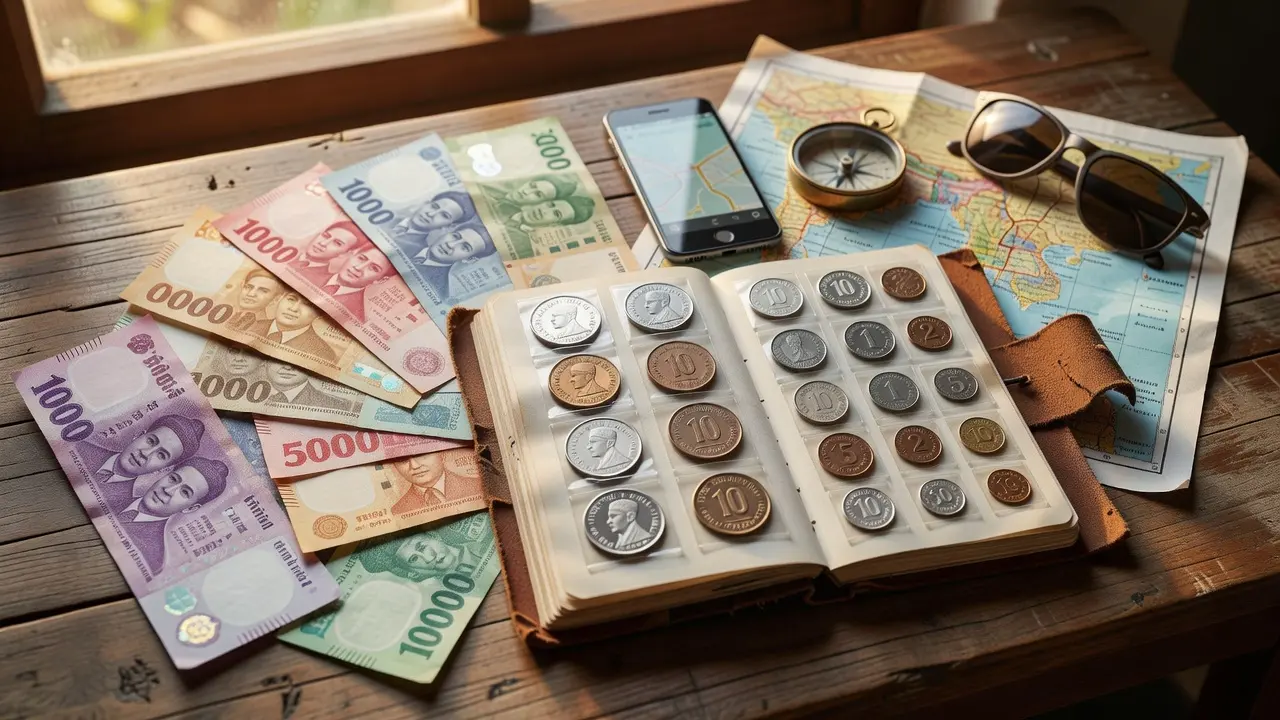
Thai currency at a glance
Thailand's currency is the baht (บาท), coded THB, with the sign ฿. The Bank of Thailand, founded in 1942, issues the notes and sets monetary policy, while the Treasury Department makes the coins. The baht has floated since July 1997.
- Currency: Thai baht
- Code and numeric code: THB, 764
- Sign: ฿ (also written บาท after the number in Thai)
- Subunit: 100 satang
- Notes: 20, 50, 100, 500, 1,000 baht
- Coins: 25 and 50 satang; 1, 2, 5 and 10 baht
- Issuer: Bank of Thailand
On 25 November 2026, 1 baht is worth 0.0294 US dollars. Live rates against every currency are on the thai baht exchange rate page.
Thai baht notes in circulation
Thai baht notes in the current Series 17, issued from 6 April 2018, show King Maha Vajiralongkorn on the front and earlier kings of the Chakri dynasty on the back. Each value has its own colour, and the 20 baht note has been printed on polymer since 2022.
| Note | Main colour | Back design (Series 17) |
|---|---|---|
| 20 baht | Green | Kings Rama I and Rama II |
| 50 baht | Blue | Kings Rama III and Rama IV |
| 100 baht | Red | Kings Rama V and Rama VI |
| 500 baht | Purple | Kings Rama VII and Rama VIII |
| 1,000 baht | Brown | Kings Rama IX and Rama X |
The 1,000 baht note is the largest, worth about 29.44 US dollars today. Street vendors, small shops and tuk-tuk drivers often cannot change a 1,000 baht note, so break large notes at convenience stores such as 7-Eleven.
Every note carries the king's portrait, and the monarchy is protected by strict laws in Thailand. Stepping on a note or a coin, for example to stop it rolling away, is considered disrespectful, so pick it up by hand.
Thai coins
Thai coins are 25 and 50 satang and 1, 2, 5 and 10 baht. The 10 baht coin is bimetallic, with a gold-coloured centre and a silver ring; the 2 baht coin is gold-coloured. Satang coins are rarely used, and prices in shops are usually whole baht, so most change you receive will be 1, 5 and 10 baht coins.
Coins are useful for songthaews (shared pick-up taxis), bus fares, temple donations and vending machines, so keep a few in your pocket.
How to check a baht note is real
To check a baht note, hold it to the light to see the king's watermark and the see-through register, tilt it to see the colour-shifting thread or patch, and feel the raised print on the portrait and the words at the top. The Bank of Thailand describes these as the main features of Series 17.
- Watermark of the king's portrait and the value, visible against light.
- A security thread woven into the paper, visible as a line when held to the light.
- Colour-shifting ink or a hologram patch on higher values.
- Raised print on the portrait and the denomination.
- A clear window on the polymer 20 baht note.
How prices are written in baht
Thai prices are usually written as a number followed by "baht" or บาท, such as 120 บาท, or with the ฿ sign before the number, such as ฿120. Menus in tourist areas often show only the number. Satang appear in supermarket and fuel prices, written as decimals, for example 35.50 baht.
Thai numerals are still used on some signs, temple entry boards and older price tags. They look different from Western digits, so it helps to know a few:
- ๑ = 1, ๒ = 2, ๓ = 3, ๔ = 4, ๕ = 5
- ๖ = 6, ๗ = 7, ๘ = 8, ๙ = 9, ๐ = 0
A sign reading ๑๐๐ บาท means 100 baht. Some places show one price in Thai numerals and a higher one in Western digits for foreigners, a two-tier system used at certain national parks and attractions. The national park entry fee for foreign adults, for example, is set separately from the fee for Thai citizens.
Older baht notes and damaged notes
Older baht notes from Series 16, with King Bhumibol Adulyadej on the front, remain legal tender alongside the current series, so you can spend them normally. Commemorative notes issued for royal anniversaries are also legal tender, though many people keep them rather than spend them.
Shops may refuse notes that are badly torn, written on or taped together. Commercial banks in Thailand exchange damaged notes under Bank of Thailand rules, and the amount refunded depends on how much of the note remains. Money changers abroad are stricter: many refuse folded, marked or old-series baht notes, so bring clean notes if you buy baht before travelling.
Where to exchange baht and today's rate
In Bangkok, licensed money changers such as SuperRich, with branches around Ratchadamri and in shopping malls, often give rates close to mid-market for major currencies. Bank exchange booths are common in tourist areas, and airport counters usually charge more. Outside Thailand, baht is easy to buy in most of Southeast Asia.
Today's mid-market rate, dated 25 November 2026, is 1 THB = 0.0294 USD. For readers in Vietnam, the baht to vnd converter shows the live rate in dong.
ATMs are everywhere, but most Thai banks charge foreign cards about 220 baht per withdrawal, on top of any fee from your own bank. Withdrawing a larger amount once costs less than several small withdrawals. Our guide to thai baht cash covers how much to carry for different trips.
A worked example with an assumed rate: if 1 USD = 33 THB, a 60 baht bowl of noodles is about $1.80, and the 220 baht ATM fee is about $6.70, which is a large share of a small withdrawal.
Thailand money and payments
Thailand money habits mix cash and phone payments. Thais pay by scanning PromptPay QR codes at most shops and stalls, but this requires a Thai bank account, so visitors mostly use cash and cards. Cards are accepted in hotels, malls, chain restaurants and larger shops; markets, street food and taxis usually want cash.
Some shops add a surcharge of about 2% to 3% for card payments, and hotels often take a deposit on a card at check-in. When a card machine asks whether to charge in baht or your home currency, choose baht.
Tipping is not required, but rounding up a taxi fare or leaving 20 baht at a restaurant is common. Prices at markets can be bargained; prices in shops and restaurants are fixed.
A short history of the baht
The baht began as a unit of weight for silver, and older Western texts call it the tical. In 1897 Thailand, then Siam, made the baht decimal, dividing it into 100 satang. The Bank of Thailand opened in 1942 and took over note issue. After decades of a fixed or managed rate, the baht was floated on 2 July 1997, which set off the Asian financial crisis as it lost about half its value against the dollar within months.
For other currencies in this format, see our guides to chinese money and the taiwan currency. Every currency's code and sign is in our world currencies list, and you can convert any amount with the currency converter.






