
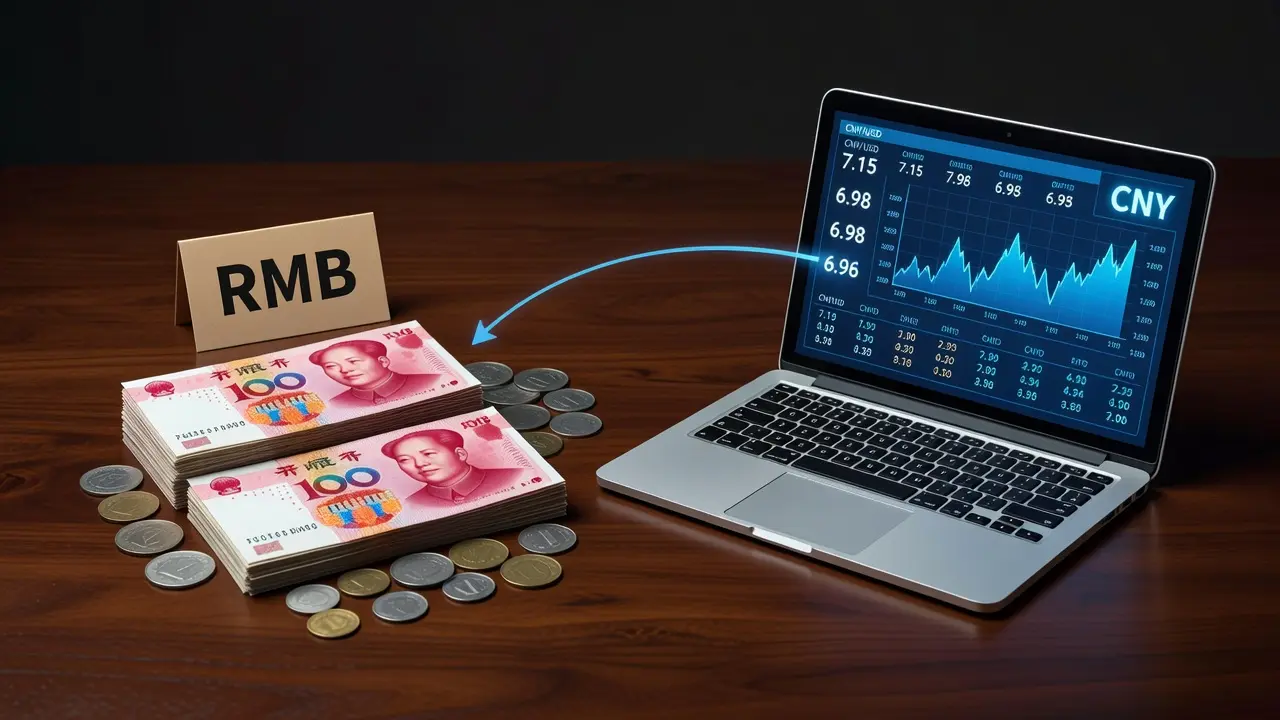
Currency of china at a glance
China's currency is the renminbi, meaning "people's currency", and its unit is the yuan. The ISO code is CNY, and the signs are ¥ in international text and 元 in Chinese. The People's Bank of China is the central bank. It manages the yuan against a basket of currencies, setting a daily central parity rate around which the onshore yuan may trade within a band.
- Currency: renminbi (RMB); unit: yuan (元)
- Code and numeric code: CNY, 156
- Signs: ¥, ¥ or 元; spoken "kuai" (块) for yuan
- Subunits: 10 jiao (角, spoken "mao") = 1 yuan; 100 fen (分) = 1 yuan
- Notes: 1, 5, 10, 20, 50, 100 yuan (and older jiao notes)
- Coins: 1 yuan, 5 jiao, 1 jiao
- Issuer: People's Bank of China
On 25 November 2026, 1 yuan is worth 0.1501 US dollars. Live rates against every currency are on the chinese yuan exchange rate page.
RMB vs CNY vs CNH: what each term means
RMB and CNY refer to the same currency: renminbi is its name and CNY is its ISO code, the way "sterling" and GBP describe the British pound. CNH is a market label for yuan traded offshore, mainly in Hong Kong. It is the same currency, but its rate can differ slightly from the onshore CNY.
| Term | Meaning | Where you see it |
|---|---|---|
| Renminbi (RMB) | Official name of China's currency | News, contracts, Chinese law |
| Yuan (元) | The unit, like "dollar" | Prices: 50 yuan, 50元 |
| CNY | ISO 4217 code for onshore renminbi | Banks, invoices, exchange tables |
| CNH | Offshore renminbi traded outside mainland China | Financial markets, Hong Kong banks |
| Kuai (块) | Everyday spoken word for yuan | Markets, taxis, speech |
Chinese money shares the ¥ sign with the Japanese yen, which is a common source of confusion on receipts and websites; our page on the japanese yen symbol explains how to tell them apart.
Yuan banknotes in circulation
All current yuan notes belong to the fifth series and show Mao Zedong on the front, with a Chinese landmark on the back. The 100 yuan was updated in November 2015, the 50, 20, 10 and 1 yuan in August 2019, and the 5 yuan in November 2020. Older editions remain legal tender.
| Note | Main colour | Back design |
|---|---|---|
| 100 yuan | Red | Great Hall of the People, Beijing |
| 50 yuan | Green | Potala Palace, Lhasa |
| 20 yuan | Brown | Li River, Guilin |
| 10 yuan | Blue | Three Gorges of the Yangtze |
| 5 yuan | Purple | Mount Tai |
| 1 yuan | Olive green | West Lake, Hangzhou |
The 100 yuan note is the largest, worth about 15.00 US dollars today. China has never issued a larger note for general use, partly because mobile payments now handle most large purchases. Older 1 and 5 jiao notes are still legal tender and occasionally appear as change, mostly outside big cities. Each note has the value written in Chinese, in Latin numerals and in Mongolian, Tibetan, Uyghur and Zhuang scripts on the back, a detail that shows the country's official minority languages.
Chinese coins
Coins in daily use are 1 yuan, 5 jiao and 1 jiao. The 2019 edition made the 1 yuan coin slightly smaller and changed the 5 jiao from brass to a steel coin with a nickel-plated finish. Fen coins are still legal tender but rarely seen, and in cities many people pay for everything by phone, so coins are less common than in the past.
How to check a yuan note is real
To check a 100 yuan note, tilt it to see the large "100" in the middle change colour between gold and green, look for the security thread that shifts colour, hold it to the light for the Mao Zedong watermark, and feel the raised print on the portrait and the words "People's Bank of China".
- Colour-shifting "100" on the front, which also shows a moving bright band when tilted.
- Security thread with windowed sections that change colour.
- Watermark of Mao Zedong and of the denomination number.
- Raised intaglio print on the portrait and the bank's name.
- Features visible under ultraviolet light.
Many Chinese shops and banks check large notes with counting machines that detect fakes. Exchanging at banks avoids the risk of receiving a bad note.
How prices are written and spoken in yuan
Chinese prices are written with ¥ before the number or 元 after it, and can include two decimal places for jiao and fen: ¥12.50 is twelve yuan and five jiao. In speech, people say kuai for yuan and mao for jiao, so "shí èr kuài wǔ" means 12.50 yuan.
- ¥38 or 38元: thirty-eight yuan.
- ¥6.5 or 6块5: six yuan fifty.
- 2万元: 20,000 yuan, using 万 (10,000) as in Japanese and Korean.
- 1.2亿元: 120 million yuan, using 亿 (100 million) in business news.
On a menu or market board, the 元 is often left out entirely, and a price of "28" simply means 28 yuan. Fen amounts rarely matter in cash; mobile payments charge to the exact fen.
Paying in China: Alipay, WeChat Pay and cash
Most payments in Chinese cities go through two mobile apps, Alipay and WeChat Pay, by scanning a QR code. Since 2023 both apps have allowed visitors to link foreign Visa and Mastercard cards, and spending limits for foreigners have been raised. International cards work in large hotels and department stores but are accepted less widely than in many countries.
Cash remains legal tender, and the People's Bank of China has repeatedly said that businesses may not refuse cash. Carrying a few hundred yuan in small notes helps at small shops, taxis and markets that are used to mobile payment and may not keep much change. Our guide to china travel money covers what to bring.
Where to exchange yuan and today's rate
Inside China, banks such as Bank of China exchange major currencies at their branches and at airports. Outside China, yuan is widely available in Asian countries. Rates for cash are usually a little worse than the mid-market rate, and it helps to keep your exchange receipts, which banks may ask for when you convert unused yuan back before leaving.
Today's mid-market rate, dated 25 November 2026, is 1 CNY = 0.1501 USD. For dollar budgets, see usd to rmb, and for readers in Vietnam, cny to vnd.
A worked example with an assumed rate: if 1 USD = 7.10 CNY, a 300 yuan hotel night is about $42, and a 25 yuan noodle lunch about $3.50.
A short history of the renminbi
The People's Bank of China issued the first renminbi on 1 December 1948, shortly before the founding of the People's Republic. A new renminbi replaced the old at 10,000 to 1 in 1955. For years the yuan was fixed against the dollar, at about 8.28 per dollar from the mid-1990s until July 2005, when China moved to a managed float against a basket. In October 2016 the yuan joined the International Monetary Fund's Special Drawing Right basket. Long-run moves are charted on our yuan to usd history page.
For other currencies in this format, see the guides to thai currency and the Russian Ruble Guide. Every currency's code and sign is in our world currencies list, and you can convert any amount with the currency converter.






