
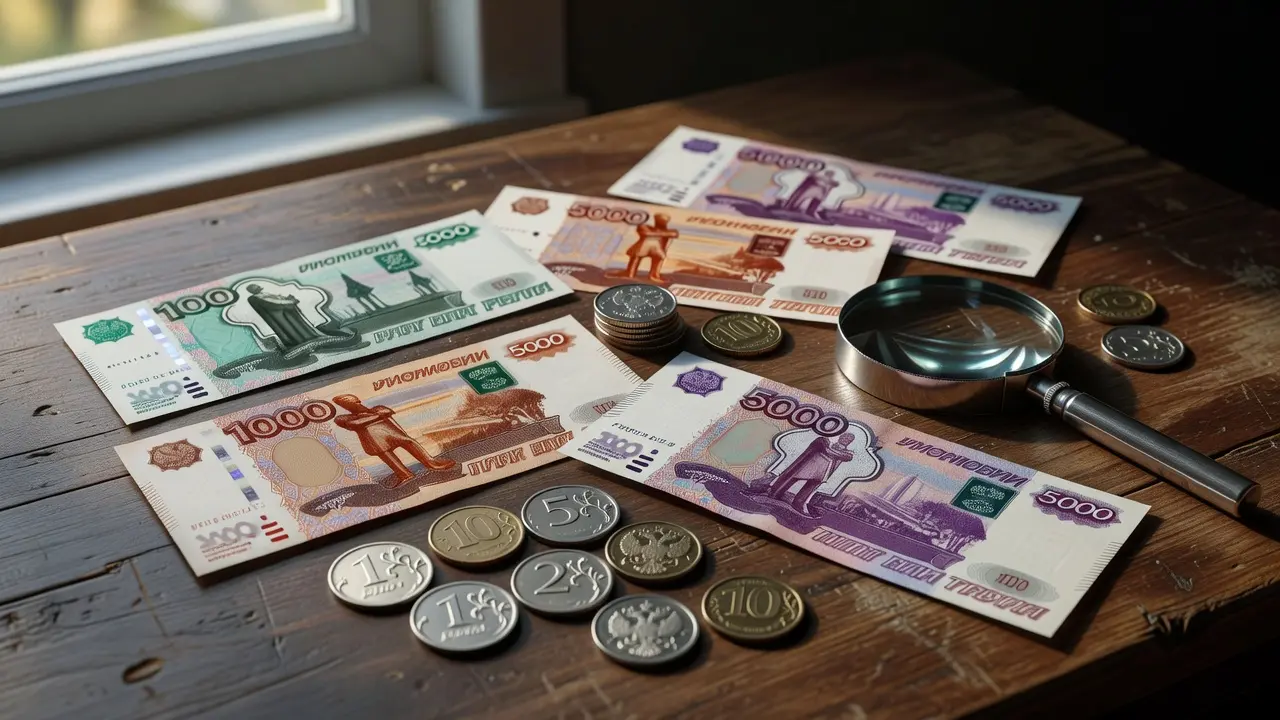
Russian currency at a glance
Russia's currency is the ruble (рубль), coded RUB, with the sign ₽. The Bank of Russia is the central bank and the only issuer of notes and coins. The rouble, as it is also spelled in British English, floats, and its rate is affected by capital controls introduced after 2022.
- Currency: Russian ruble
- Code and numeric code: RUB, 643
- Sign: ₽ (also written руб. or р.)
- Subunit: 100 kopecks
- Notes in common use: 100, 200, 500, 1,000, 2,000, 5,000 rubles
- Coins: 1, 5, 10, 50 kopecks; 1, 2, 5, 10 rubles
- Issuer: Bank of Russia
On 25 November 2026, 1 ruble is worth 0.0122 US dollars. Live rates against every currency are on the russian ruble exchange rate page, and the most watched pair is usd rub.
Ruble notes in circulation
Ruble notes in the 1997 design series show a Russian city on each note, with a landmark on the front and back. The 200 and 2,000 ruble notes were added in October 2017. The Bank of Russia has begun issuing modernised versions of some notes since 2022, and older designs remain valid.
| Note | City shown |
|---|---|
| 50 rubles | Saint Petersburg |
| 100 rubles | Moscow (1997 design: Bolshoi Theatre) |
| 200 rubles | Sevastopol |
| 500 rubles | Arkhangelsk |
| 1,000 rubles | Yaroslavl |
| 2,000 rubles | Vladivostok and the Vostochny cosmodrome |
| 5,000 rubles | Khabarovsk |
The 5,000 ruble note is the largest, worth about 60.89 US dollars today. Small kiosks and buses may not accept it, so carry 100 and 500 ruble notes for small purchases. Notes of 5 and 10 rubles also exist but are rare; coins cover those amounts.
Russian coins
Russian coins come in 1, 5, 10 and 50 kopecks and 1, 2, 5 and 10 rubles. Kopeck coins are worth very little and are seldom used, while the 10 ruble coin, introduced to replace the 10 ruble note, is common in change. The Bank of Russia also issues many commemorative 10 ruble coins.
How to check a ruble note is real
To check a ruble note, hold it to the light for the watermark and the security thread, tilt it to see the colour-changing coat of arms or numbers, and feel the raised print. The Bank of Russia publishes the features of each note.
- Watermarks with the value and an image, visible against light.
- A security thread that appears as a dashed line and becomes continuous against light.
- Colour-shifting ink on the coat of arms of the higher notes.
- Raised print on the words "Bank of Russia" in Russian and on the value.
- Microperforation of the value, visible as tiny holes against light.
Paying in Russia and card restrictions since 2022
Since March 2022, Visa and Mastercard have suspended operations in Russia, and many Russian banks have been cut off from the SWIFT messaging network. As a result, cards issued abroad do not work at Russian shops or ATMs, and Russian-issued Visa and Mastercard cards do not work outside Russia.
Inside Russia, payments run on the domestic Mir card system and on fast payment transfers between Russian banks. Visitors without a Russian bank account usually rely on cash brought in foreign currency and exchanged at banks in Russia. Sanctions and payment rules change, so check the latest situation with your bank and airline before travelling.
Where to exchange rubles and today's rate
Inside Russia, banks and their exchange offices change US dollars, euros and Chinese yuan into rubles. Outside Russia, few banks hold ruble cash, and spreads are often wide. In Vietnam, rubles are rarely available in cash, so travellers usually exchange dollars after arriving.
Today's mid-market rate, dated 25 November 2026, is 1 RUB = 0.0122 USD. For readers in Vietnam, the rub to vnd page shows the live rate in dong.
A worked example with an assumed rate: if 1 USD = 80 RUB, a 1,500 ruble dinner is about $18.75, and a 5,000 ruble note is about $62.50.
A short history of the ruble
The ruble is one of the oldest currencies in the world, with roots in medieval Russia. After the Soviet Union broke up, high inflation in the 1990s led to a redenomination on 1 January 1998, when one new ruble replaced 1,000 old rubles. The ruble fell sharply in the 2014 and 2022 crises and moved to a free float in November 2014. The ₽ sign was approved by the Bank of Russia in December 2013 after a public vote.
For other currencies in this format, see the Australian Dollar Guide: Polymer Notes and Coins and the guide to the singapore currency. Every currency's code and sign is in our world currencies list, and you can convert any amount with the currency converter.






