
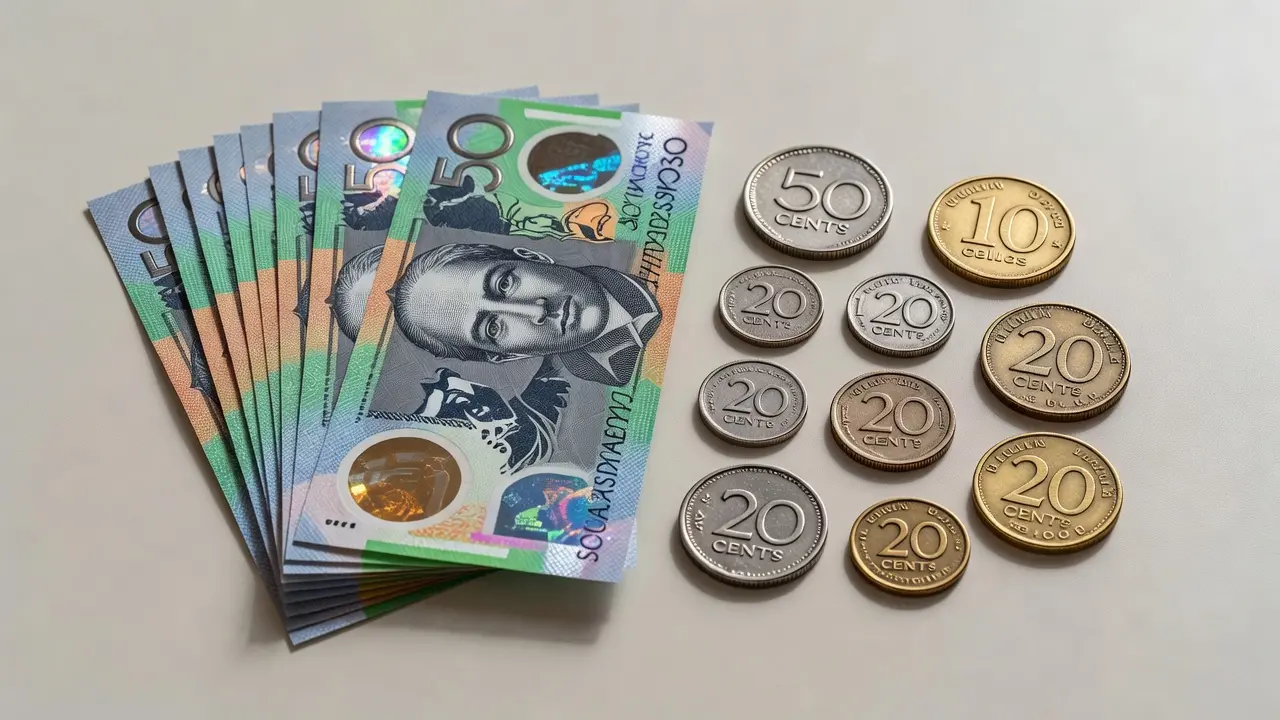
Australian currency at a glance
Australia's currency is the Australian dollar, coded AUD and written A$ or simply $ inside Australia. The Reserve Bank of Australia (RBA) issues the notes and sets monetary policy, and the Royal Australian Mint makes the coins. The dollar has floated freely since December 1983.
- Currency: Australian dollar
- Code and numeric code: AUD, 036
- Sign: A$ (or $ locally)
- Subunit: 100 cents
- Notes: $5, $10, $20, $50, $100
- Coins: 5c, 10c, 20c, 50c, $1, $2
- Issuer: Reserve Bank of Australia
On 25 November 2026, A$1 is worth 0.6626 US dollars. Live rates against every currency are on the australian dollar exchange rate page. The Australian dollar is also used by Kiribati, Nauru and Tuvalu. It is among the most traded currencies in the world, and traders often call it the "Aussie".
AUD notes in circulation
The AUD notes in circulation are the Next Generation Banknote series, issued between 2016 and 2020, together with older polymer notes that are still legal tender. Each note except the $5 shows two notable Australians, one on each side, and every note has a clear window running from top to bottom.
| Note | Colour | People shown (Next Generation series) |
|---|---|---|
| $5 | Purple-pink | Queen Elizabeth II; Parliament House on the back |
| $10 | Blue | Banjo Paterson, poet, and Dame Mary Gilmore, writer |
| $20 | Red | Mary Reibey, businesswoman, and Reverend John Flynn, founder of the Royal Flying Doctor Service |
| $50 | Yellow | David Unaipon, inventor and writer, and Edith Cowan, the first woman elected to an Australian parliament |
| $100 | Green | Dame Nellie Melba, soprano, and Sir John Monash, engineer and general |
In February 2023 the RBA announced that the next $5 note would carry a design honouring First Nations culture and history instead of a portrait of King Charles III. Until the new note is issued, the current $5 with Queen Elizabeth II stays in circulation and remains legal tender.
The $50 is the most common note in circulation, and the $100 note, the largest, is worth about 66.26 US dollars today. Each note in the series has raised bumps on its long edges so that people with low vision can identify the value by touch: one bump for $5, up to five for $100.
Australian coins
Australian coins come in 5, 10, 20 and 50 cents, and in $1 and $2. The 50 cent coin has twelve sides, and the gold-coloured $2 coin is smaller than the $1 coin even though it is worth twice as much. The 1 and 2 cent coins were withdrawn in 1992, and cash totals have been rounded to the nearest 5 cents since then; card payments are charged to the exact cent.
The Royal Australian Mint regularly issues commemorative $1, $2 and 50 cent coins with special designs, which circulate alongside the standard ones.
Australia money for students and workers
Students and workers in Australia are paid and charged in Australian dollars, and the exchange rate decides how much their home currency buys. Under the Fair Work Commission's annual wage review, the national minimum wage rose to A$24.95 an hour from 1 July 2025. A full-time week of 38 hours at that rate is about A$948 before tax.
A worked example with an assumed rate of A$1 = 17,000 dong: a weekly wage of A$948 is about 16.1 million dong, and a yearly tuition bill of A$40,000 is about 680 million dong. A move of 5% in the rate changes that tuition bill by about 34 million dong, which is why many families watch the rate before paying.
Opening an Australian bank account early helps: wages are paid into it, and tuition and rent can be paid locally without international transfer fees. When sending money home or receiving it from abroad, compare the amount that arrives across two or three providers, since margins differ more than fees.
Paying in Australia
Australia is one of the countries where visitors rarely need cash. Contactless cards and phone wallets work in shops, cafés, taxis and on public transport in cities such as Sydney and Brisbane. Some businesses add a small surcharge for card payments, which must be shown before you pay. Keeping a few coins is useful for parking meters and small market stalls. Tipping is not expected in most places, so the price shown is usually the price you pay.
How to check an Australian note is real
To check an Australian note, look through the clear top-to-bottom window, tilt the note to see the flying bird and the reversible number in the window change, and feel the raised print and tactile bumps. The RBA lists these as the main features of the Next Generation notes.
- Clear window running from top to bottom, with a bird that flaps its wings and changes colour when tilted.
- A number in the window that reverses direction when the note is tilted.
- Rolling colour effect on a bird in the top corner.
- Raised print on the portraits and large numbers.
- Microprinting and features that glow under ultraviolet light.
Older polymer notes from the 1990s series do not have the top-to-bottom window, but they have a smaller clear window with a printed image and remain legal tender. Shops accept both series, and banks exchange worn or damaged notes under RBA rules.
Polymer notes are difficult to copy and hard to tear. A paper-feel note or a window that is only printed, not clear, is a warning sign.
Where to exchange Australian dollars and today's rate
Banks, licensed money changers and travel money shops exchange Australian dollars in most countries, because AUD is one of the more traded currencies. In Australia, cards and phone payments are accepted almost everywhere, so many visitors use little cash. Airport counters in Sydney and Melbourne are convenient but usually charge more than city shops.
Today's mid-market rate, dated 25 November 2026, is A$1 = 0.6626 USD. For readers in Vietnam, the aud to vnd converter shows the live rate in dong, and for readers in India, aud to inr shows the rate in rupees.
Students often pay large sums in Australian dollars for tuition. Our guide to how to pay tuition abroad compares bank transfers and specialist services. A worked example with an assumed rate: if A$1 = 0.65 USD, a tuition bill of A$40,000 is about $26,000; a 1% better rate saves about $260.
A short history of the Australian dollar
Australia changed to decimal currency on 14 February 1966, when the Australian dollar replaced the Australian pound at two dollars to the pound. Paper notes were used until the polymer era: the commemorative $10 note of 1988 marked the bicentenary of European settlement and was the world's first polymer note, and by 1996 all denominations were polymer. The $1 note was replaced by a coin in 1984 and the $2 note by a coin in 1988, which is why Australia has no notes below $5. The dollar was floated in December 1983, ending decades of fixed and managed rates, and it has moved freely against the US dollar since then, often in line with prices for the commodities Australia exports. Long-run moves are charted on our australian dollar history page.
Other currencies in this format are covered in the Singapore Dollar Guide: Notes, Coins and Value and the guide to the russian currency. Every currency's code and sign is in our world currencies list, and you can convert any amount with the currency converter.






