
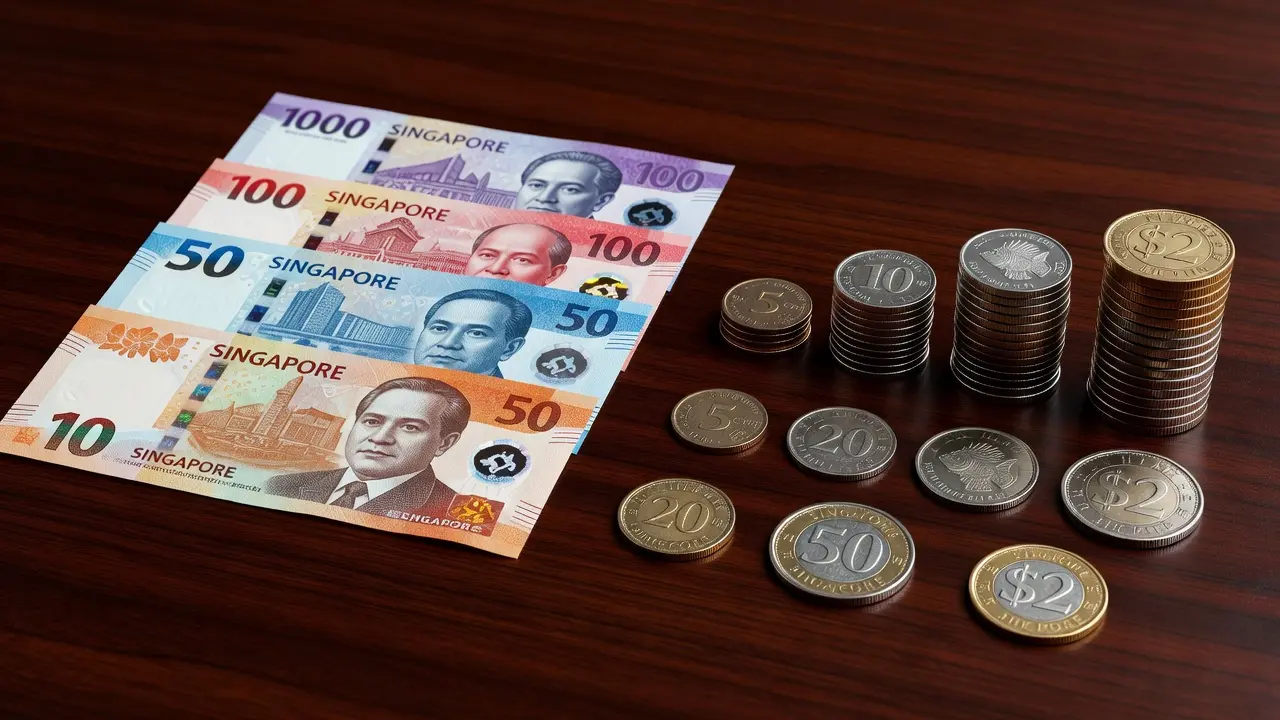
Singapore currency at a glance
Singapore's currency is the Singapore dollar, coded SGD and shown as S$ or simply $ inside Singapore. MAS is the central bank and currency issuer. Instead of targeting an interest rate, MAS steers the Singapore dollar's trade-weighted value within an undisclosed policy band, which it reviews in regular monetary policy statements.
- Currency: Singapore dollar
- Code and numeric code: SGD, 702
- Sign: S$ (or $ locally)
- Subunit: 100 cents
- Notes in daily use: $2, $5, $10, $50, $100
- Coins: 5, 10, 20, 50 cents and $1
- Issuer: Monetary Authority of Singapore
On 25 November 2026, S$1 is worth 0.775 US dollars. Live rates against every currency are on the singapore dollar exchange rate page. The Singapore dollar is often listed among the strongest currency in asia by unit value.
SGD notes in circulation
The SGD notes in circulation are the Portrait Series, issued from 9 September 1999. Each shows Yusof bin Ishak on the front and a theme about Singapore on the back. The $2, $5 and $10 notes moved to polymer between 2004 and 2007, which makes them last longer in daily use.
| Note | Colour | Back theme | Status |
|---|---|---|---|
| $2 | Purple | Education | Polymer since 2006 |
| $5 | Green | Garden City | Polymer since 2007 |
| $10 | Red | Sports | Polymer since 2004 |
| $50 | Blue | Arts | In circulation |
| $100 | Orange | Youth | In circulation |
| $1,000 | Purple | Government | Not issued since 1 January 2021, still legal tender |
| $10,000 | Gold | Economics | Not issued since 1 October 2014, still legal tender |
MAS stopped issuing the two largest notes to reduce money laundering and terrorism financing risks, since large notes make it easy to move big sums in cash. Existing $1,000 and $10,000 notes can still be spent or deposited.
All Portrait Series notes share the same portrait, so the colour and the large number are the quickest way to tell them apart. The $2 and $1,000 notes are both purple, but the $1,000 is much larger and rarely seen. Notes also grow in length with their value, which helps when sorting them by touch.
The $100 note, the largest in daily use, is worth 77.50 US dollars today. Most shops are happy with $50 notes, but hawker centres prefer $2, $5 and $10.
How MAS manages the Singapore dollar
MAS manages the Singapore dollar's exchange rate rather than a short-term interest rate. It tracks the currency against a basket of the currencies of Singapore's main trading partners, a measure known as the S$NEER, and keeps it within a policy band whose level, width and slope it does not publish in exact numbers.
The reason is Singapore's open economy. Imports and exports are large compared with the size of the economy, so the exchange rate has a strong effect on prices. Letting the Singapore dollar rise gradually against the basket helps keep imported inflation down; slowing that rise supports exporters when growth is weak.
MAS announces its policy in monetary policy statements, which it has published four times a year since 2024. A change to the slope or the centre of the band can move the Singapore dollar on the day of the statement. Against any single currency, such as the US dollar, the Singapore dollar still floats, so its rate against the dollar or the dong changes every day.
Paying in Singapore: cards, NETS and PayNow
Singapore money is mostly spent electronically. Contactless Visa and Mastercard cards are accepted on MRT trains and public buses through the SimplyGo system, as well as in most shops and restaurants. Local systems include NETS, a debit network, and PayNow, which lets people send money with a phone number.
Visitors can manage almost entirely with a card, but some hawker stalls and small shops still prefer cash or local QR payments. Carrying S$50 to S$100 in small notes covers most of those cases, and a few coins help at drink stalls and older vending machines that do not take cards. Check whether your card charges a foreign transaction fee, and always pay in Singapore dollars if a terminal offers to charge your home currency.
Singapore coins
The current coins, the third series released in 2013, are 5, 10, 20 and 50 cents and $1. Each shows a Singapore landmark. The 1 cent coin is no longer issued but remains legal tender. The $1 coin is the one visitors use most, for public transport top-ups at machines and for small purchases at hawker stalls.
Singapore money also includes the coins and notes of Brunei, which are accepted in Singapore at par under a currency interchangeability agreement dating from 1967. You may receive a Brunei note in change; it is worth exactly the same as a Singapore one.
How to check a Singapore note is real
To check a Portrait Series note, tilt it to see the hologram or the kinegram on polymer notes, hold it up to the light for the watermark and the see-through lion head symbol, and feel the raised print on the portrait. MAS lists these among the main features on its notes.
- Watermark of Yusof bin Ishak on paper notes, and a clear window on polymer notes.
- Kinegram or hologram that changes image when tilted.
- Raised print on the portrait and on the words "Singapore".
- Microprinting and features visible under ultraviolet light.
Where to exchange SGD and today's rate
Licensed money changers in Singapore, especially in areas such as Raffles Place, Chinatown and Little India, often give rates close to mid-market for major currencies. Bank ATMs accept most foreign cards, and cards are widely accepted, so many visitors carry little cash.
Today's mid-market rate, dated 25 November 2026, is S$1 = 0.775 USD. For travellers from Vietnam, the sgd to vnd converter shows the live rate in dong. Our singapore travel money guide covers how much to bring and when cash is needed.
A worked example with an assumed rate: if S$1 = 0.75 USD, a S$15 hawker meal for two is about $11, and a S$200 hotel night is about $150. Prices in Singapore are shown in Singapore dollars with two decimals, such as $4.50, and goods and services tax is usually included in the displayed price.
Workers and students from abroad who are paid in Singapore dollars can send money home through banks or remittance companies licensed by MAS under the Payment Services Act. Licensed providers are listed in the MAS Financial Institutions Directory, which is worth checking before using a new service. Compare the amount the recipient gets in their currency, not the advertised fee: on S$1,000, a margin difference of 1% is S$10.
Leftover Singapore dollars are easy to sell back in most Asian countries, including Vietnam, because the currency is widely traded. Coins are the exception; spend them before you fly, for example at Changi Airport shops.
A short history of the Singapore dollar
Singapore issued its own dollar in 1967, two years after independence, replacing the Malaya and British Borneo dollar. The Board of Commissioners of Currency issued notes until its role passed to MAS, which had been set up in 1971 to manage monetary policy. The Orchid, Bird, Ship and Portrait series of notes followed. Since 1981, MAS has managed the currency against a trade-weighted basket. The long-term moves are charted on our sgd history page.
For other currencies in this format, see the guides to US Dollar Banknotes: All Denominations Explained and the australian currency. Every currency's code and sign is in our world currencies list, and you can convert any amount with the currency converter.






