
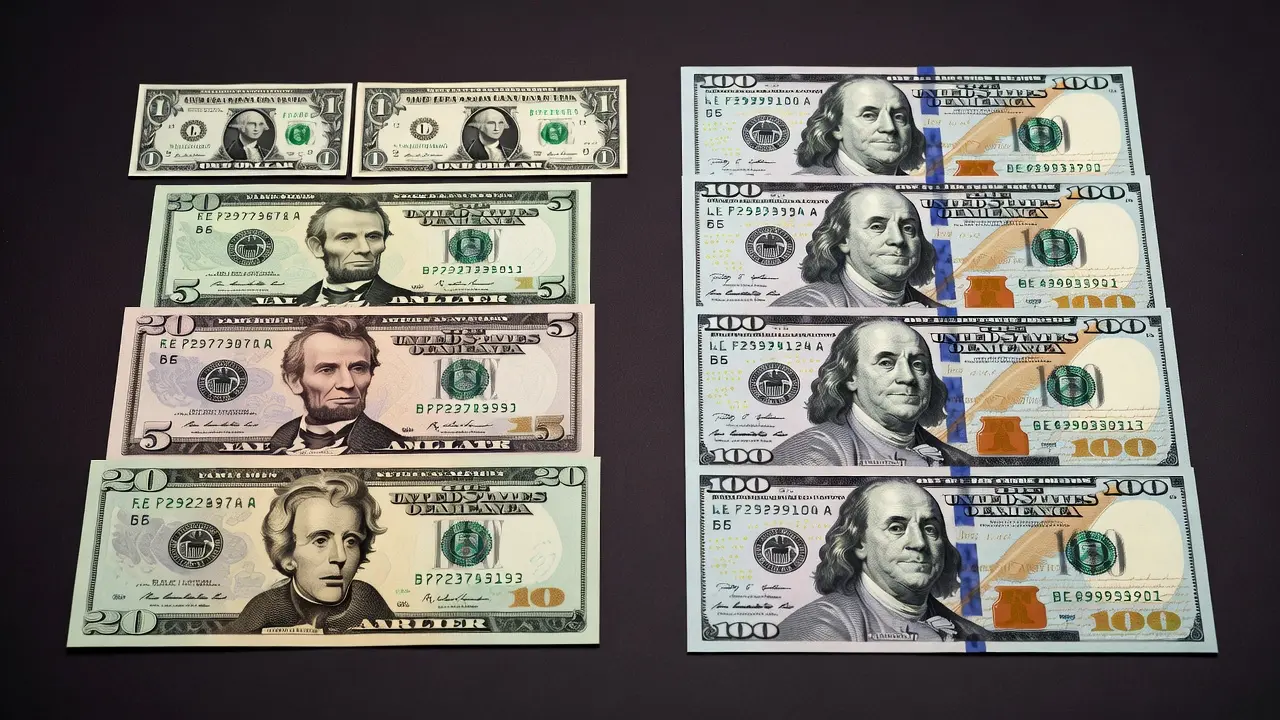
US dollar bills at a glance
The US dollar has the ISO code USD and the sign $, and it is divided into 100 cents. The Federal Reserve System is the central bank and issues the notes; the US Mint makes the coins. The dollar floats freely and is the most traded currency in the world.
- Currency: United States dollar
- Code and numeric code: USD, 840
- Sign: $ (cents: ¢)
- Subunit: 100 cents
- Notes: $1, $2, $5, $10, $20, $50, $100
- Issuer of notes: Federal Reserve; printed by the Bureau of Engraving and Printing
- Coins: minted by the US Mint
On 25 November 2026, $1 is 25,834 Vietnamese dong at the mid-market rate. For other currencies, see the us dollar exchange rate page.
USD denominations: notes in circulation
The seven USD denominations in circulation are $1, $2, $5, $10, $20, $50 and $100. All are the same size, and older designs are mostly green and black, so value is easiest to read from the large number and the portrait. Since the 2000s, the $5 and higher notes have added background colours and larger numbers.
| Note | Portrait on front | Image on back |
|---|---|---|
| $1 | George Washington | The Great Seal of the United States |
| $2 | Thomas Jefferson | The signing of the Declaration of Independence |
| $5 | Abraham Lincoln | The Lincoln Memorial |
| $10 | Alexander Hamilton | The US Treasury Building |
| $20 | Andrew Jackson | The White House |
| $50 | Ulysses S. Grant | The US Capitol |
| $100 | Benjamin Franklin | Independence Hall |
Hamilton and Franklin are the only people on current notes who were never president. The $2 note is still printed but rarely used, so many Americans have never received one in change; it is valid everywhere.
The $1 note has kept essentially the same design for decades and was left out of the redesigns that added colour and new security features to higher notes.
Notes of $500, $1,000, $5,000 and $10,000 also exist. They were last printed in 1945 and the Federal Reserve stopped issuing them in 1969. They are still legal tender, but collectors pay far more than face value for them, so they never appear in daily use.
US coins
US coins in use are the nickel (5¢), dime (10¢), quarter (25¢), half dollar (50¢) and dollar coin, plus the penny (1¢). The US Mint struck its last circulating penny in November 2025, ending production because each coin cost more to make than it was worth. Pennies remain legal tender and are still common in change.
The quarter is the coin most people use, for parking meters, laundry machines and tolls. Half dollars and dollar coins exist in large numbers but are rarely seen in daily life. Coins cannot be sold back at foreign exchange counters outside the US, so spend them before leaving.
How to check a $100 bill is real
To check a $100 bill, tilt it to see the blue 3-D security ribbon, where bells change to 100s as you move the note, and watch the copper inkwell bell turn green. Hold it to the light for Franklin's watermark and the embedded security thread. Run a finger over his shoulder to feel the raised print.
- 3-D security ribbon: a blue ribbon woven into the paper, with bells and 100s that move when the note is tilted.
- Bell in the inkwell: changes from copper to green when tilted.
- Portrait watermark: a faint image of Franklin visible from both sides against light.
- Security thread: a thin strip with "USA 100" that glows pink under ultraviolet light.
- Colour-shifting 100: the large number in the lower right corner changes from copper to green.
- Raised printing: Franklin's coat feels rough.
The Federal Reserve's site uscurrency.gov publishes these features for every note. Lower notes have their own threads that glow different colours under UV: blue for $5, orange for $10, green for $20 and yellow for $50.
The paper is a blend of cotton and linen, not wood pulp, which is why US notes feel different from ordinary paper and survive being washed in a pocket.
Series years and note designs
Every US note carries a series year printed near the portrait, such as "Series 2017 A". It shows when the design or the signatures of the Treasurer and Treasury Secretary changed, not the exact year the note was printed. The letter after the year marks a minor change within the same series.
For the $100 note, three design generations are still found in circulation:
- Small-portrait notes from before 1996, with Franklin's portrait in an oval and no watermark. They are often called "small head" notes.
- Large-portrait notes from 1996 to 2009, with an off-centre portrait, a watermark and a colour-shifting 100. They are often called "big head" notes.
- Current notes from 2013, with the blue 3-D security ribbon and the bell in the inkwell.
All three are legal tender in the United States. Abroad, many money changers pay the best rate only for the current design and pay less for older ones, or refuse small-portrait notes, because they are harder to check. Travellers who bring dollars from home should ask their bank for current-design notes.
Lower notes went through similar redesigns: the $20 in 2003, the $50 in 2004, the $10 in 2006 and the $5 in 2008, each adding background colours and a larger number in the lower right corner on the back.
Where to exchange dollars and today's rate
US dollars are exchanged at banks and licensed exchange offices in almost every country. Because the dollar is the main currency for travel and remittances, spreads are usually narrower than for other currencies. Outside the United States, many counters pay less for small notes, old series and damaged bills.
Today's mid-market rate, dated 25 November 2026, is $1 = 25,834 dong. For travellers to Vietnam, the 1000 usd to vnd converter shows how much dong a typical travel budget buys.
Clean, recent $100 and $50 notes get the best rates abroad. Some counters reject notes with tears, ink marks, stamps or heavy folds, even though they are legal tender in the US. Ask your bank for newer notes before you travel.
A short history of US notes
The United States began issuing national paper money in 1861, during the Civil War; those first notes were green on the back, which gave rise to the nickname "greenbacks". Federal Reserve notes, the type in use today, date from 1914 after the Federal Reserve was created in 1913. The modern small-size notes were introduced in 1929.
The motto "In God We Trust" has appeared on all notes since 1957. Redesigns with security features started in 1996, and the $100 note received its blue ribbon in 2013. The Treasury has announced plans to put Harriet Tubman on the $20 note, but the new design has not yet been released.
Other currencies in this format are covered in the Indonesian Rupiah Guide: Why the Numbers Are So Big and the singapore currency guide. Every currency's code and sign is in our world currencies list, and you can convert dollars to any currency with the currency converter.






