
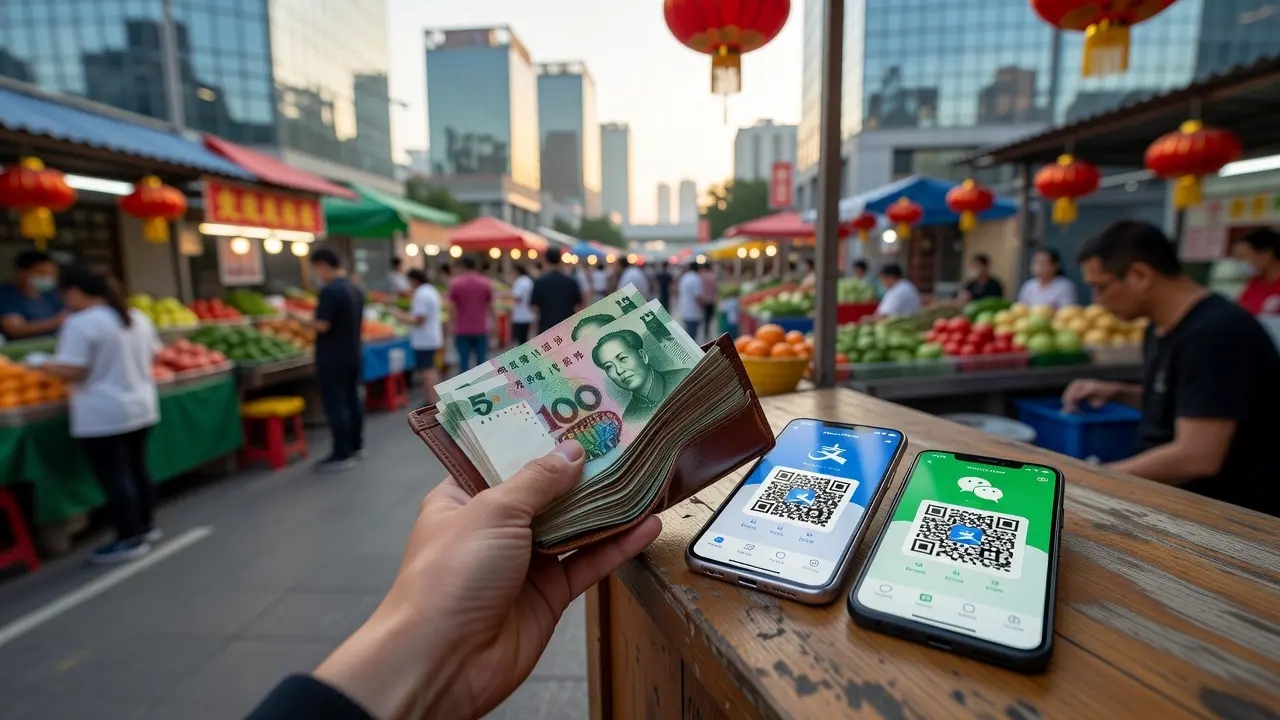
China travel money: the short answer
Most visitors need a phone wallet linked to a foreign card for daily spending, plus ¥300 to ¥500 cash per person per day for backup. On 25 November 2026, ¥300 is about 45.01 US dollars and ¥500 about 75.02 dollars. Hotels and train tickets can be paid by card or wallet, and cash covers places where QR payment fails.
For a week-long trip, ¥2,000 to ¥3,000 in cash, about 375.13 US dollars at the middle of that range, is enough for most travellers who also use a phone wallet. Travellers without a working wallet should plan on cash for almost everything, roughly ¥500 to ¥800 a day in big cities.
The notes and coins are covered in our guide to the currency of china, and the ¥ sign shared with Japan in Yen ¥ vs Yuan ¥: Same Symbol, Two Currencies.
Cash, cards or e-wallets in China
Alipay and WeChat Pay dominate payments in Chinese cities, and foreign visitors can now use both with a foreign card. International cards work in large hotels, department stores and some restaurants, but far fewer places accept them than accept QR payments. Cash remains legal tender and must be accepted.
- Download Alipay or WeChat Pay before you travel, verify your passport in the app and link a Visa or Mastercard.
- Alipay has charged a 3% fee on foreign-card payments above ¥200; smaller payments have been free.
- Metro systems in many cities let you scan in with the wallet's transport code.
- Keep yuan cash in ¥10, ¥20 and ¥50 notes; small vendors often cannot change ¥100 notes.
Yuan cash china rules are clear: the People's Bank of China has repeatedly told businesses that refusing cash is not allowed, after visitors complained they could not pay. Even so, carry a second payment method, since a phone battery or network problem can leave you stuck.
Where to exchange yuan: before you go or on arrival
For US dollars, exchanging at a Chinese bank such as Bank of China after arrival usually gives a fair rate, though it can take time and requires your passport. Airport counters are faster but cost more. Buying yuan before you leave is convenient for the first day, and in Vietnam major banks sell yuan, with good stock near the northern border.
Compare offers with the mid-market rate for usd to yuan, or for readers in Vietnam vnd to cny and cny to vnd. A full comparison of options is in our guide to currency exchange.
A worked example with an assumed rate: at a mid-market rate of 7.20 yuan per dollar, a bank giving 7.15 costs about $7 on $1,000 (0.7%), while an airport counter giving 6.95 costs about $35 (3.5%). Keep exchange receipts; Chinese banks may ask for them when you convert unused yuan back.
ATM fees and dynamic currency conversion in China
ATMs of large banks such as Bank of China, ICBC, China Construction Bank and Agricultural Bank of China accept most foreign Visa and Mastercard cards, though not every machine does. The ATM operator may charge a fee, and your own bank may add a foreign withdrawal fee and a foreign transaction fee.
- Use ATMs at bank branches in larger cities, which are more likely to take foreign cards.
- Withdraw larger amounts less often to cut fixed fees.
- Decline any offer to charge you in your home currency; choose yuan.
- Turn on overseas use in your banking app before travel.
Customs cash limits for China
Chinese customs requires travellers to declare more than ¥20,000 in yuan cash or more than 5,000 US dollars in foreign currency when entering or leaving the country. Leaving Vietnam, travellers carrying more than 5,000 US dollars or 15 million dong in cash must declare it to Vietnamese customs. Check the latest rules before travelling.
The yuan's long-term rate is covered in Chinese Yuan Exchange Rate History. For other trips, see Singapore Travel Money: SGD Cash and Cards and how to exchange euros for Europe. Any amount can be checked on the currency converter.






