
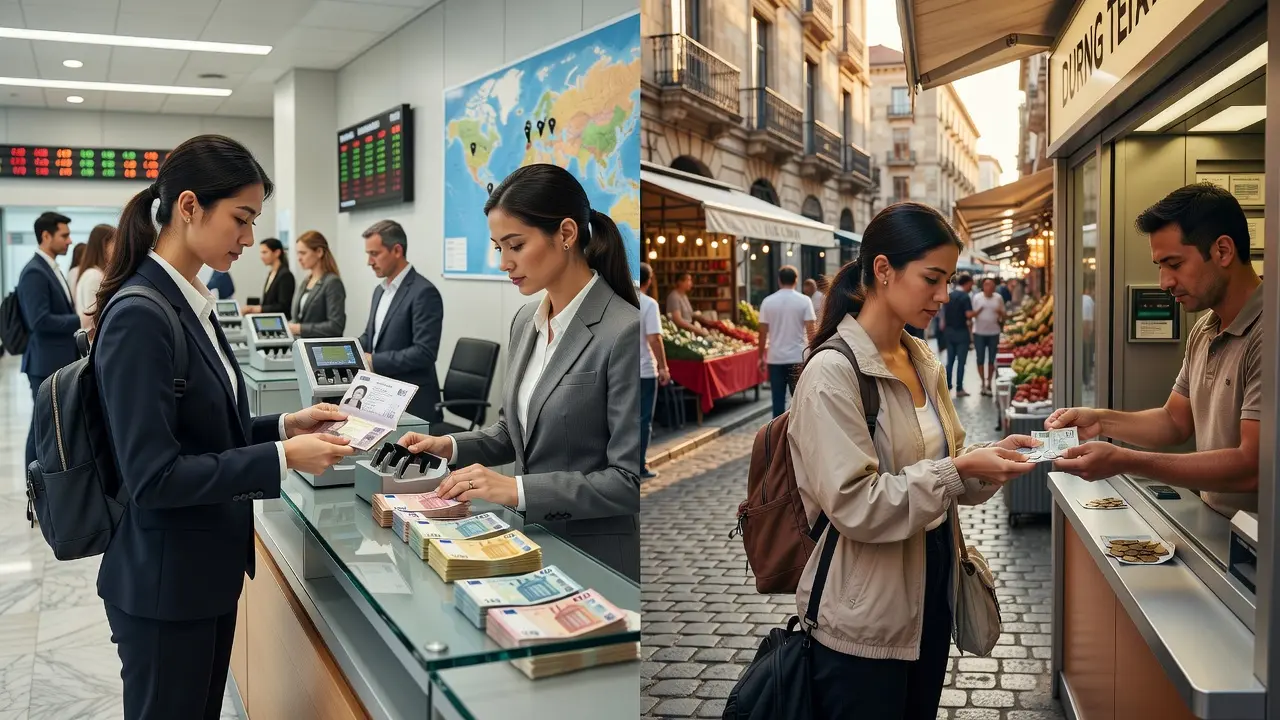
Where is the best place to exchange currency?
The best place to exchange currency is the one that gives you the rate closest to the mid-market rate after all fees. For most travellers that means paying by a no-fee card and withdrawing local cash from a bank ATM abroad. For cash bought before departure, a bank or a licensed exchange office in town beats the airport.
The mid-market rate is the midpoint between the price at which banks buy and sell a currency among themselves. It is the rate you see on news sites and on our currency converter. Nobody sells to the public at exactly that price. Every provider adds a margin, and many add a fixed fee too.
A simple way to measure the cost: divide the rate you are offered by the mid-market rate and compare the result with 1. If the mid-market rate is 0.90 euros per dollar and a counter offers 0.85, you get 0.85 / 0.90 = 0.944, a cost of about 5.6% before any fee. On $1,000 that is $56 lost to the rate alone.
Four things decide which option wins on a given trip:
- The destination: some countries run on cards (Sweden, the UK, South Korea), others still on cash (Japan in rural areas, much of Cambodia).
- Your card: whether it charges a foreign transaction fee, and whether your bank refunds ATM fees.
- The amount: fixed fees hurt small exchanges; percentage margins hurt large ones.
- Timing: changing everything at the airport on arrival is the most common way travellers overpay.
Exchanging money at your bank
Banks sell foreign cash at a margin of roughly 2% to 5% above the mid-market rate for major currencies, and more for currencies they rarely stock. Most need a few days' notice for anything other than US dollars, euros or pounds. The advantage is safety and certainty: you know the cash is genuine and you leave with it before the trip.
Compare the bank's "we sell" rate with the mid-market rate on the same day. Many banks publish their cash rates online, and the difference between two banks in the same city can be 1% or more. Ask whether the price is the same for collecting in a branch and for ordering online, since online orders are often cheaper.
Buying back is where banks earn the most. When you return with leftover notes, the bank's "we buy" rate can be 4% to 8% below mid-market, and coins are usually not accepted at all. Plan to spend down cash before you leave the destination.
Licensed currency exchange offices
Licensed currency exchange offices in city centres often offer the best cash rates, sometimes within 1% of mid-market for popular currencies. Competition matters: streets with several offices side by side, such as Bangkok's Ratchadamri Road or the money changers in Singapore's Mustafa Centre, keep margins thin.
Searching "money exchange near me" on a phone map will show options, but the nearest office is not always the cheapest. Check three things before handing over cash:
- The board shows both a buy and a sell rate. A large gap between them signals a wide margin.
- Commission. "0% commission" signs often come with a worse rate; ask for the final amount you will receive.
- A receipt. Licensed offices give one. In Czechia, the law even lets you cancel an exchange of up to €1,000 within three hours.
Avoid people offering to change money in the street or in markets. Their rates can look attractive, but short counting and fake notes are common tricks, and in several countries the exchange itself is illegal.
Exchanging money at the airport
Airport exchange counters are usually the most expensive place to change money, with margins of 7% to 15% common in many airports, sometimes hidden behind a "no fee" sign. They pay high rent and serve travellers who have no time to compare. Our page on the airport exchange rate shows how to work out what a counter really charges.
There are exceptions. Bank-run counters in some Asian airports, for example in Taiwan and Japan, give rates close to their city branches. If you need cash on arrival and have no card that works, change only enough for the first day, typically the taxi or train into town and a meal, and change the rest in the city.
Withdrawing cash from ATMs abroad
Withdrawing cash from a bank ATM at your destination is usually cheaper than buying cash before you go, because the card network uses a rate close to mid-market. The cost comes from fees: a charge from the ATM owner, a foreign transaction fee from your card issuer (often 1% to 3%), and sometimes a fixed fee per withdrawal.
To keep costs down:
- Use ATMs attached to bank branches, not stand-alone machines in tourist areas, which often charge more.
- Withdraw larger amounts less often, so fixed fees are spread over more money.
- Decline any offer to convert the withdrawal into your home currency; choose to be charged in the local currency.
Withdrawal limits vary. Thai ATMs charge foreign cards a flat fee per withdrawal, and many machines in Indonesia cap a single withdrawal at a few million rupiah. Our guide on how to withdraw money abroad lists typical charges by country.
Cards with no foreign transaction fee
A card with no foreign transaction fee is the cheapest way to pay abroad wherever cards are accepted, because Visa and Mastercard convert at rates close to mid-market. Many digital banks and travel cards offer this, and some also refund ATM fees up to a monthly limit.
The trap is dynamic currency conversion. A shop terminal or ATM may offer to charge you in your home currency "for convenience". The rate it uses is usually 3% to 8% worse than your card's. Always choose to pay in local currency. If you are weighing a prepaid travel card against your normal credit card, our comparison of the forex card and credit card covers fees, rates and safety.
Tell your bank you are travelling if it asks you to, and carry two cards from different networks. If one is blocked or swallowed by a machine, the other keeps you going.
Money exchange cost comparison
The table shows typical total costs as a percentage of the mid-market rate for a $1,000 exchange into a major currency. These are our estimates from published bank and bureau rates; your bank and destination can differ. The worked column uses an assumed mid-market rate of 0.90 euros per dollar.
| Option | Typical total cost | Euros received for $1,000 (assumed 0.90 rate) | Best for |
|---|---|---|---|
| No-fee card, paid in local currency | 0% to 1% | €891 to €900 | Shops, hotels, restaurants |
| Bank ATM abroad | 1% to 4% incl. fees | €864 to €891 | Local cash on arrival |
| Licensed exchange office in town | 1% to 3% | €873 to €891 | Cash for cash-heavy destinations |
| Bank at home | 2% to 5% | €855 to €882 | Cash before departure |
| Airport or hotel counter | 7% to 15% | €765 to €837 | Emergencies only |
| Card with dynamic currency conversion | 3% to 8% extra | €828 to €873 | Avoid |
The gap between the best and worst rows is about €135 on $1,000. On a two-week family trip with $4,000 of spending, choosing the airport counter over a no-fee card can cost more than a night in a hotel.
Exchanging less common currencies
For currencies that banks rarely stock, such as the Lao kip, the Mongolian tögrög or the Kenyan shilling, the cheapest route is usually to carry US dollars or euros and exchange them after arrival. Banks at home that can supply these currencies at all tend to price them with margins of 10% or more.
A two-step exchange sounds expensive, but each step on a major currency is cheap. Suppose you hold Vietnamese dong and are going to Laos. Buying dollars in Vietnam at a margin of about 1%, then changing them in Vientiane at a margin of 2%, costs around 3% in total. Buying kip directly from a bank outside Laos, if you can find any, often costs far more.
Three tips help with less common currencies:
- Bring clean, undamaged notes. Money changers in many countries refuse US dollar notes that are torn, written on or from old series, and some pay less for $1, $5 and $10 notes than for $50 and $100.
- Check whether the destination uses dollars alongside its own currency. In Cambodia, US dollars are widely accepted next to the riel, so exchanging all your money into riel is unnecessary.
- Exchange in stages. Change enough for a few days at a time, so you are not left with a large amount of a currency that is hard to sell back.
What to do with leftover foreign cash
Selling leftover foreign cash back is the most expensive exchange of the whole trip. The buy-back rate is usually several percent below mid-market, and coins are almost never accepted. Spending it down before departure, or keeping it for the next trip, saves more than any rate comparison.
Some practical options for the last day:
- Pay part of the hotel bill in cash and the rest by card.
- Keep a small amount of major currencies, such as US dollars or euros, for future trips. They do not expire, although very old designs may be harder to exchange.
- Donate coins to the charity collections that some airlines run on board, such as UNICEF's Change for Good.
For larger sums, compare the buy-back rate at two or three places, just as you did when buying. A licensed office in town usually pays more than the airport counter on departure day.
How exchange rates are shown on a counter board
Every exchange board shows two prices per currency: the rate at which the counter buys from you and the rate at which it sells to you. The gap between them, the spread, is the counter's margin. A small spread is the quickest sign of a fair counter.
Boards can be read in two directions, which confuses many travellers. In Vietnam, a board lists how many dong one US dollar buys, for example "USD buy 25,900, sell 26,200". In the euro area, a board may show how many dollars one euro buys. Always check which currency is the base before comparing two boards.
A worked example with assumed rates: a counter shows "USD buy 25,900, sell 26,200" while the mid-market rate is 26,050. The spread is 300 dong, about 1.2% of the mid rate. A second counter showing "buy 25,500, sell 26,600" has a spread of 1,100 dong, about 4.2%, so selling $500 there gives 200,000 dong less than at the first counter.
Watch for boards that show a rate only for large notes or large amounts. Some counters print an attractive rate in big type and a footnote saying it applies only above $1,000 or to $100 notes. Ask for the exact amount you will receive before you hand over money.
Money exchange checklist before you travel
A week before departure, check your cards, buy a small amount of cash for the first day, and find out how much cash you may legally carry. These steps take less than an hour and prevent most of the expensive surprises.
- Check whether your cards charge a foreign transaction fee and an ATM fee. If both do, consider opening a no-fee card before you go.
- Note the mid-market rate for your destination currency, so you can judge any offer on the spot.
- Buy cash for the first 24 hours only, from your bank or a licensed office, not at the airport.
- Check the customs limit for carrying cash. Many countries require a declaration above an amount equal to $10,000 or €10,000; Vietnam requires one above $5,000 or 15 million dong. Our guide on how to declare cash at airport lists the rules for common destinations.
- Save your bank's emergency number and lock or freeze features in your phone.
- Split cash and cards between two places, such as a wallet and a bag.
- Plan to spend down cash on the last day, since selling it back costs the most.
Country money guides
Each destination has its own habits. These guides cover cash needs, cards and where to exchange in specific countries:
- japan cash or card: how much yen to carry and where foreign cards work
- thai baht cash: exchange shops, ATM fees and daily budgets
- How Much Money to Bring to South Korea
- yuan cash china: Alipay, WeChat Pay and when cash is still needed
- Europe Travel Money: Euro Cash and Cards
- Singapore Travel Money: SGD Cash and Cards
- Taiwan Travel Money: TWD Cash, Cards and Exchange






