
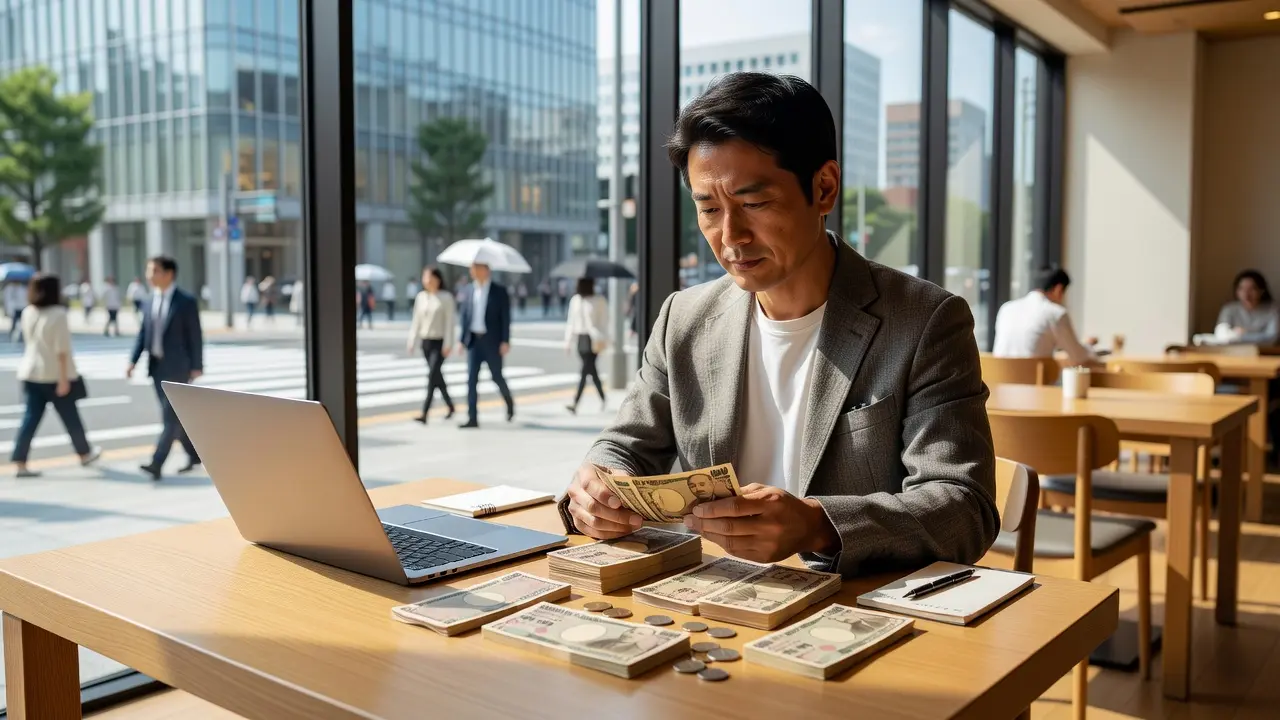
How much cash to bring to Japan: the short answer
Plan on ¥10,000 to ¥20,000 in cash per person per day, with the higher end for days with temple fees, local buses and small restaurants. On 25 November 2026, ¥10,000 is about 62.77 US dollars and ¥20,000 about 125.54 dollars. Pay hotels, long-distance trains and large shops by card, and keep the cash for everything else.
Here is an example daily budget for a mid-range traveller in Tokyo or Osaka, split by how each item is usually paid:
| Item | Typical cost | Usually paid by |
|---|---|---|
| Breakfast at a café or convenience store | ¥500 to ¥1,000 | Cash, card or IC card |
| Lunch at a ramen or set-meal shop | ¥1,000 to ¥1,500 | Often cash, ticket machine |
| Dinner at an izakaya or local restaurant | ¥3,000 to ¥5,000 | Cash or card |
| City trains and buses | ¥800 to ¥1,500 | IC card (Suica, PASMO, ICOCA) |
| Temples, museums, coin lockers | ¥500 to ¥2,000 | Mostly cash |
| Snacks, drinks, small shopping | ¥1,000 to ¥3,000 | Cash, card or IC card |
These are example prices, not fixed rates; costs in Kyoto's tourist areas or Tokyo's centre can be higher. A 7-day trip at ¥15,000 a day needs about ¥105,000 in cash over the whole trip, or 659.1 US dollars at today's rate.
Cash budget by travel style
The right amount depends more on how you travel than on how long you stay. Travellers who eat in convenience stores and stay in business hotels paid by card need far less cash than those who eat in small local restaurants and visit many temples. Three example cash budgets for one week, per person, show the range:
- Light cash user (mostly cards and IC card): about ¥50,000, or 313.86 US dollars on 25 November 2026.
- Typical visitor (mix of cards and cash): about ¥100,000, or 627.71 US dollars.
- Heavy cash user (rural areas, ryokan, markets): about ¥150,000, or 941.57 US dollars.
Families should multiply by the number of adults, with less for children, whose train fares and many entry fees are half price. If you plan to buy electronics, cosmetics or souvenirs, pay for these by card where possible instead of carrying extra cash.
Japan cash or card: what to use where
The japan cash or card question has a simple answer: use both. Cards work in hotels, department stores, chain restaurants, convenience stores and for shinkansen tickets, while cash is still expected at small family restaurants, shrines and temples, market stalls, many taxis outside big cities and some ryokan inns.
- IC cards such as Suica, PASMO and ICOCA pay for trains, buses, vending machines and convenience stores. You can load them with cash, and Suica can also be added to an iPhone wallet.
- Visa and Mastercard are the most widely accepted foreign cards; American Express and JCB work in many places too.
- QR payment apps such as PayPay are common, but most require a Japanese phone number or bank account.
- Ramen shops often use ticket machines at the door, and many older machines take only cash.
Card acceptance has grown fast in recent years, but signs at the door still say "cash only" (現金のみ) in many small shops.
Coins matter more than in many countries. The ¥100 and ¥500 coins pay for lockers, vending machines and temple offerings, so keep a small coin purse. The notes and coins themselves are covered in our guide to the currency of japan, and the ¥ sign shared with China is explained in Yen ¥ vs Yuan ¥: Same Symbol, Two Currencies.
Where to exchange yen: before you go or on arrival
For yen travel, exchanging some cash before you leave and withdrawing the rest from ATMs in Japan is usually the cheapest mix. Exchange counters at Japanese airports give rates close to city banks, while hotel desks give the worst rates. In Vietnam, major banks sell yen, and the best rate is often at banks in large cities.
Compare the rate each option gives you with the mid-market rate for usd to yen, or for readers in Vietnam, vnd to jpy. The options are compared in our guide to currency exchange.
A worked example with an assumed rate: if a bank in Hanoi sells yen at 180 dong and the mid-market rate is 172 dong, buying ¥50,000 costs 9,000,000 dong instead of 8,600,000 dong. The 400,000 dong difference is the bank's margin, about 4.7%. The live mid-market figure is on the jpy/vnd page.
ATM fees and dynamic currency conversion in Japan
7-Eleven's Seven Bank ATMs, found in every 7-Eleven store, accept most foreign Visa, Mastercard, UnionPay and JCB cards, with menus in English and other languages. Seven Bank charges a usage fee for overseas cards, shown on screen before you confirm, and allows up to ¥100,000 per withdrawal. Japan Post Bank ATMs in post offices also take foreign cards.
Two costs come on top of the ATM's own fee:
- Your home bank's charges: a foreign withdrawal fee and a foreign transaction fee, often 1% to 3%.
- Dynamic currency conversion: if the ATM or a card terminal offers to charge you in your home currency, decline and choose yen. The conversion rate offered is usually worse than your bank's.
Not every ATM in Japan works with foreign cards. Many bank ATMs inside branches accept only Japanese cards, and some close at night or on holidays. 7-Eleven ATMs are open around the clock in most stores, which makes them the most reliable option.
Withdrawing larger amounts less often keeps fixed fees down. Taking out ¥50,000 once costs less than ¥10,000 five times.
Tipping and cash etiquette in Japan
Japan has no tipping custom. Restaurants, taxis and hotels do not expect tips, and staff may chase you to return money left on a table. Some high-end restaurants add a service charge to the bill instead.
When paying cash at a counter, place the money on the small tray by the register rather than handing it over directly; change will come back on the same tray. Clean, new notes are expected for gifts such as wedding money, which is put in a special envelope. Torn or heavily marked notes are accepted in shops but can be exchanged free at banks.
Customs cash limits for Japan
Japanese customs requires travellers to declare cash and other means of payment worth more than ¥1 million, or the equivalent in foreign currency, when entering or leaving Japan. The rule covers banknotes, coins, cheques and securities, and the declaration is made on a customs form at the airport.
Leaving Vietnam has its own rule: travellers carrying more than 5,000 US dollars or 15 million dong in cash must declare it to Vietnamese customs. Check the latest rules before travelling, because limits can change.
For comparison with nearby trips, see our guides on how much money to bring to korea and the Thailand Money Guide for Travelers. If you are used to thinking in round numbers, our page on what is a grand explains how units like "1 man" (¥10,000) compare. You can check any amount on the currency converter.






