
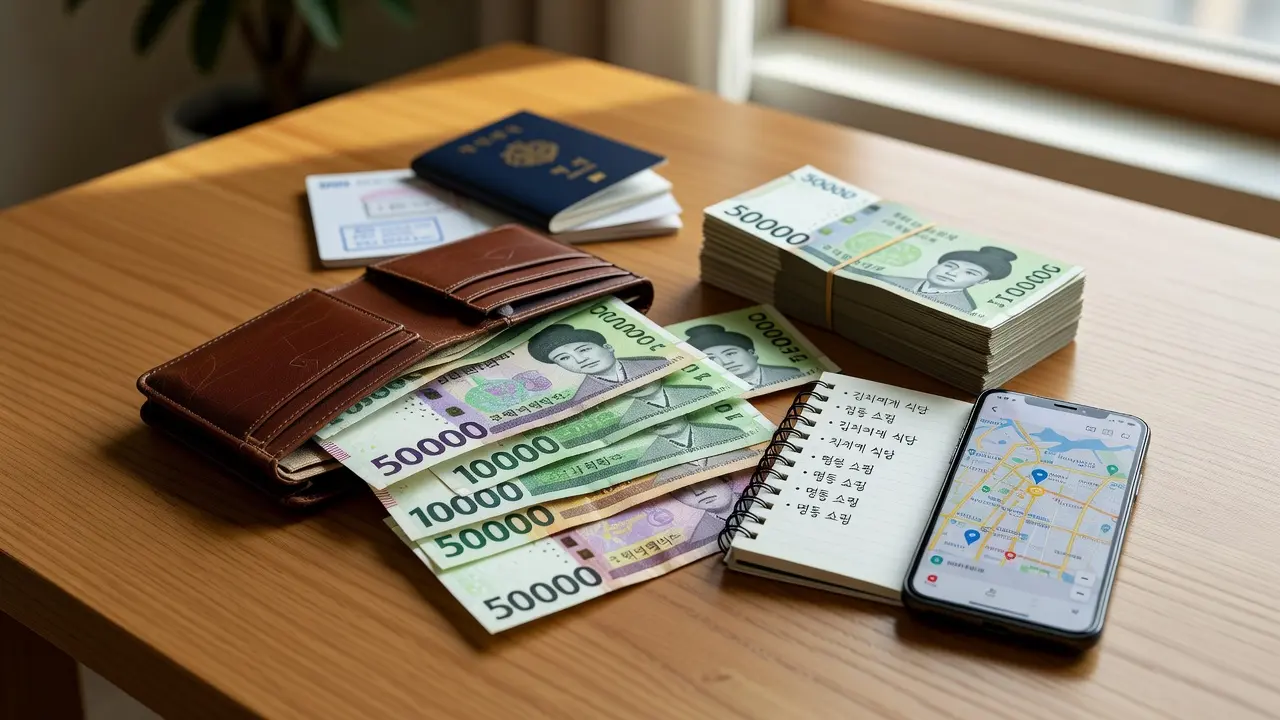
How much money to bring to Korea: the short answer
Plan on ₩50,000 to ₩100,000 in cash per person per day, and pay hotels, shopping, cafés and most meals by card. On 25 November 2026, ₩50,000 is about 37.22 US dollars and ₩100,000 about 74.44 dollars. Carry more on days at traditional markets or outside big cities, where small vendors may want cash.
An example daily budget for a mid-range traveller in Seoul or Busan, split by how each item is usually paid:
| Item | Typical cost | Usually paid by |
|---|---|---|
| Breakfast at a café or convenience store | ₩5,000 to ₩10,000 | Card or T-money |
| Lunch at a local restaurant | ₩10,000 to ₩15,000 | Card |
| Dinner with Korean barbecue | ₩20,000 to ₩40,000 | Card |
| Subway and buses | ₩5,000 to ₩10,000 | T-money card |
| Street food and market snacks | ₩5,000 to ₩15,000 | Often cash |
| Palaces, museums and attractions | ₩3,000 to ₩30,000 | Card or cash |
These are example prices, not fixed rates. A 6-day trip at ₩70,000 a day in cash needs about ₩420,000, or 312.64 US dollars at today's rate, with the rest of the spending on card.
Cash budget by travel style
How you travel decides how much cash you need. Three example cash budgets for one week, per person:
- Light cash user (cards for almost everything): about ₩250,000, or 186.1 US dollars on 25 November 2026.
- Typical visitor (cards plus street food and markets): about ₩500,000, or 372.2 US dollars.
- Heavy cash user (markets, rural trips, small guesthouses): about ₩750,000, or 558.29 US dollars.
Shopping trips are a separate budget. Many stores give tax refunds to foreign visitors on qualifying purchases, so pay for larger buys by card and keep the receipts.
Korea cash or card: what to use where
The korea cash or card answer is mostly card. Visa and Mastercard work in taxis, convenience stores, chain restaurants, cafés, department stores and most small restaurants in cities. Cash is still useful at street food stalls, traditional markets such as Gwangjang and Namdaemun, small guesthouses and some rural buses.
- T-money is a rechargeable transport card for the subway, buses and many taxis across the country. Buy and top it up with cash at convenience stores and subway machines.
- Prepaid travel cards for foreigners, sold at airports and in Seoul, can be loaded with foreign currency and used like a debit card and a transport card.
- Korean mobile payment apps such as Kakao Pay and Naver Pay are widely used, but most need a Korean phone number or bank account.
- Some small shops prefer domestic cards; if a foreign card fails, try another card or pay cash.
Coins of ₩10, ₩50, ₩100 and ₩500 are common in change but rarely needed. The notes and coins are covered in our guide to korean currency, and the ₩ sign in Korean Won Symbol ₩, KRW Code and Banknotes.
Where to exchange won: before you go or in Korea
For US dollars, exchanging in Korea usually gives a better rate than buying won abroad. Licensed money changers in Myeongdong and other tourist districts in Seoul often quote rates close to mid-market for dollars, yen and yuan. Airport bank counters are convenient but usually charge more, so change only what you need for the first day there.
In Vietnam, major banks sell won, but spreads are often wider than for dollars. Many Vietnamese travellers bring US dollars in $100 notes and change them in Myeongdong. Compare offers with the mid-market rates for usd to krw and, for readers in Vietnam, vnd to krw and 1000 won = vnd. The options are compared in our money exchange guide.
A worked example with an assumed rate: at a mid-market rate of 1,400 won per dollar, a Myeongdong changer giving 1,395 costs $3.60 on $1,000 (0.36%), while an airport counter at 1,360 costs $28.60 (2.9%). For large amounts, see our page on 2 million won to usd.
How prices are written in Korea
Korean prices are written as a number followed by 원 (won), such as 12,000원, or with ₩ before the number on English menus. Large amounts are often given in units of 만 (10,000), so 5만원 is ₩50,000 and 10만원 is ₩100,000. There are no decimals in daily prices.
Counting in 만 is the most common source of confusion for visitors. A hotel quoting "15만원" a night means ₩150,000, not ₩15,000. Notes come in ₩1,000, ₩5,000, ₩10,000 and ₩50,000, so ₩50,000 notes are handy for carrying cash, while ₩10,000 and ₩1,000 notes are better for markets.
Leftover won and the trip home
Spend coins before you leave, because money changers outside Korea rarely buy them, and keep enough cash for a last T-money top-up or snack at the airport. Unused T-money balances up to a set limit can be refunded at convenience stores, minus a small fee.
Leftover won notes can be changed back at Incheon or Gimhae airport counters, or kept for the next trip. In Vietnam, some banks buy won notes, but at a wide spread, so selling small amounts back often costs more than it is worth.
ATM fees and dynamic currency conversion in Korea
Many Korean ATMs accept foreign cards, especially machines marked "Global ATM" or "Foreign Card" in convenience stores, subway stations and bank branches. The ATM operator usually charges a fee shown on screen, and your own bank may add a foreign withdrawal fee and a foreign transaction fee.
- Look for ATMs labelled for foreign cards; others may reject them.
- Withdraw larger amounts less often to keep fixed fees down.
- When a terminal or ATM offers to charge in your home currency, choose won instead.
- Turn on overseas use in your banking app and check your daily limit before you fly.
Cards to bring and backup plans
Bring at least two cards from different networks, such as one Visa and one Mastercard, and keep them in separate places. Korean terminals occasionally reject a foreign card for reasons unrelated to your balance, and a second card avoids being stuck at a hotel desk or ticket machine.
Tell your bank you are travelling if it requires it, and save its international phone number. A small emergency cash reserve, around ₩100,000 kept apart from your daily wallet, covers a taxi or meal if both cards fail.
Customs cash limits for Korea
Travellers entering or leaving South Korea with more than 10,000 US dollars in cash, or the equivalent in other currencies and cheques, must declare it to Korean customs. Leaving Vietnam, travellers carrying more than 5,000 US dollars or 15 million dong in cash must declare it to Vietnamese customs. Check the latest rules before travelling.
Customs officers can also ask about large amounts below the limit, so keep exchange receipts and bank withdrawal slips as proof of where the money came from.
Tipping is not part of Korean culture. Restaurants, taxis and hotels do not expect tips, and prices on menus already include tax.
For other trips, see China Travel Money: Cash, Alipay and WeChat Pay and our guide to euro travel money. Any amount can be checked on the currency converter.






