
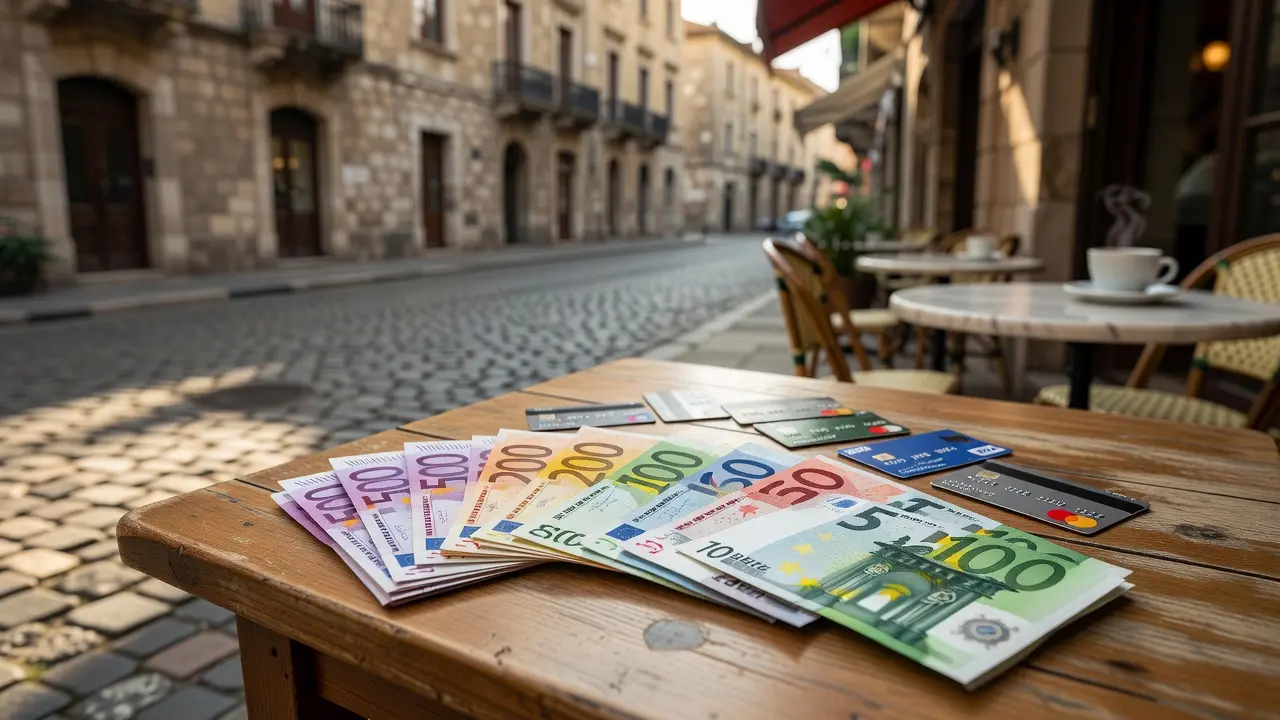
Euro travel money: the short answer
Plan on €50 to €100 in cash per person per day, more in Germany, Austria, Italy and rural areas where cash is still common, less in Scandinavia and the Netherlands where many places are card-only. On 25 November 2026, €50 is about 54.75 US dollars and €100 about 109.49 dollars.
- Light cash user (cards almost everywhere): about €300 a week, or 328.47 US dollars.
- Typical visitor (cards plus cafés, markets, small museums): about €500 a week, or 547.45 US dollars.
- Heavy cash user (rural areas, small guesthouses, markets): about €700 a week, or 766.43 US dollars.
These are example amounts for planning, not official figures. Large costs such as hotels, rail passes and flights are better paid by card. The notes and coins are covered in our guide to the euro countries.
Cash, cards or e-wallets in Europe
Cards are the main payment method across most of Europe, and contactless payment by card or phone works on many city buses, metros and even small cafés. Cash still matters in Germany and Austria, at markets, in rural villages, for public toilets and for tips. Apple Pay and Google Pay work wherever contactless cards do.
- Visa and Mastercard are accepted almost everywhere; American Express less often.
- Some small shops set a minimum card amount, often €5 or €10.
- Use the chip and PIN; some machines, such as motorway tolls and fuel pumps, require a PIN.
- Keep €1 and €2 coins for lockers, trolleys and toilets.
Outside the euro area, pay in the local currency. In Switzerland, the UK, Czechia or Hungary, shops that accept euros usually use a poor rate and give change in local money. The € sign itself is explained in Euro Symbol €: Meaning, How to Type It and Where to Put It.
Where to exchange euros: before you go or on arrival
To exchange euros, buying some before you leave is usually fine, because the euro is one of the most traded currencies and spreads are narrow at major banks. In Vietnam, large banks sell euros and keep cash in most city branches. On arrival, ATMs usually beat exchange counters, and airport and tourist-area bureaus are often the most expensive option.
Compare offers with the mid-market rate for usd to eur, or for readers in Vietnam vnd to euro and 1 eur = vnd. Options are compared in Best Way to Exchange Currency Before and During Travel.
A worked example with an assumed rate: at a mid-market rate of 1.10 US dollars per euro, a city bank selling euros at 1.12 costs about $18 on €1,000 (1.8%), while a tourist bureau charging 1.20 costs about $100 (9%). The euro's long-term moves are on our euro to usd history page.
ATM fees and dynamic currency conversion in Europe
Bank ATMs inside or next to bank branches usually charge little or nothing to foreign cards, while independent ATMs in tourist areas, often brightly branded, can charge several euros per withdrawal and push poor conversion rates. Your own bank may add a foreign withdrawal fee and a foreign transaction fee.
- Use ATMs belonging to local banks rather than standalone machines in tourist streets.
- When the screen asks whether to charge in euros or your home currency, choose euros.
- Withdraw larger amounts less often to cut fixed fees.
- Tell your bank you are travelling and check your daily limit before you go.
Customs cash limits for the EU
Travellers entering or leaving the European Union with €10,000 or more in cash, or the equivalent in other currencies, cheques and other bearer instruments, must declare it to customs. The rule applies per person at the EU's external border, not when moving between EU countries. Leaving Vietnam, travellers carrying more than 5,000 US dollars or 15 million dong in cash must declare it to Vietnamese customs.
For other trips, see our guides to china travel money and singapore travel money. Any amount can be checked on the currency converter.






