
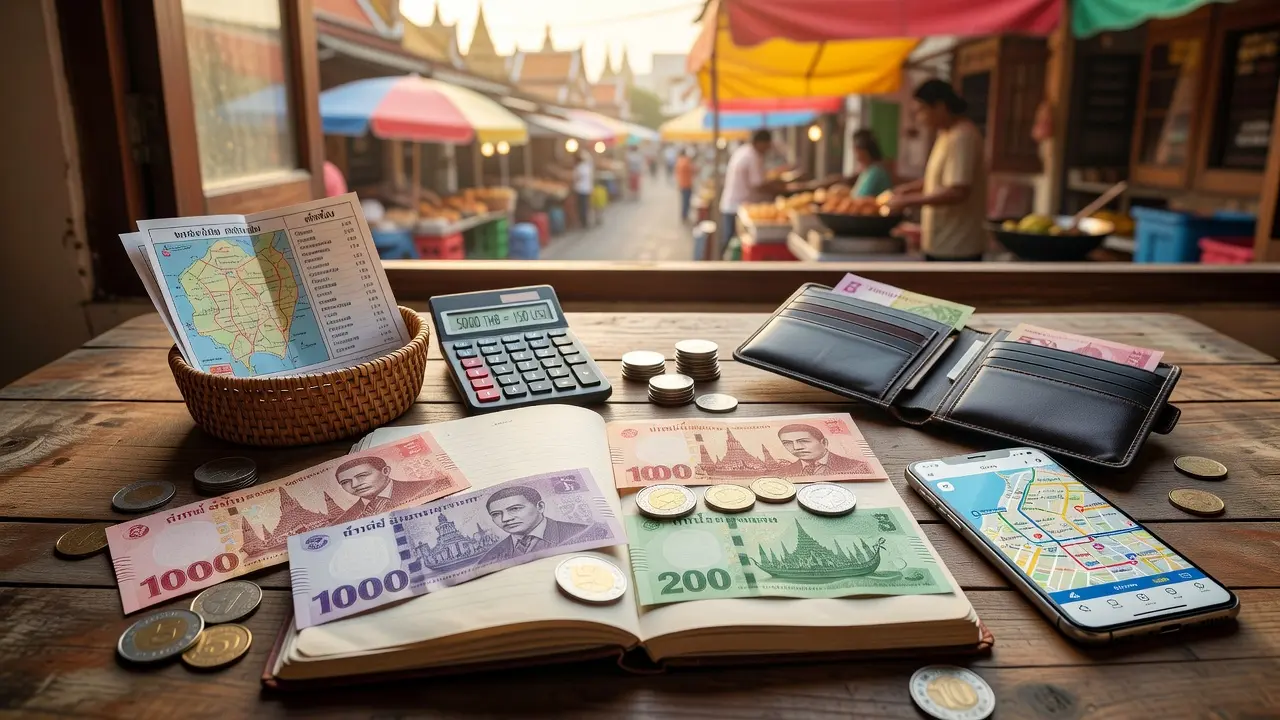
How much money in Thailand per day: the short answer
Plan on about 1,500 to 3,000 baht in cash per person per day, with the higher end in Phuket, Koh Samui and central Bangkok. On 25 November 2026, 1,500 baht is about 44.16 US dollars and 3,000 baht about 88.31 dollars. Hotels, flights, tours booked online and malls go on a card; cash covers the rest.
An example daily budget for a mid-range traveller in Bangkok, split by how each item is usually paid:
| Item | Typical cost | Usually paid by |
|---|---|---|
| Street food breakfast and lunch | 100 to 250 baht | Cash |
| Dinner at a local restaurant | 300 to 600 baht | Cash or card |
| BTS, MRT and river boats | 100 to 200 baht | Cash, contactless card or Rabbit card |
| Taxi, tuk-tuk or ride-hailing | 200 to 500 baht | Cash; app rides can be paid by card |
| Temple fees and attractions | 100 to 500 baht | Mostly cash |
| Massage, drinks, small shopping | 300 to 1,000 baht | Cash |
These are example prices, not fixed rates. Islands and beach resorts are usually 20% to 50% dearer than Bangkok for food and transport. A 6-day trip at 2,000 baht a day needs about 12,000 baht in cash, or 353.24 US dollars at today's rate.
Cash budget by travel style
How you travel changes the cash you need more than the length of the trip. A traveller who books everything online and eats in malls needs far less cash than one who eats at street stalls and takes tuk-tuks. Three example cash budgets for one week, per person:
- Light cash user (cards, apps, mall food courts): about 7,000 baht, or 206.06 US dollars on 25 November 2026.
- Typical visitor (street food, BTS, some tours paid in cash): about 14,000 baht, or 412.12 US dollars.
- Heavy cash user (islands, markets, massages, nightlife): about 21,000 baht, or 618.18 US dollars.
Families should count each adult, with less for young children. Island-hopping trips need more cash, because ferry piers, longtail boats and small beach bars rarely take cards.
Thai baht cash, cards or e-wallets
Thai baht cash is still the main way to pay at street stalls, markets, small restaurants, temples, tuk-tuks, songthaews and island ferries. Visa and Mastercard work in hotels, malls, chain restaurants, 7-Eleven and larger shops, and many places accept contactless payment, though some add a 2% to 3% card surcharge.
- PromptPay QR codes are everywhere, from street carts to cafés. Thais scan them with their bank app.
- Some Vietnamese banking apps support cross-border QR payments with Thailand, so they can scan Thai QR codes and pay from a dong account. Check whether your bank supports it, and look at the rate shown before confirming.
- Ride-hailing apps such as Grab and Bolt let you pay by card, avoiding cash for many trips.
- Bangkok's MRT metro accepts contactless Visa and Mastercard at the gates, so you can tap in with a card.
Keep small notes. Vendors often cannot change a 1,000 baht note, so break large notes at 7-Eleven or a supermarket. The notes and coins are covered in our guide to thai currency.
Where to exchange baht: before you go or on arrival
For major currencies, exchanging in Thailand usually gives a better rate than buying baht abroad. Licensed money changers in Bangkok, such as SuperRich near Ratchaprasong and in malls, often quote rates close to mid-market for US dollars, euros and yen. Airport counters charge more, though some airport changers on the train-station level offer fairer rates.
Large, new US dollar notes ($50 and $100) usually get a better rate than small or old notes at Thai money changers. Bring your passport, which changers must see by law.
Compare offers with the mid-market rate for usd to thb, or for readers in Vietnam, vnd to thb and baht to vnd. A full comparison of options is in Best Way to Exchange Currency Before and During Travel.
A worked example with an assumed rate: at a mid-market rate of 33 baht per dollar, a changer giving 32.80 costs $6 on $1,000 (0.6%), while an airport counter at 31.50 costs $45 (4.5%).
Keep exchange receipts. Thai money changers and banks may ask for them when you sell leftover baht back before leaving, and they help if a rate or amount is disputed. Spend coins before you go, because changers outside Thailand rarely buy them.
Avoid changing money with people on the street or in unlicensed shops. Licensed changers display a Bank of Thailand licence and print a receipt with the rate and amount for every transaction.
ATM fees and dynamic currency conversion in Thailand
Most Thai bank ATMs charge foreign cards a fee of about 220 baht per withdrawal, shown on screen before you confirm. Your own bank may add a foreign withdrawal fee and a foreign transaction fee. Many Thai ATMs limit each withdrawal to 20,000 or 30,000 baht, so the 220 baht fee is about 1% of a full withdrawal but 4.4% of a 5,000 baht one.
Your own card also has limits. Many Vietnamese and other foreign banks set a daily cap on overseas withdrawals, and some block foreign use until you turn it on in the banking app. Check both settings before you fly, so a card does not fail at the first ATM in Bangkok.
Dynamic currency conversion is the second trap. When an ATM or card terminal offers to charge you in your home currency, choose baht instead. The conversion rate offered is usually several percent worse than your bank's.
- Withdraw larger amounts less often.
- Decline conversion to your home currency at ATMs and card machines.
- Use a card with low foreign transaction fees if you have one.
- Keep the receipt in case of a dispute with your bank.
Tipping and money etiquette in Thailand
Tipping is not required in Thailand, but it is welcome. Leaving the coins from your change or about 20 to 50 baht at a restaurant is common, and massage therapists are often tipped 50 to 100 baht. Hotels and upmarket restaurants may already add a 10% service charge plus 7% VAT to the bill.
Thai notes and coins carry the king's portrait, so never step on money, even to stop a rolling coin. Hand money over with your right hand, and keep cash in a wallet rather than a back pocket in crowded markets.
Customs rules for cash in Thailand
Thai customs requires travellers to declare foreign currency over 20,000 US dollars or its equivalent when entering or leaving Thailand. For Thai baht, the Royal Thai Embassy in London states that up to 500,000 baht may be taken to bordering countries and up to 50,000 baht to other destinations; larger amounts must be declared or changed before departure.
Leaving Vietnam, travellers carrying more than 5,000 US dollars or 15 million dong in cash must declare it to Vietnamese customs. Check the latest rules before you travel.
For other trips in the region, see How Much Cash to Bring to Japan (2026) and our guide on korea cash or card. Any amount can be checked on the currency converter.






