
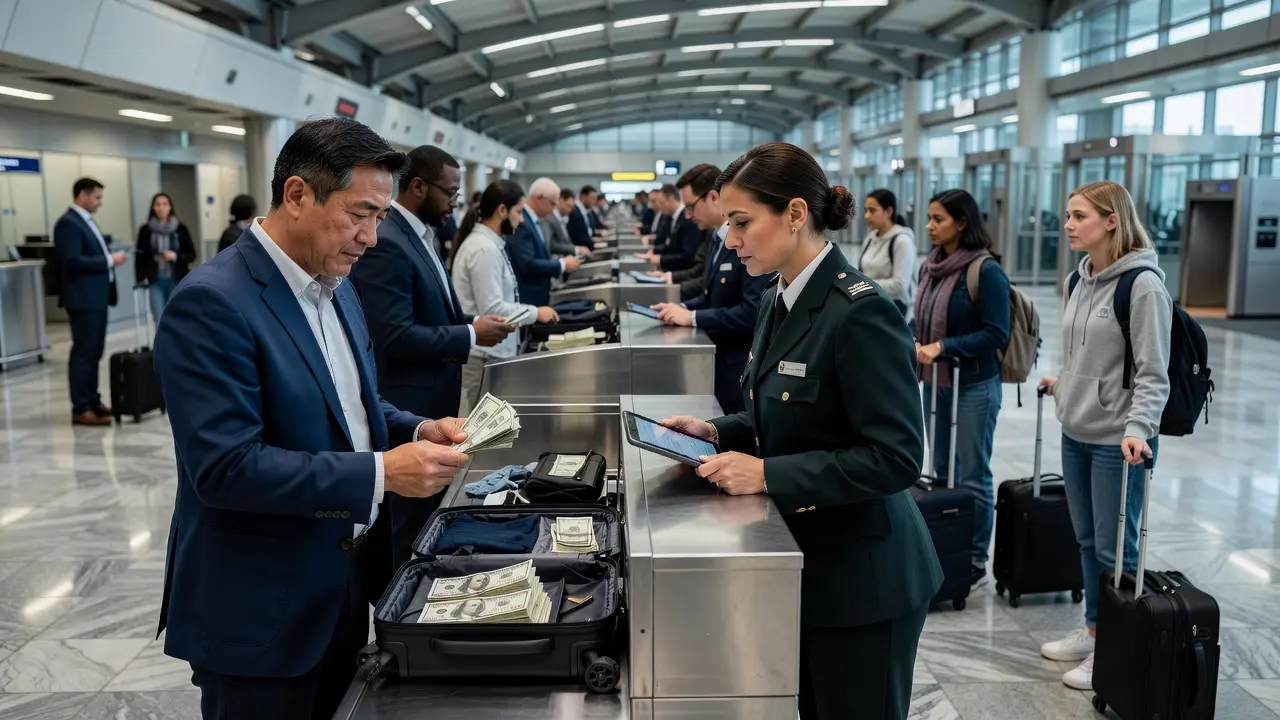
How much cash can you carry internationally?
There is usually no legal maximum on cash you can carry across a border. The rules set a reporting threshold instead: below it you walk through, above it you fill in a declaration. Thresholds range from about US$5,000 to US$15,000 for most countries, and are counted per traveller, across all currencies combined.
Many travellers confuse a declaration limit with a ban. A traveller carrying US$20,000 to the US is acting legally if they declare it. A traveller carrying US$10,500 without declaring is breaking the rule, even though the amount is smaller. What counts as cash varies: the EU and the US also count travellers' cheques and other bearer instruments, and Vietnam has a separate threshold for gold.
Leaving or entering Vietnam with cash
Travellers leaving or entering Vietnam must declare foreign currency above US$5,000 or its equivalent, and Vietnamese cash above 15 million dong, under the State Bank of Vietnam's rules. Gold jewellery weighing 300 grams or more must also be declared. The declaration is made on the customs form at the airport, land border or seaport.
- Per person: a couple travelling together each has their own US$5,000 threshold; one person cannot carry the whole family's money undeclared.
- Combined currencies: euros, yen and dollars are added together at their US dollar value.
- Proof of origin: when leaving with a large declared amount, keep the bank's sale receipt or withdrawal slip, which customs may ask to see.
- Larger sums: amounts well above the threshold may need a bank's confirmation or a permit, depending on the purpose.
Declaring on the way in also protects you on the way out. A visitor who brings US$8,000 into Vietnam and declares it can usually take back the unspent part when leaving by showing the entry declaration. Without it, customs may ask how a foreigner came to hold more than US$5,000 in cash at departure.
A worked example: a family of three flies from Ho Chi Minh City to Tokyo. The father carries US$4,000 and ¥200,000 (about US$1,300 at an assumed 150 yen per dollar), the mother US$2,000, and the teenage son ¥30,000. The father's total is about US$5,300, over Vietnam's threshold, so he must declare when leaving Vietnam even though no single currency is above US$5,000. In Japan he stays under the ¥1 million line, so no declaration is needed on arrival.
Vietnam's penalties changed in 2026. Decree 169/2026/ND-CP, in force from 1 July 2026, sets fines from 1 million dong up to 50 million dong for travellers who leave without declaring, or who declare less than they carry, depending on the undeclared amount.
Cash declaration thresholds by country
The thresholds below apply when entering and, in most cases, when leaving. They count cash in all currencies, per traveller. Check the official customs website before you travel, because limits and forms change.
| Country or area | Declare cash of | Form or method |
|---|---|---|
| Vietnam | over US$5,000 or over 15 million dong | Customs declaration at the border |
| United States | over US$10,000 | FinCEN Form 105, on paper or online |
| European Union | €10,000 or more | EU cash declaration form at the external border |
| United Kingdom | £10,000 or more | Online or at the red channel |
| Japan | over ¥1 million | Declaration of means of payment |
| South Korea | over US$10,000 | Traveller customs declaration |
| China | over US$5,000 or over ¥20,000 | Customs declaration |
| Singapore | over S$20,000 | Physical currency declaration |
| Taiwan | over US$10,000 or over NT$100,000 | Red channel declaration |
| Australia | A$10,000 or more | Cross-border movement report |
"Over" and "or more" matter at the edge. Carrying exactly €10,000 into the EU requires a declaration; carrying exactly US$10,000 into the US does not, because the US rule starts above that figure.
How to declare cash at the airport
To declare cash at the airport, fill in the customs form or the country's online declaration, walk through the red channel, and show the money and the form to an officer. The process usually takes 5 to 15 minutes. Declaring is free, no tax is charged on the cash, and the officer may ask where the money came from and what it is for.
- Count all cash and bearer instruments you carry, in every currency.
- Convert them to the country's threshold currency at a recent rate.
- If the total is at or over the threshold, fill in the form before you queue.
- Use the red channel, or the "goods to declare" lane, and hand over the form.
- Keep the stamped copy until you have left the airport, and on the return trip if you carry the money back.
The United States allows FinCEN Form 105 to be filed electronically before travel, and the UK lets travellers declare online before departure. For the EU, each member state has its own form, usually available at the customs desk.
What happens if you do not declare cash
If you carry cash over the threshold without declaring it, customs can fine you, hold the money while they investigate, and in some countries confiscate it. The size of the penalty usually depends on how much was undeclared and whether officers suspect crime. Honest mistakes are still penalised, though usually less.
- Vietnam: fines of 1 million to 50 million dong when leaving, depending on the undeclared amount, under Decree 169/2026/ND-CP.
- United States: customs can seize undeclared currency, and travellers may face civil penalties or criminal charges.
- European Union: member states set their own penalties, and customs can detain undeclared cash for up to 30 days, longer in some cases, while they check its origin.
- Elsewhere: most countries combine fines with temporary or permanent seizure.
Splitting money between family members to stay under the limit, if all of it belongs to one person, can itself be treated as an attempt to avoid declaring. Declare the full amount instead.
Cash or cards: carrying less to start with
Most travellers never come near a customs threshold, because cards and ATMs cover most spending abroad. Carrying a few days' cash and withdrawing more on the trip keeps the amount small and the risk of loss low. Moving larger sums, such as tuition or a property deposit, is safer by bank transfer than in a suitcase.
Money in your bank account, on a debit or credit card, or in a payment app is not cash and is not declared at the border. Only physical notes and coins, plus bearer instruments such as travellers' cheques where a country counts them, go into the total. A traveller with US$3,000 in notes and US$50,000 available on cards declares nothing in Vietnam, the US or the EU. This is one more reason to move large sums electronically: the bank records the transfer, so there is no form to fill in and no risk of seizure at the airport.
Withdrawal costs and how to cut them are covered in Using ATMs Abroad: Fees and How to Avoid Them, and where to buy currency before you fly in Best Way to Exchange Currency Before and During Travel. For a country-specific example, see how much sgd cash visitors to Singapore need. Any amount can be checked on the currency converter.






