
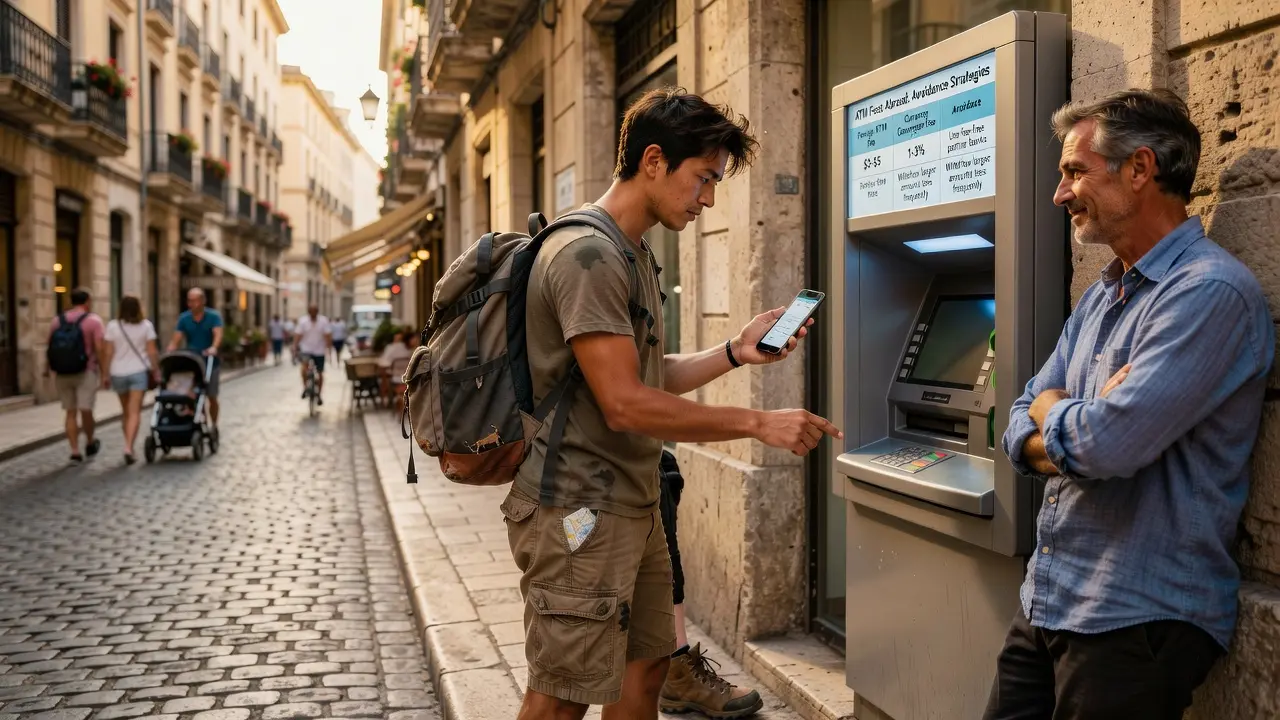
How much do ATM withdrawals abroad cost?
A cash withdrawal abroad usually costs your bank's withdrawal fee, a foreign transaction fee on the amount, and any fee the local ATM adds. For a small withdrawal of about US$100, the total is often US$5 to US$12. For US$400, fixed fees spread further and the total share falls.
A worked example with assumed fees: a traveller in Bangkok withdraws 4,000 baht with a card that charges a 2% foreign withdrawal fee with a minimum of US$2, and a 2% conversion fee. Assume a market rate of 33 baht per US dollar, so 4,000 baht is about US$121.
| Cost item (example) | Accept ATM conversion | Decline conversion |
|---|---|---|
| Thai ATM operator fee | 220 baht (about US$6.70) | 220 baht (about US$6.70) |
| Your bank's withdrawal fee | US$2.40 | US$2.40 |
| Conversion | ATM rate 6% worse: about US$7.30 | Card network rate plus 2% fee: about US$2.40 |
| Total | about US$16.40 (13.6%) | about US$11.50 (9.5%) |
The figures are assumed to show the method. Withdraw 20,000 baht in one go and the 220 baht charge falls from 5.5% of the cash to 1.1%, because it is paid once per withdrawal.
Your bank's fee vs the local ATM fee
Two different banks charge you when you withdraw money abroad. Your card issuer sets the foreign withdrawal fee and conversion fee in its fee schedule. The ATM owner abroad may add an access fee, which is usually shown on screen before you confirm. You can avoid the second fee only by choosing a different machine.
- Card issuer fees: a cash withdrawal fee (often a percentage with a minimum) and a foreign transaction fee on the converted amount. Credit cards may also charge a cash advance fee and interest from the day of withdrawal.
- Local ATM fees: common in Thailand, the US and in tourist areas of Europe; less common at bank-branch ATMs in Japan, Singapore and much of the euro area.
- Daily limits: both your bank and the local ATM cap how much you can take out, so a large withdrawal may need two transactions and two operator fees.
If you hold a card from a bank in Vietnam, read the fee schedule (biểu phí) for "rút tiền mặt ở nước ngoài" and "phí chuyển đổi ngoại tệ" before you fly. The two lines decide most of the cost.
Dynamic currency conversion at the ATM
Dynamic currency conversion (DCC) is the ATM's offer to charge you in your home currency instead of the local one. The machine shows a fixed amount in dollars, euros or dong, but uses its own rate, often several percent worse than the card network's rate. Choosing the local currency almost always costs less.
The screen wording varies. "Accept conversion", "Charge me in USD" or "Guaranteed rate" mean DCC. "Decline conversion", "Without conversion" or the local currency code mean you keep the network rate. Independent ATMs in airports and tourist streets push DCC hardest, sometimes with the accept button highlighted in green. The same choice appears at card machines in shops and restaurants.
A worked example with assumed rates: on the same 4,000 baht, the ATM offers to charge you US$129 at its own rate of 31 baht per dollar. Declining gives the network rate of 33 baht, about US$121, plus a 2% card fee, about US$123.40 in all. Accepting costs about US$5.60 more on one withdrawal. In the European Union, Regulation (EU) 2019/518 requires DCC providers to show the markup over the European Central Bank's reference rate before you accept, which makes the gap easier to see there.
How to cut ATM costs abroad
The cheapest way to withdraw money abroad is to use a card with low foreign fees, take out larger amounts less often, use ATMs inside or next to bank branches, and always decline conversion. These four habits often halve the cost of cash on a one-week trip.
- Decline conversion at every ATM and card machine, and pay in local currency.
- Withdraw enough for several days, within what you are comfortable carrying.
- Use bank ATMs; avoid standalone machines in tourist streets, bars and hotels.
- Check the fee shown on screen; cancel and try another bank if it is high.
- Carry two cards on different networks (Visa and Mastercard) in separate places.
- Turn on overseas use and check daily limits in your banking app before you leave.
Cash from home is another option for the first day. Exchanging a small amount before departure, then using ATMs, is often cheaper than airport counters; the trade-offs are compared in our guide to currency exchange.
Cards with low or no fees abroad
Cards with low or no fees abroad are usually multi-currency debit cards from online providers, travel credit cards without a foreign transaction fee, and some bank cards sold for travellers. They charge little or no foreign transaction fee and convert at or close to the Visa or Mastercard rate. Some include a few free withdrawals each month.
- Multi-currency debit cards: you hold balances in several currencies and spend or withdraw them without conversion. Most have a monthly free withdrawal allowance and a small fee after it.
- Travel credit cards: good for card payments, but cash withdrawals often count as cash advances with a fee and immediate interest.
- Bank debit cards: convenient, but foreign fees vary widely between banks and card tiers.
A worked example with assumed fees shows why credit cards are poor for cash. Withdraw US$300 as a cash advance with a 4% fee and the card takes US$12 at once. With interest of 2% a month charged from the day of withdrawal, repaying a month later adds about US$6 more. The same US$300 from a debit card with a 2% foreign fee costs US$6 in total. Keep the credit card for hotel deposits and card payments, and the debit card for cash.
Even a card with no fee of its own cannot remove the local ATM operator's fee. In Thailand that fee applies to almost every foreign card, so one larger withdrawal is still better than several small ones. In Singapore, where cards work almost everywhere, many travellers need very little cash; see our guide to singapore travel money.
Cash, cards and safety on the road
Large withdrawals cut fees but raise the cost of losing your wallet. A middle path is to withdraw for three to four days, keep most cash in the hotel safe, and carry one day's spending. Cover your PIN, use ATMs in daylight or inside banks, and save your bank's overseas hotline number so you can lock a card at once. Most banking apps also let you freeze a card in seconds, which is faster than calling from abroad.
Cash you carry across borders has its own limits. Most countries ask travellers to declare amounts at or above a threshold, such as US$10,000 for the United States and the EU's €10,000; the full list is in our guide on how much cash can you carry internationally. Any amount can be checked on the currency converter.






