
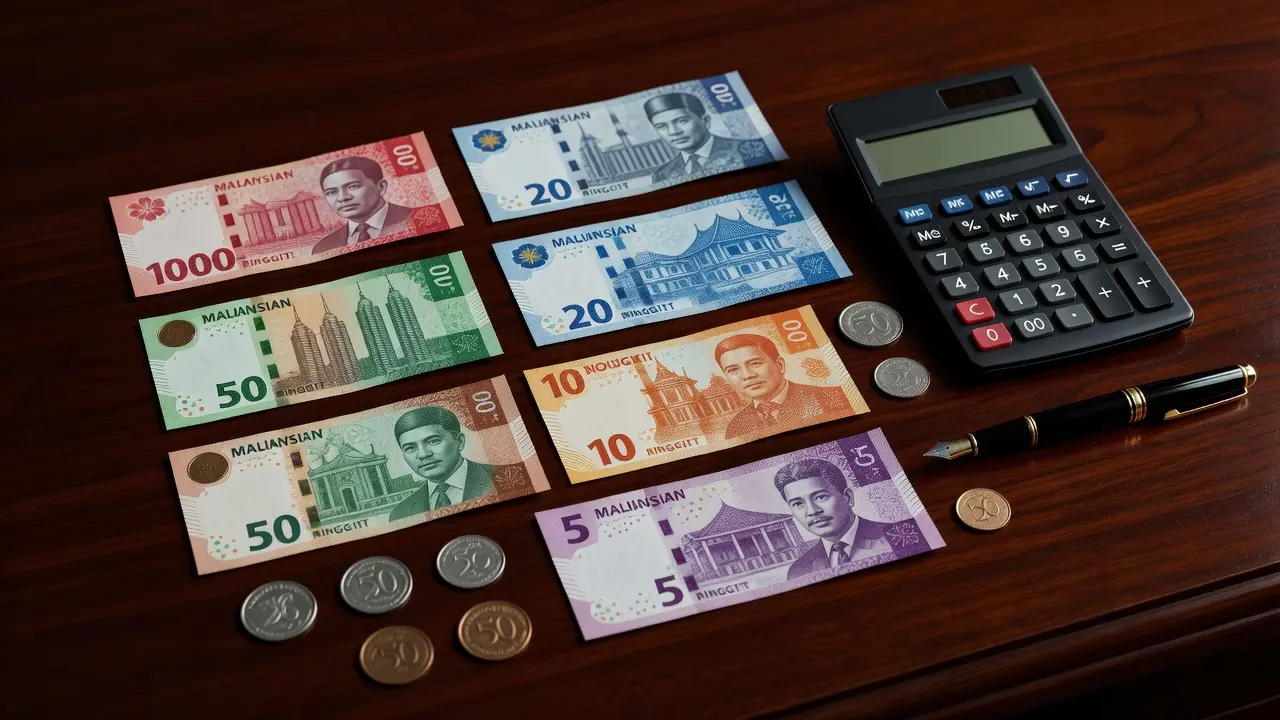
Malaysia currency at a glance
Malaysia's currency is the ringgit, shown as RM and coded MYR. Bank Negara Malaysia, founded in 1959, issues notes and coins and manages the exchange rate, which floats against other currencies.
- Currency: Malaysian ringgit
- Code and numeric code: MYR, 458
- Sign: RM, written before the amount (RM25)
- Subunit: 100 sen
- Notes: RM1, RM5, RM10, RM20, RM50, RM100
- Coins: 5, 10, 20, 50 sen
- Issuer: Bank Negara Malaysia
On 25 November 2026, RM1 is worth 0.243 US dollars. Live rates against all currencies are on the malaysian ringgit exchange rate page.
Ringgit notes in circulation
The ringgit notes in use today belong to the fourth series, released in 2012, which added the RM20 note. The RM1 and RM5 are polymer; the RM10 to RM100 are printed on cotton paper. All six carry the portrait of Tuanku Abdul Rahman on the front.
| Note | Material | Main colour | Back design |
|---|---|---|---|
| RM1 | Polymer | Blue | Wau bulan, the traditional moon kite |
| RM5 | Polymer | Green | Rhinoceros hornbill |
| RM10 | Paper | Red | Rafflesia flower |
| RM20 | Paper | Orange | Hawksbill and leatherback turtles |
| RM50 | Paper | Green-blue | Agricultural and national motifs |
| RM100 | Paper | Purple | Natural landmarks of Malaysia |
The RM100 note, the largest, is worth 24.30 US dollars today. Small shops and hawker stalls prefer RM10 and RM20 notes, so break larger notes at supermarkets or petrol stations.
Malaysian coins
Malaysia uses coins of 5, 10, 20 and 50 sen. The 1 sen coin has not been issued since 2008, when Bank Negara introduced rounding: cash totals ending in 1, 2, 6 or 7 sen round down, and those ending in 3, 4, 8 or 9 round up to the nearest 5 sen. Card and e-wallet payments are charged to the exact sen. The RM1 coin was withdrawn from use in 2005.
How to check a ringgit note is real
To check a ringgit note, hold it to the light for the watermark portrait and the see-through register, tilt it to see the security thread or colour-shifting features, and feel the raised print on the portrait. On the polymer RM1 and RM5, look through the clear window.
- Watermark portrait of Tuanku Abdul Rahman on paper notes.
- Security thread that appears as a line or a moving pattern when tilted.
- Raised print on the portrait and the bank's name.
- Clear window on polymer notes.
- Features that glow under ultraviolet light.
Exchange at banks or licensed money changers, which Bank Negara regulates, to avoid fake or damaged notes.
Where to exchange ringgit and today's rate
In Malaysia, licensed money changers in shopping malls in Kuala Lumpur, Penang and Johor Bahru often give better rates than banks and airports. Bank ATMs accept most foreign cards. Outside Malaysia, major banks in neighbouring countries buy and sell ringgit, but rates are usually better after arrival.
Today's mid-market rate, dated 25 November 2026, is RM1 = 0.243 US dollars. To work out ringgit for a dollar budget, use the usd to myr converter.
A worked example with an assumed rate: if 1 USD = RM4.40, then $500 buys RM2,200. A money changer offering RM4.30 gives RM2,150, so you lose RM50 to the margin.
Cards and e-wallets such as Touch 'n Go are widely used in Malaysian cities, and Touch 'n Go cards pay highway tolls and public transport in Kuala Lumpur.
A short history of the ringgit
Malaysia issued its own currency, the Malaysian dollar, in 1967, replacing the Malaya and British Borneo dollar. The name ringgit came into official use in the 1970s, and the RM sign replaced the dollar sign. During the Asian financial crisis, Malaysia fixed the ringgit at RM3.80 per US dollar in September 1998 and kept the peg until July 2005, when it moved to a managed float.
For other currencies in the same format, see the guides to vnd banknotes and the saudi currency. Every currency's code and sign is in our world currencies list, and you can convert any amount with the currency converter.






