
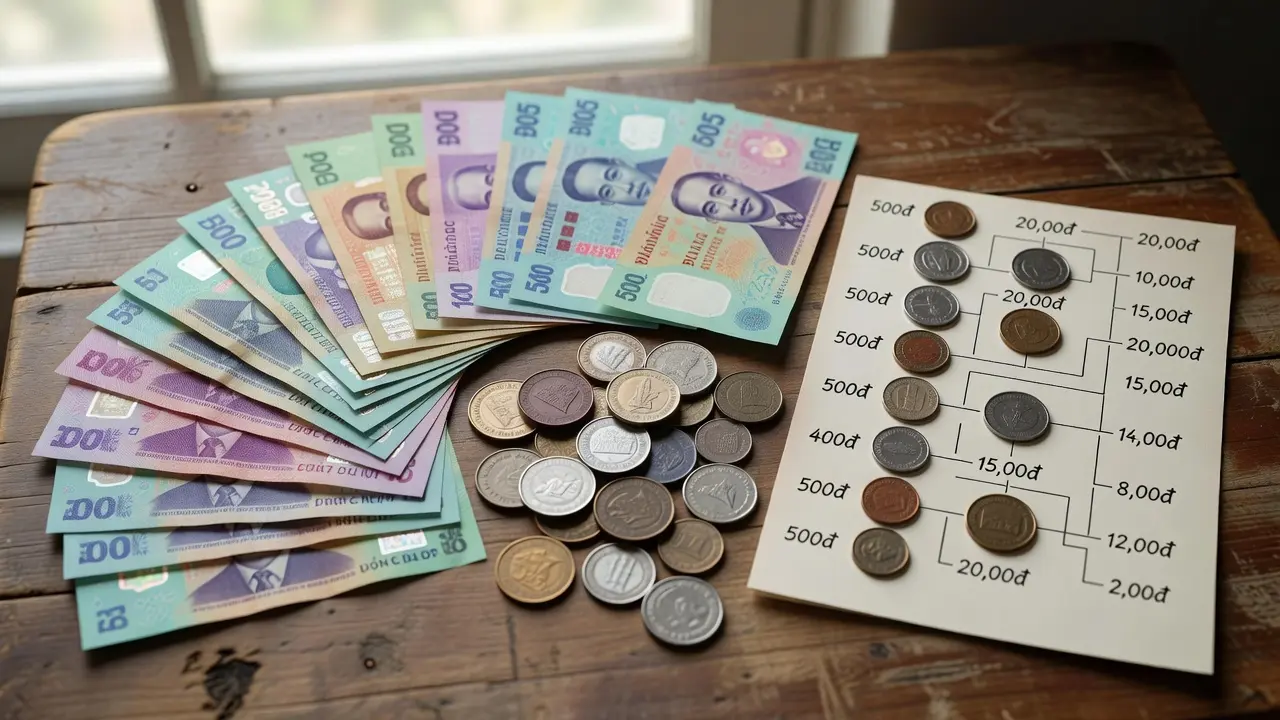
Vietnam currency at a glance
Vietnam's currency is the đồng, written dong in English, with the ISO code VND and the sign ₫. The State Bank of Vietnam (Ngân hàng Nhà nước Việt Nam) is the central bank and the only issuer of notes. The dong is managed against the US dollar through a daily central rate with a trading band.
- Currency: Vietnamese dong
- Code and numeric code: VND, 704
- Sign: ₫, often written đ or "VNĐ" locally
- Subunits: hào (1/10) and xu (1/100), no longer used
- Polymer notes: 10,000, 20,000, 50,000, 100,000, 200,000, 500,000
- Cotton notes still circulating: 100, 200, 500, 1,000, 2,000, 5,000
- Issuer: State Bank of Vietnam
On 25 November 2026, 1 US dollar is 25,835 dong, and 100,000 dong is about 3.87 dollars. For any amount, see 1 usd to vnd, or the live vietnamese dong exchange rate against every currency.
VND banknotes in circulation
The VND banknotes in daily use are the six polymer notes issued between 2003 and 2006, plus older cotton-paper notes of 5,000 dong and below. All show Ho Chi Minh on the front; the backs show places and scenes from around the country.
| Note | Material | Main colour | Back of the note |
|---|---|---|---|
| 500,000 | Polymer | Blue-green | Ho Chi Minh's birthplace, Kim Liên, Nghệ An |
| 200,000 | Polymer | Red-brown | Incense Burner Islet, Hạ Long Bay |
| 100,000 | Polymer | Green | Khuê Văn Các, Temple of Literature, Hà Nội |
| 50,000 | Polymer | Pink-purple | Nghênh Lương Đình and Phu Văn Lâu, Huế |
| 20,000 | Polymer | Blue | The Japanese Covered Bridge, Hội An |
| 10,000 | Polymer | Yellow-brown | Offshore oil rig |
| 5,000 to 100 | Cotton paper | Various | Industrial and rural scenes |
The 20,000 and 500,000 notes are both blue, and both visitors and locals sometimes hand over one for the other. Check the number before paying, especially in taxis and at night markets. The 500,000 note is worth about 19.35 US dollars today.
Vietnamese coins
Vietnamese money includes coins of 200, 500, 1,000, 2,000 and 5,000 dong, issued from December 2003. They remain legal tender, but the State Bank of Vietnam stopped putting coins into circulation in 2011, and shops almost never give them as change. Prices are rounded to the nearest 500 or 1,000 dong in practice, so small cotton notes do the job of coins.
How to check a dong note is real
To check a polymer dong note, look through the clear window, hold the note to the light for the watermark portrait, and feel the raised print on the portrait and the words at the top. Fake notes often feel smooth or have a window that is only printed, not see-through.
- Clear window: a transparent area with an embossed or printed image, see-through from both sides.
- Watermark: a portrait of Ho Chi Minh visible against light.
- Colour-shifting ink: on the higher notes, part of the design changes colour when tilted.
- Raised print: the portrait, the national title and the value feel rough.
- Microprinting and UV features that glow under ultraviolet light.
Polymer notes do not tear easily, but they can be folded or melted; banks exchange damaged notes under State Bank rules.
Where to exchange dong and today's rate
Exchange foreign currency into dong at banks, licensed foreign currency agents and some hotels. Withdrawing dong from bank ATMs with a low-fee card is often the cheapest way for visitors. Gold shops sometimes offer to change money, but only licensed places may legally buy and sell foreign currency in Vietnam, and unlicensed exchange can be fined.
Today's mid-market rate, dated 25 November 2026, is 1 USD = 25,835 VND. Banks buy dollars a little below this and sell a little above it. Dong is hard to exchange outside Vietnam, so convert leftover notes before you leave.
A worked example with an assumed rate: if 1 USD = 26,000 VND, a 150,000 dong taxi ride is about 5.80 dollars, and a 500,000 note is about 19 dollars.
A short history of the dong
The dong replaced the French Indochinese piastre in North Vietnam in 1946. After reunification, a single dong was introduced across the country in 1978. In September 1985, a currency reform replaced 10 old dong with 1 new dong, during a period of very high inflation. Polymer notes arrived in December 2003, starting with the 50,000 and 500,000 notes, and the set was completed in 2006. On 4 January 2016, the State Bank began setting a daily central rate for the dollar.
For other currencies in the same format, see our guides to the malaysia currency and the currency of japan. Every other currency is listed in our world currencies list, and you can convert any amount with the currency converter.






