
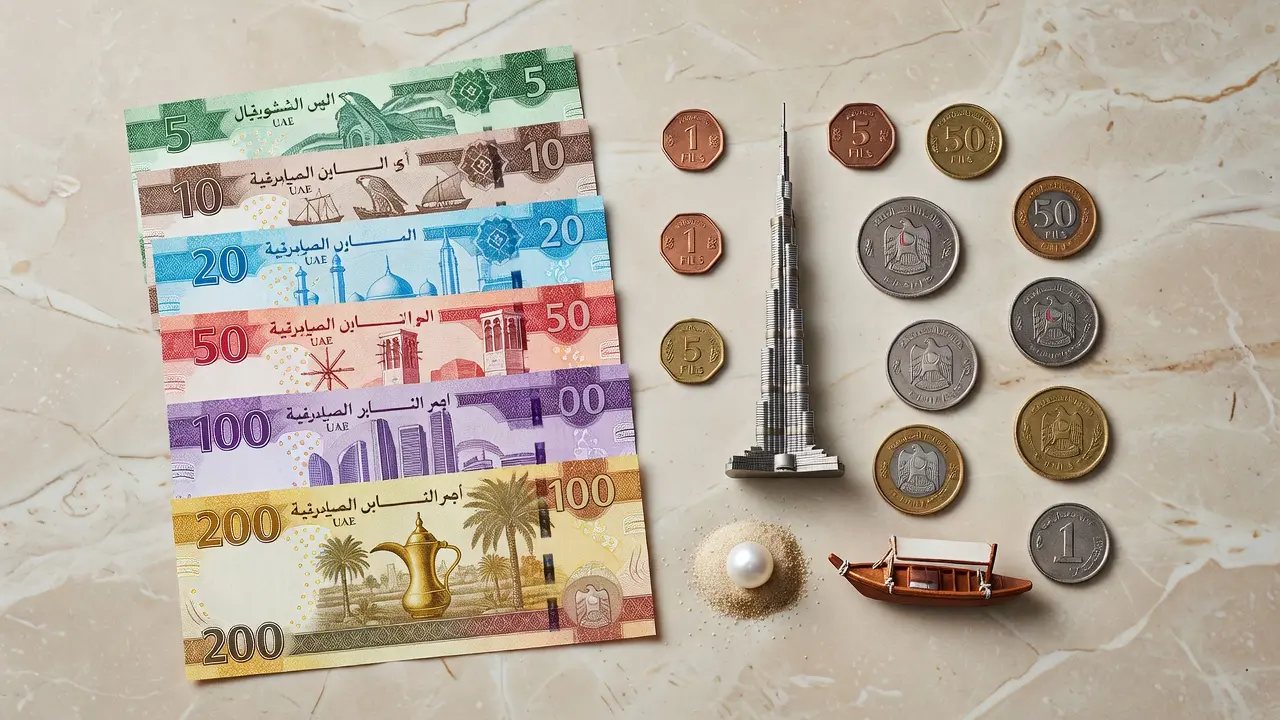
Dubai currency at a glance
The UAE currency is the dirham, written AED in banking, Dh or Dhs on price tags and د.إ in Arabic. In March 2025 the central bank also introduced a new dirham symbol, a Latin D crossed by two horizontal lines, for use in digital payments and on printed prices. The issuer is the Central Bank of the UAE (CBUAE), based in Abu Dhabi.
- ISO code: AED (numeric 784)
- Subunit: 100 fils
- Peg: 3.6725 AED per 1 USD
- Banknotes: 5, 10, 20, 50, 100, 200, 500, 1,000 dirhams
- Coins in use: 25 fils, 50 fils, 1 dirham
Because the dirham is pegged, its value against the dollar barely moves. Against everything else it moves with the dollar. A Dubai price therefore looks cheaper to a European visitor when the euro is strong and dearer when it is weak. The peg is one of several in the Gulf, listed with the Saudi riyal and Hong Kong dollar in our page on currencies pegged to usd.
AED notes in circulation
Eight AED notes circulate today: 5, 10, 20, 50, 100, 200, 500 and 1,000 dirhams. Since late 2021 the central bank has been replacing paper with polymer. The 50 came first in December 2021, the 5 and 10 followed in 2022, the 1,000 in December 2022 and the 500 in November 2023. Older paper notes of every value remain legal tender, so a single wallet can hold both types.
The polymer designs show UAE landmarks and national projects on the back. The polymer 500 won a regional "banknote of the year" award in 2025 for its design. Shops accept every valid note, but small cafes and taxis often have no change for a 500 or 1,000, so keep some 20s and 50s.
The 1,000 dirham note is the largest. On 25 November 2026 it equals about $272.29.
Coins: 25 fils to 1 dirham
Three coins are in daily use: 25 fils, 50 fils and 1 dirham. The 1 dirham coin shows a dallah, the traditional Arabic coffee pot, and the 50 fils coin is a seven-sided shape you can identify by touch. Smaller fils coins (1, 5 and 10) were issued in the past but are almost never seen now.
Prices often end in fils, such as AED 12.75, so a few coins come back with almost every cash payment. Keep them for taxis and small shops, which like exact change.
How to check a dirham note is real
Genuine polymer dirhams have a clear window with printed details, a hologram that changes as you tilt the note, and raised ink you can feel on the portrait and the number. Paper notes have a falcon-head watermark visible against light and a metallic thread running through the paper.
- Tilt the note: colour-shifting ink and holograms move and change.
- Feel it: raised print is rough under a fingertip; flat print is a warning sign.
- Look through it: on paper notes the falcon watermark appears; on polymer the window stays clear and sharp.
- Compare with a note from a bank or an ATM if in doubt.
Fake dirhams are rare in shops but sometimes turn up in informal street exchanges. Changing money only at banks or licensed exchange houses avoids the problem.
Where to exchange Dubai currency, and today's rate
The best rates in Dubai come from licensed exchange houses such as Al Ansari Exchange and LuLu Exchange, which have branches in most malls. They usually beat hotel desks and airport counters by 1% to 3%. Banks give similar rates but keep office hours and may ask for an account. ATMs work with most foreign cards and dispense dirhams directly.
On 25 November 2026, 1 AED is worth $0.2723. Live prices against the euro, pound and rupee are on the united arab emirates dirham exchange rate page. Indian visitors and workers, who form the largest foreign community in the UAE, can check the aed to inr page before changing or sending money. Anyone wiring wages home can compare exchange houses, banks and apps in our guide to send money from uae.
For any other pair, the currency converter on our home page turns dirhams into any other currency at the mid-market rate.
A short history of the UAE dirham
The dirham was introduced on 19 May 1973, two years after the seven emirates formed the UAE. Before that, Dubai and the northern emirates used the Qatar-Dubai riyal, and Abu Dhabi used the Bahraini dinar. Earlier still, the whole coast ran on the Gulf rupee, a version of the Indian rupee printed for the region until 1966.
The name comes from the Greek drachma, through the Arabic dirham used for silver coins in the early Islamic period. Morocco also calls its currency the dirham, but the Moroccan dirham (MAD) is a separate, unpegged currency. Other national currencies, from the korean money to the uk currency, have their own guides, and the full set is in the world currencies list.






