
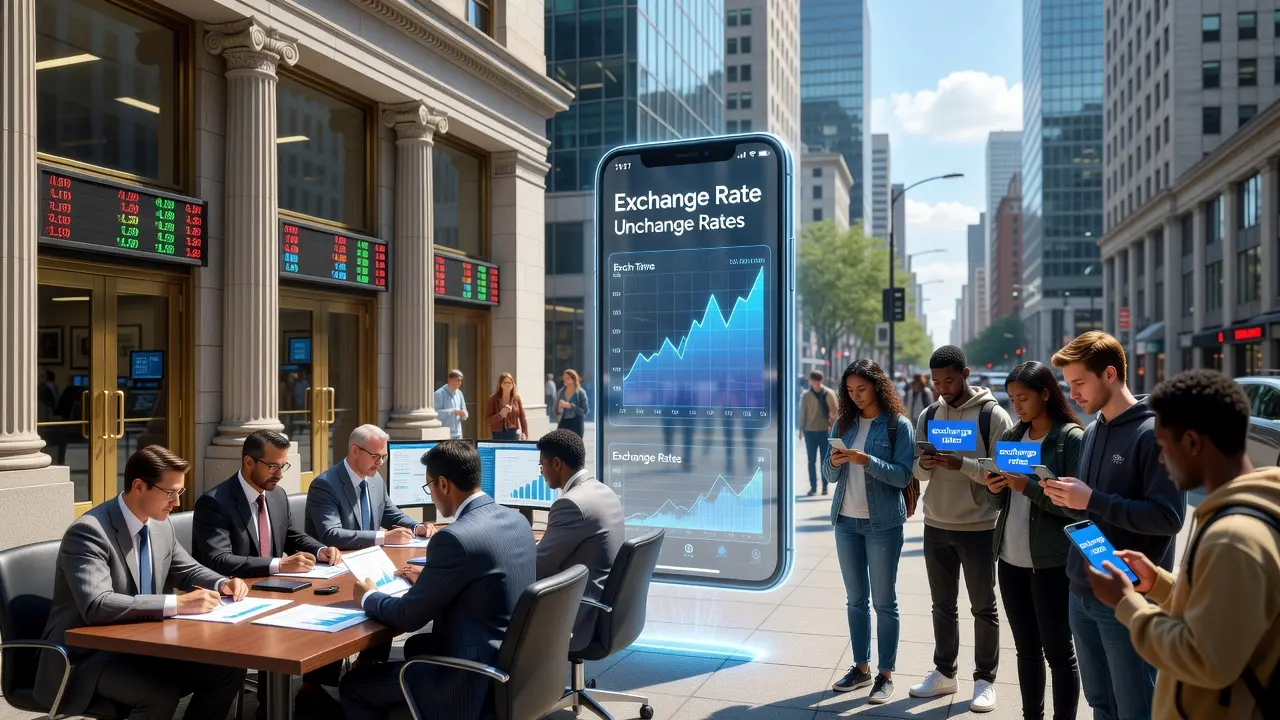
Why are exchange rates different everywhere?
Exchange rates are different everywhere because each provider sets its own price on top of the market rate. Three things create the gap: the spread between buying and selling prices, fees that may be hidden in the rate, and the time at which the rate was taken. Only the mid-market rate is the same for everyone at a given moment.
The buy-sell spread
Every bank and exchange office shows two prices: the rate at which it buys a currency from you and the rate at which it sells it to you. The difference is its margin. A bank that buys dollars at 25,900 dong and sells them at 26,300 dong has a spread of 400 dong. The wider the spread, the more you pay on each exchange.
Fees inside the rate
Some providers charge a visible fee, such as $5 per transfer. Others advertise "no fee" and add a larger margin to the rate instead. Card networks and banks can also add a foreign transaction fee of 1% to 3% on top of the network rate. The only way to compare is to look at how much you receive in the end.
Timing
Currency markets trade around the clock on working days, and rates move every second. A bank may set its board rates once or twice a day, an app may update every minute, and a website may show a rate that is a few minutes old. Two honest sources can differ simply because their numbers were taken at different times. At weekends, when markets are mostly closed, many providers widen their spreads to protect themselves from Monday's opening price.
The definition of the rate itself is covered in our guide to what is an exchange rate.
How the gap works: a $1,000 example
The clearest way to see why rates differ is to send the same amount through several channels and compare what arrives. The example below uses an assumed mid-market rate of 1 USD = 26,000 VND, and typical margins and fees for each channel; your own bank and app will differ.
| Channel | Rate offered | Fee | You receive for $1,000 | Cost vs mid-market |
|---|---|---|---|---|
| Mid-market rate (Google, currency sites) | 26,000 | None | 26,000,000 VND | 0% |
| Online transfer app | 25,870 | $4 | 25,766,520 VND | 0.9% |
| Bank cash counter | 25,600 | None | 25,600,000 VND | 1.5% |
| Credit card abroad with 3% foreign fee | 26,000 network rate | 3% | About 25,240,000 VND of value | 2.9% |
| Airport exchange counter | 24,700 | None | 24,700,000 VND | 5.0% |
The gap between the app and the airport counter in this example is about 1.07 million dong on a single $1,000 exchange. None of the providers is lying; each one shows its own price, and only one of those prices is the mid-market rate.
To check any offer, divide the rate you get by the mid-market rate. If the result is 0.985, you are paying about 1.5%. The full method is in How to Calculate Currency Conversion by Hand (With Examples).
Google exchange rate vs bank exchange rate
The google exchange rate is a mid-market rate for information, taken from financial data providers and updated through the day. A bank exchange rate is the price at which that bank will actually trade with you, and it includes a margin. That is why you can rarely exchange money at the rate Google shows.
| Rate | Who sets it | Can you trade at it? | Typical use |
|---|---|---|---|
| Mid-market rate | The market; shown by Google and currency sites | Rarely; some apps come close | Benchmark for comparing offers |
| Central bank reference rate | A central bank, once a day | No | Accounts, statistics, legal references |
| Bank buying and selling rates | Each bank | Yes | Cash exchange, transfers |
| Card network rate | Visa, Mastercard | Yes, plus any card fee | Card payments abroad |
| Exchange counter rate | Each counter | Yes | Cash for travellers |
The exchange rate today on a currency site therefore answers the question "what is the market price?", while a bank's board answers "what will this bank pay me?". Both are correct for their purpose.
Banks also show different rates for cash and for transfers. Cash rates are usually worse, because handling, storing and transporting notes costs money. A bank's transfer buying rate for dollars can be a few dozen dong higher than its cash buying rate.
Some currencies cost more to exchange than others. Major currencies such as the US dollar and euro have narrow spreads because they trade in huge volumes. Less traded currencies, such as many African or Central Asian currencies, carry wider spreads at every bank, because the bank holds them for longer and finds fewer buyers. Rare currencies can also be hard to find as cash, which pushes the price up further.
What it means for travellers, senders and savers
For travellers, the cheapest options are usually a card with no foreign transaction fee, paid in the local currency, and cash withdrawn from a bank ATM abroad. Airport and hotel counters are usually the most expensive. Exchange only what you need for the first day before you travel.
For people sending money abroad, compare the amount the recipient gets, not the advertised fee. A transfer app with a $4 fee and a rate close to mid-market often beats a "free" transfer with a wide margin. For large amounts, ask the bank for a better rate; many will negotiate.
For savers holding foreign currency, the spread matters twice: once when you buy and again when you sell. A spread of 2% each way means the currency must rise about 4% before you break even. Holding cash for a short time to "profit" from rate moves is usually a losing trade once spreads are counted.
Businesses that pay suppliers abroad face the same costs at a larger scale, and often agree a rate with their bank in advance for regular payments. Anyone who earns income in a foreign currency can use the mid-market rate on the payment date as a benchmark, to see how much the bank kept when it converted the money.
Common mistakes and how to avoid them
The most expensive mistake is accepting dynamic currency conversion: a shop terminal or ATM abroad offering to charge you in your home currency. The rate it uses is usually several percent worse than your card's rate. Always choose to pay in the local currency.
- Trusting "0% commission" signs. Ask how much you will receive in total; a wide margin replaces the commission.
- Comparing the bank's rate with Google and expecting a match. Use the mid-market rate as a benchmark, not as a price.
- Exchanging all your money at the airport on arrival.
- Using a credit card for cash withdrawals, which can be charged as a cash advance with interest from day one.
- Converting twice. Paying a euro bill with a dollar card from Vietnam can convert dong to dollars and dollars to euros, with a margin each time. Pay in the bill's currency from a card in your home currency, or use a multi-currency account.
The basics of buying and holding foreign currency are covered in a separate guide. To see today's mid-market rate for any amount, use the currency converter.






